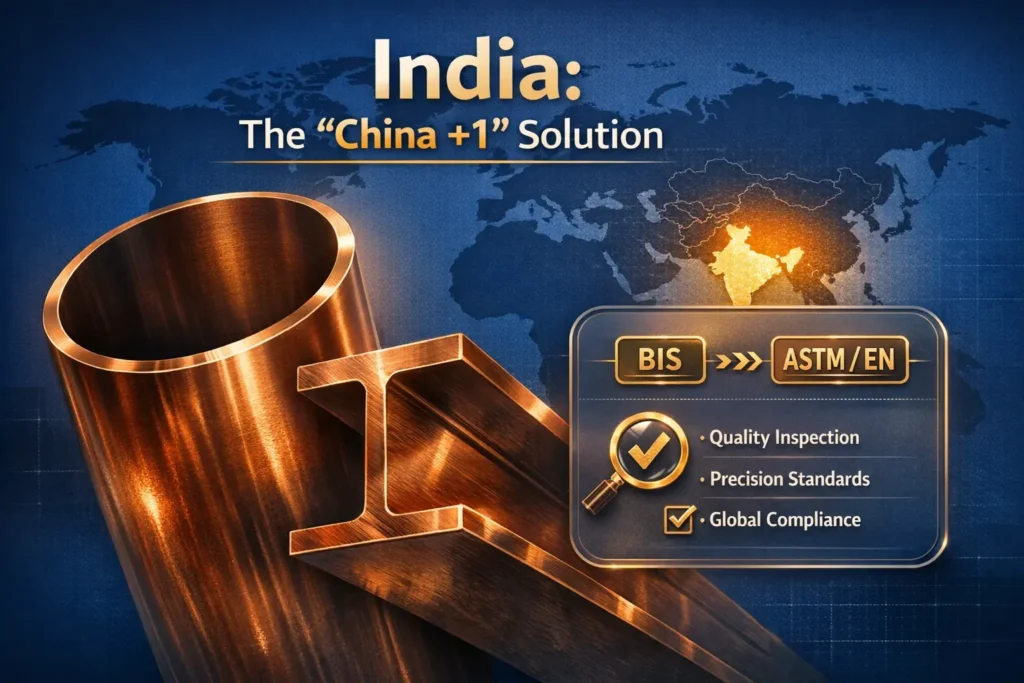
Global procurement teams are actively diversifying their supply chains, moving away from single-source reliance and embracing a robust “China +1” strategy. At the center of this shift is India’s metallurgical sector, which is undergoing a massive structural transformation. We are seeing a definitive pivot from volume-led basic exports to high-grade, certification-heavy specialized products like large-diameter pipes, structural steel, and precision forgings.
But if you are a Procurement Director or Global Sourcing Manager, you already know that evaluating a new geographical market requires more than browsing a B2B directory. Directories like IndiaMART might give you a list of names, but they severely lack the procurement intelligence necessary to mitigate risk. When plant uptime and multi-million dollar infrastructure projects are on the line, you need absolute certainty regarding chemical compositions, mechanical properties, and landed costs.
Let’s strip away the corporate fluff and look at exactly how to evaluate Indian steel mills, verify metallurgical specifications, and structure a resilient procurement pipeline.
Shortlisting and Evaluating Indian Steel Suppliers
In the discovery phase, market leaders like Tata, Jindal, and Welspun dominate the conversation, often showcasing massive global infrastructure wins. However, for small to mid-sized manufacturers and formulators, mid-market mills often provide the ideal balance of competitive pricing and agile production runs.
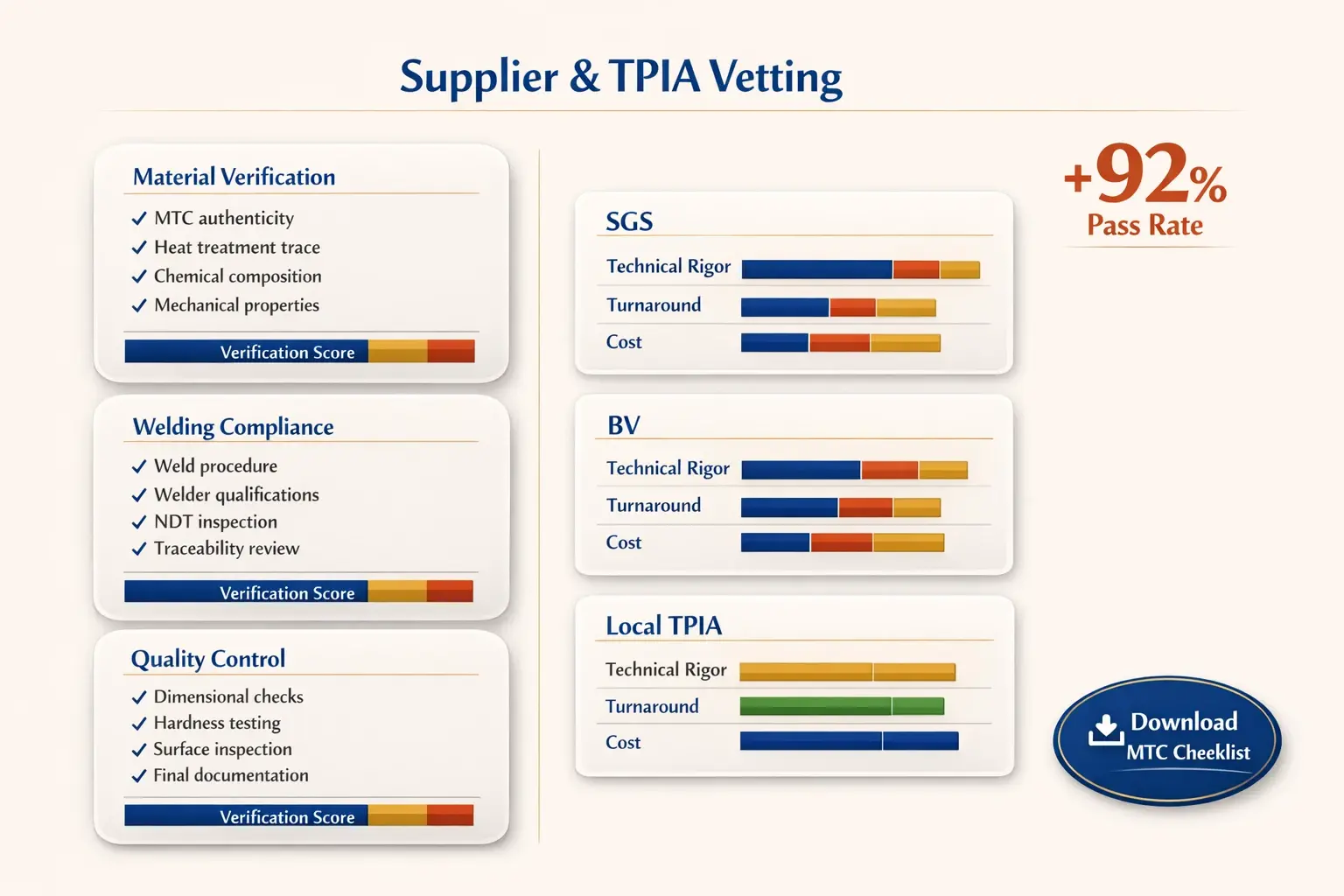
The challenge lies in vetting these suppliers. A generic ISO logo on a website is not a sufficient trust signal. You must evaluate suppliers based on their historical compliance with international standards, their raw material tracing capabilities, and their openness to Third-Party Inspection Agencies (TPIA).
When evaluating a new Indian mill, your early-stage checklist should prioritize finding a partner who understands Western expectations for transparency and communication. If a supplier hesitates when you request coordination with agencies like SGS or Bureau Veritas for a metallurgical audit, consider it a hard stop.
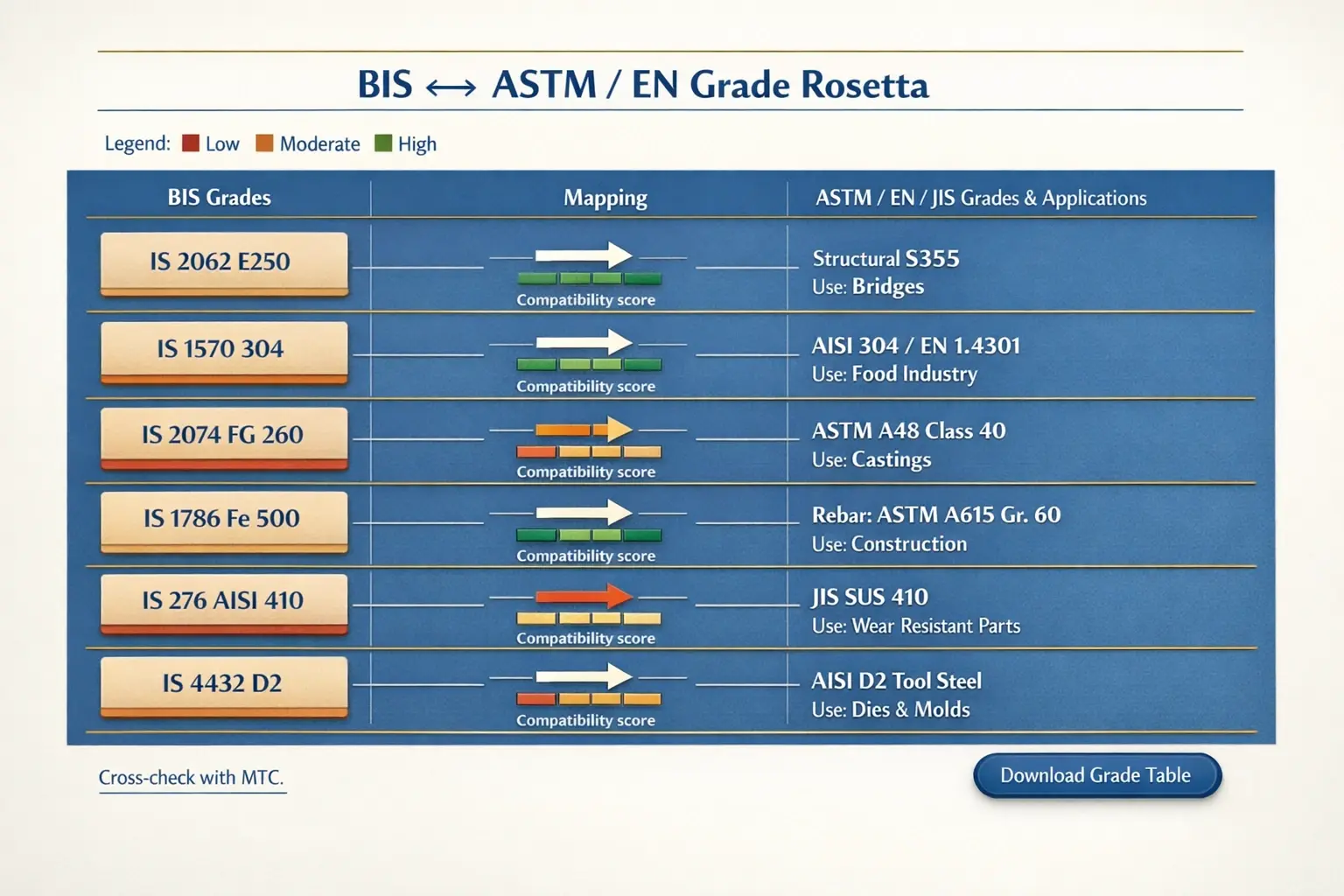
Decoding Indian Steel Standards: The BIS to ASTM/EN Rosetta Stone
The most common primary intent for engineering and procurement teams is technical verification. You need to know definitively: Does this supplier’s SS 316L actually meet my ASTM A276 requirements?
India has taken aggressive steps to elevate its manufacturing baseline. The Indian government’s Ministry of Steel has mandated Quality Control Orders (QCOs) requiring BIS (Bureau of Indian Standards) certification for over 151 steel products. For international buyers, this acts as an automatic quality filter. By blocking substandard global raw materials from entering the Indian manufacturing ecosystem, the baseline quality of India’s finished steel and forgings is protected.
This elevated quality standard is clearly reflected in India’s export mix. According to recent trade data, Pipes and Tubes (1.3 MMT) and Stainless Steel (0.9 MMT) are now among the highest-value export categories.
However, engineers sourcing globally still need to cross-reference BIS standards with ASTM (USA), EN (Europe), or JIS (Japan) requirements. A reliable sourcing partner bridges this gap, ensuring that chemical composition charts, yield strengths, and weight-per-meter specifications map perfectly to your domestic requirements before a single purchase order is cut.
The Global Buyer’s Decision Matrix: India vs. China
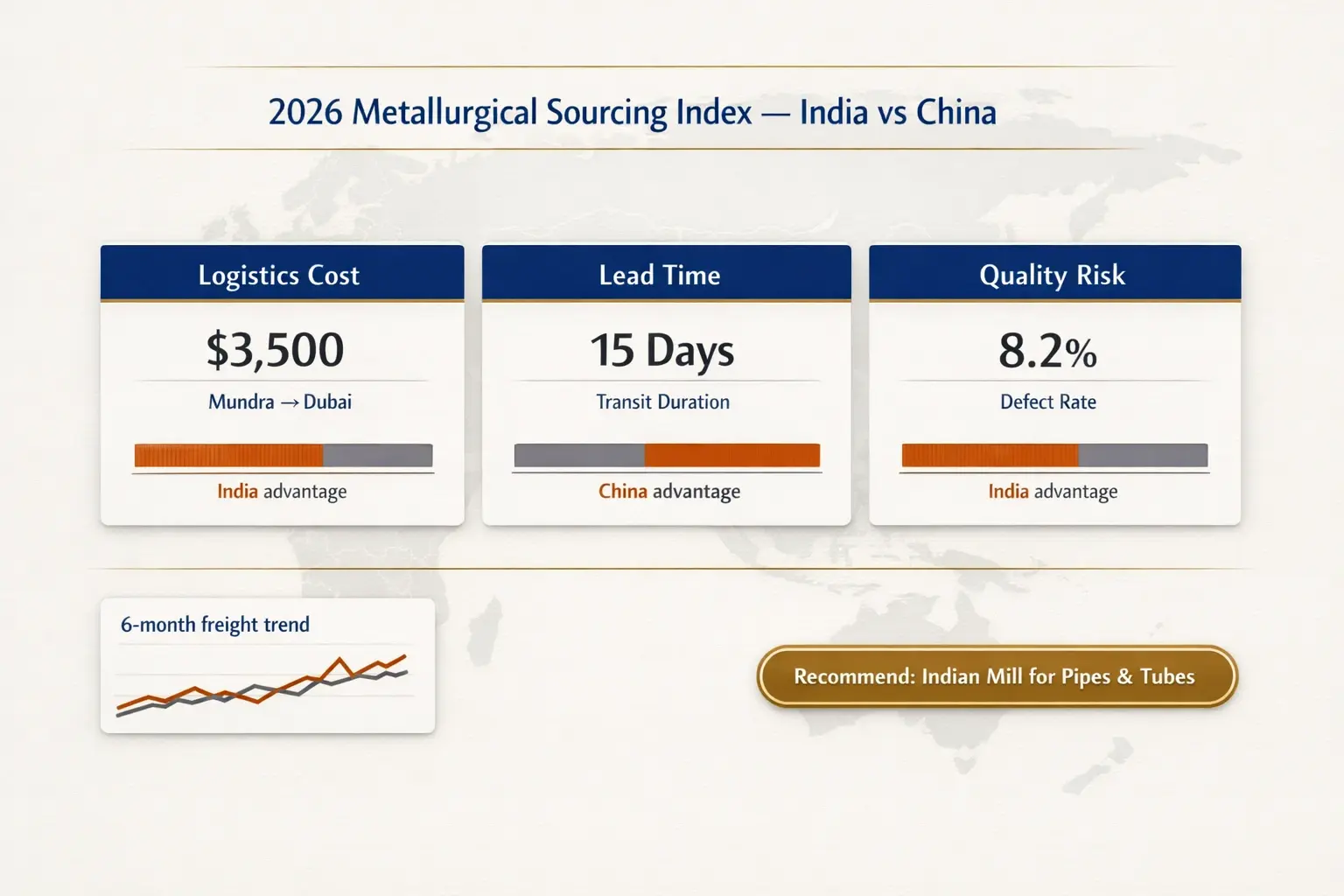
Sourcing decisions ultimately come down to reducing cost without increasing risk. When building a comparative matrix between India and China for metallurgical sourcing, buyers must look beyond the raw material cost per metric ton and calculate the total landed cost, factoring in logistics arbitrage.
Geopolitical shifts and the ongoing disruptions in the Red Sea have fundamentally altered freight economics. While shipping costs from Indian ports like Mundra to the Middle East spiked post-conflict, they stabilized at approximately $3,500 per container. Contrast this with routes originating from China, which have hovered around $6,500 per container for similar destinations.
This $3,000 delta per container provides a massive strategic advantage. When combined with competitive labor rates and the security of BIS-regulated raw materials, India presents an incredibly compelling case for buyers evaluating regional shifts in their supply chain for 2026 and beyond.
The Quality Control Protocol: Bulletproofing Your Procurement
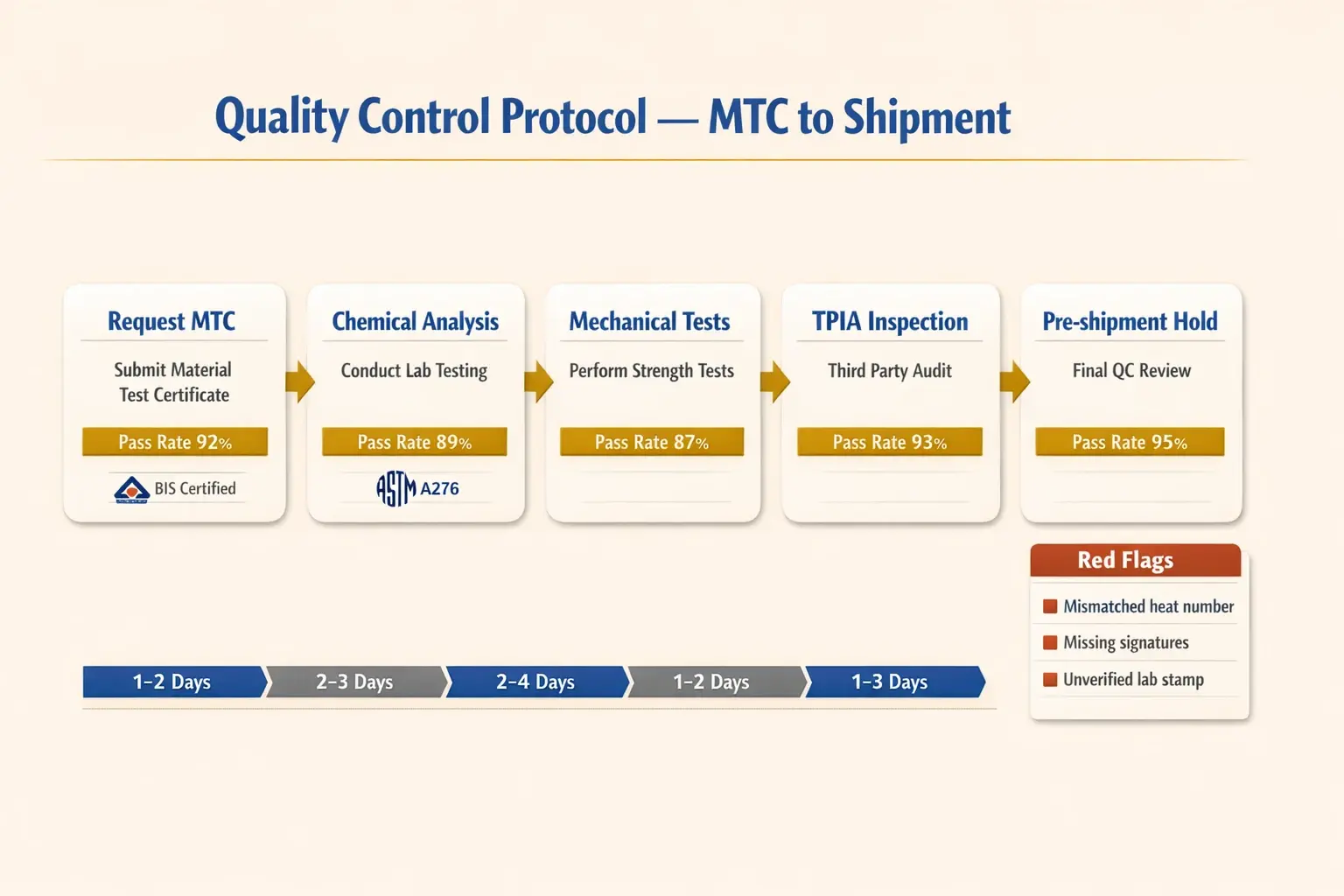
A major hidden fear among procurement leaders is the authenticity of the Mill Test Certificate (MTC). An MTC that doesn’t match the physical batch can lead to catastrophic failures on the production floor or halted construction projects.
Relying solely on digital communication leaves you vulnerable. You need boots on the ground. A comprehensive quality control protocol requires local experts who can perform in-factory QA steps, verify batch consistency, and coordinate with testing laboratories.
At Sourcing Pros, we understand that Western buyers demand absolute transparency. With American leadership and a deep operational presence in India, we act as an extension of your procurement team. We enforce strict MTC verification protocols, manage hazardous goods documentation, and implement pre-shipment holds until every specification is unequivocally confirmed.
Frequently Asked Questions (FAQ)
How do I ensure my Mill Test Certificate (MTC) from an Indian mill is authentic?
Verification requires a multi-tiered approach. First, cross-reference the heat number on the physical product (via stamping or stenciling) with the heat number on the MTC. Second, work with an on-the-ground partner who can trace the raw materials back to their source. Finally, utilize independent TPIAs to conduct localized sample testing to validate the MTC’s chemical and mechanical claims before the cargo leaves the port.
How have Red Sea disruptions impacted shipping from India compared to China?
While all global shipping has felt the impact of Red Sea disruptions, India’s geographical location provides a logistical buffer, especially for shipments heading to the Middle East, Europe, and the US East Coast. Current data shows freight from India to the Middle East remains significantly cheaper (~$3,500/container) compared to the extended routes required from China (~$6,500/container), giving Indian steel a competitive edge in landed costs.
Can Indian suppliers meet strict Western packaging and compliance standards?
Top-tier and vetted mid-market mills in India are highly accustomed to global export standards, including custom palletizing, shrink-wrapping, and anti-corrosion packaging (like VCI paper) for sea freight. However, ensuring these standards are met consistently requires a sourcing partner who explicitly details these requirements in the initial purchase agreements and verifies them during pre-shipment inspections.
What is the process for mapping BIS steel grades to ASTM/EN standards?
While direct equivalents exist for many common grades (like SS 304 or 316), specialized structural and high-tensile steels require careful cross-referencing of chemical composition limits and yield strengths. A specialized procurement partner will utilize technical mapping tools to ensure the Indian BIS grade either matches or exceeds the required ASTM/EN specifications for your application.
Partnering for Predictable Supply
Transitioning your steel and metal procurement to India is a highly strategic move that promises reduced costs and supply chain resilience. But achieving those benefits requires more than just finding a supplier—it requires active, end-to-end management.
By bridging Western expectations with India’s expansive manufacturing ecosystem, Sourcing Pros eliminates the operational risks and cultural barriers of international procurement. From vetting the right mill and validating the MTC, to managing transparent, landed-cost logistics, we provide the visibility and control you need to be a strategic procurement leader.