For years, the “China +1” strategy was largely a board-level talking point—a theoretical risk-mitigation exercise routinely discussed during annual reviews. Today, for global sourcing managers and procurement directors, it has become an urgent operational imperative.
Whether you are sourcing bulk specialty chemicals, industrial formulations, or raw construction materials, the landscape has fundamentally shifted. Tariffs, rising operational costs in traditional manufacturing hubs, and unpredictable geopolitical friction have made supply chain diversification non-negotiable. While Vietnam captured the initial wave of low-tech assembly relocation, the current landscape reveals a strategic pivot toward India for scale-intensive, compliance-heavy, and market-driven manufacturing.
But shifting a deeply entrenched chemical or industrial supply chain isn’t as simple as finding a new supplier directory. You need to look beyond the surface narrative of “India as an alternative to China” and build a resilient framework that quantifies the trade-offs between lower nominal labor costs and the realities of logistics, quality control, and regulatory compliance.
Here is the data-driven reality behind India’s appeal, and how proactive procurement leaders are successfully navigating the transition.
The Macro Drivers: Friend-Shoring and the New Geopolitical Reality
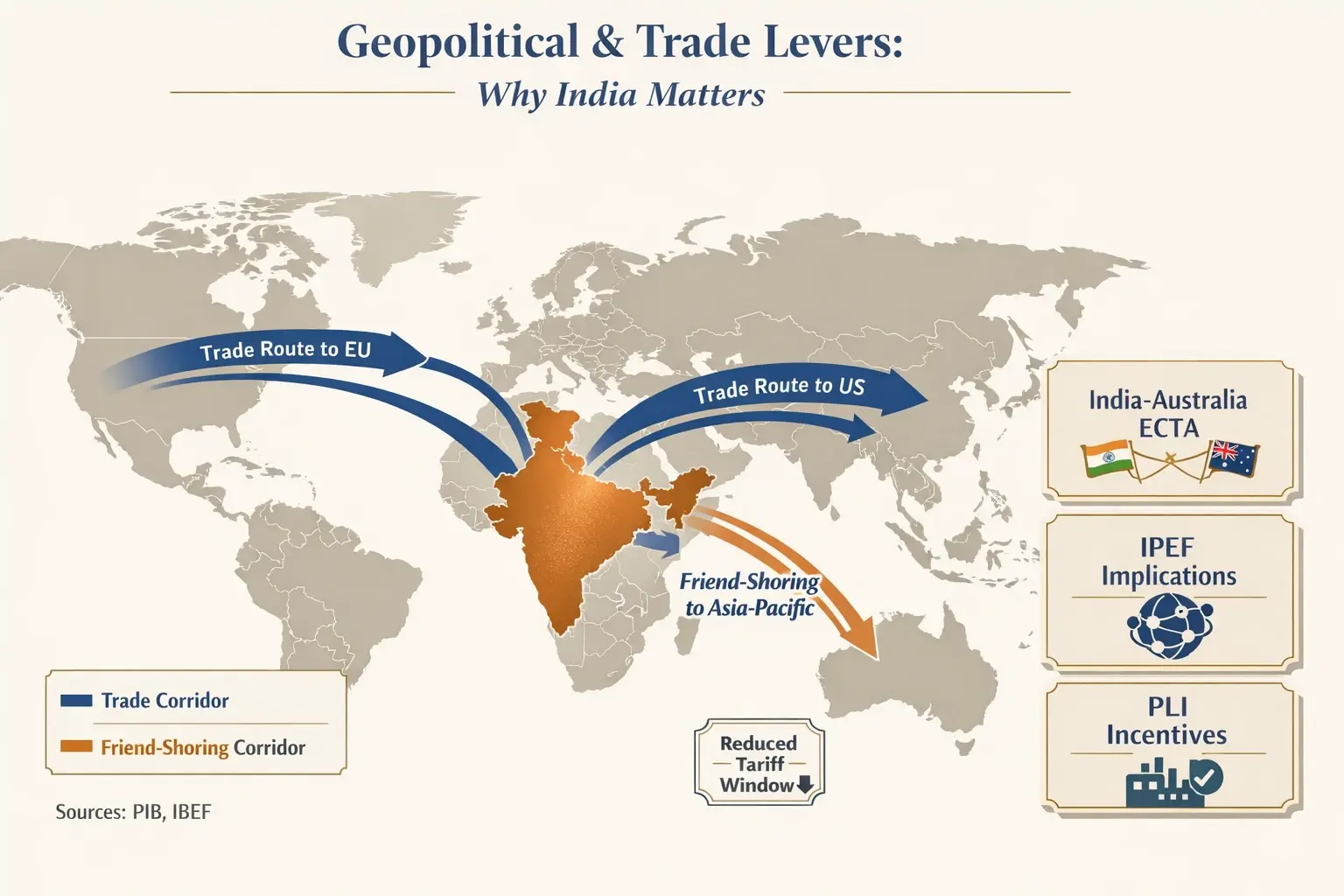
The momentum behind India isn’t just a byproduct of US-China trade tensions; it is anchored in India’s aggressive domestic manufacturing policy and strategic global alignment. The concept of “friend-shoring”—relocating supply chains to countries with shared geopolitical and economic values—has positioned India as the only highly scalable alternative to China.
This shift is backed by substantial capital. Foreign Direct Investment (FDI) in Indian manufacturing reached $165.1 billion over the last decade, with 69% of recent growth directly attributed to the government’s Production Linked Incentive (PLI) schemes.
Furthermore, trade frameworks like the India-Australia Economic Cooperation and Trade Agreement (ECTA) and the Indo-Pacific Economic Framework (IPEF) are actively reducing friction for cross-border trade. For Western buyers, this translates into a more predictable tariff environment and a strategic buffer against the volatility of single-source reliance.
The Productivity Paradox: Decoding True Manufacturing Costs
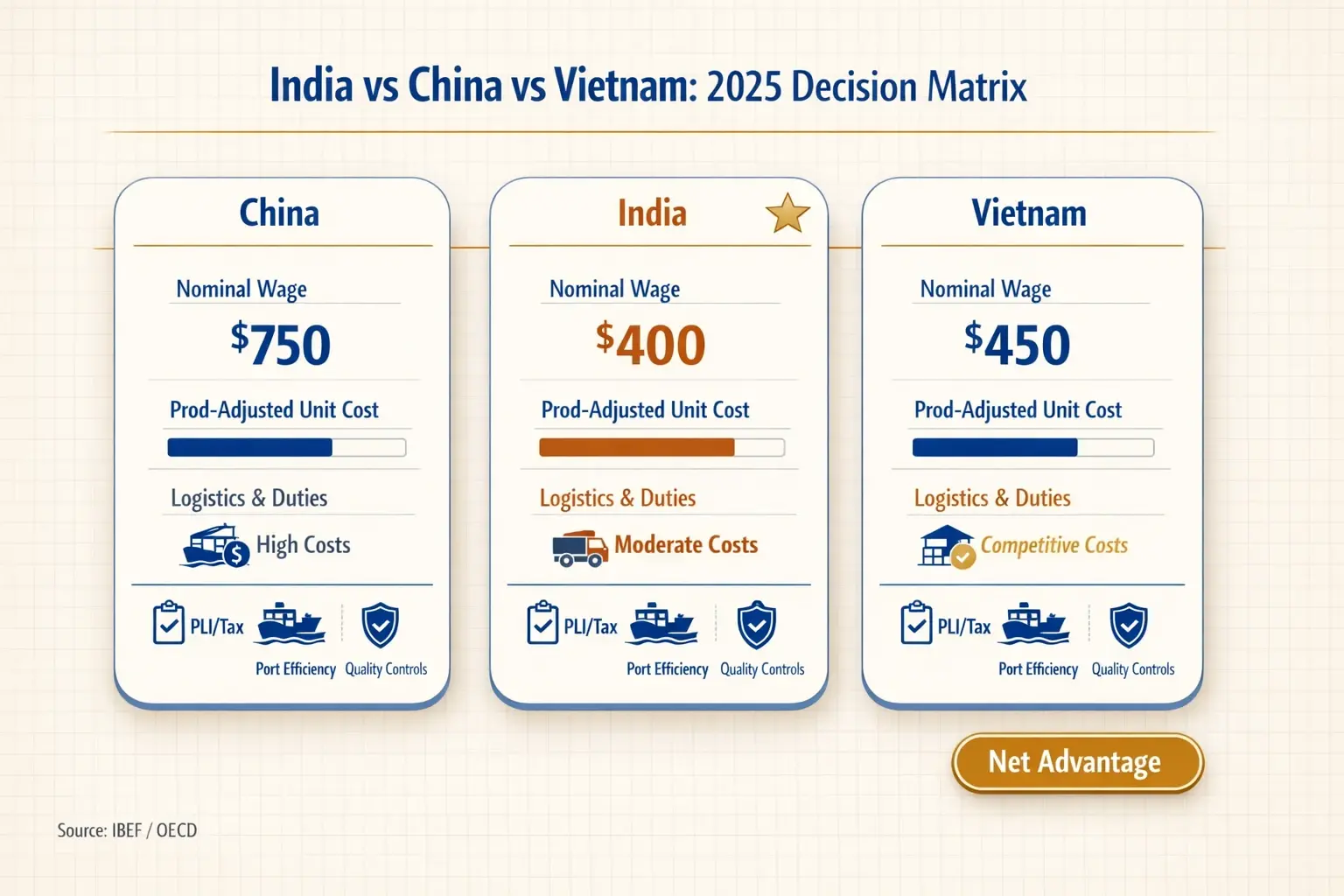
When evaluating India against traditional hubs, the initial draw is almost always cost. And on paper, the wage gap is staggering: India offers some of the world’s most competitive nominal labor costs at approximately $0.92 per hour, compared to China’s $3.52 per hour.
However, evaluating potential chemical suppliers or material formulators strictly on hourly wages is a trap that catches many mid-market manufacturers.
You must account for the “Productivity Paradox.” According to OECD data, Indian manufacturing currently requires 1.6x more worker hours to achieve the same output as China. This gap stems from differences in automation adoption, infrastructure maturity, and legacy training methodologies. If your procurement strategy assumes a 1:1 productivity ratio, your cost-saving projections will quickly evaporate.
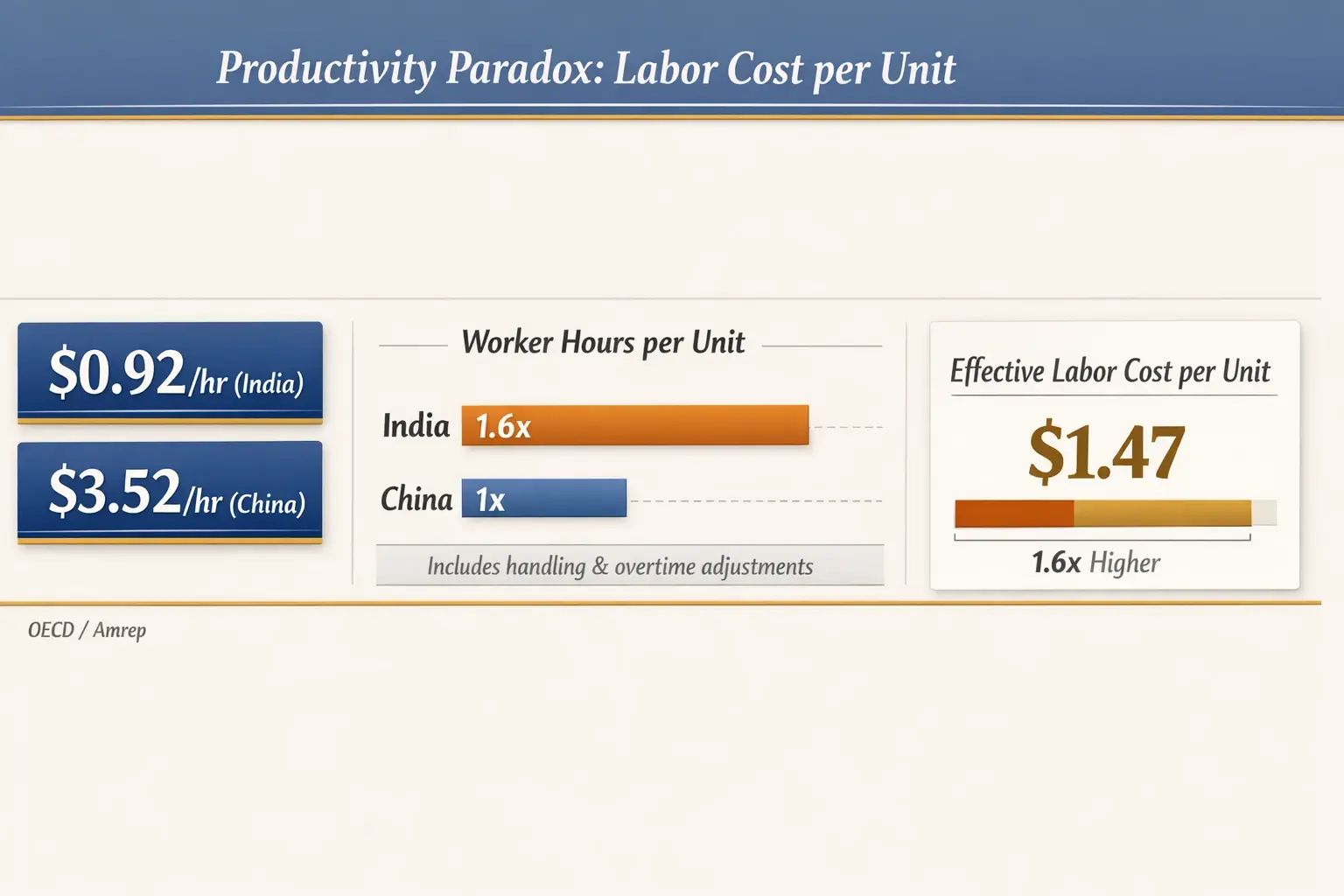
The successful procurement leader bridges this gap by focusing on total output efficiency. When dealing with specialty chemicals—where batch consistency, rigorous GHS-compliant labeling, and accurate Safety Data Sheets (SDS) are non-negotiable—the raw cost of labor matters far less than the cost of a failed quality control audit.
The Total Landed Cost Equation: Moving Beyond Nominal Price Tags
To confidently evaluate India as a sourcing destination, you need a conceptual “Landed Cost Calculator” that moves past the Ex-Works (EXW) or Free on Board (FOB) price.
Consider a scenario where a bulk chemical formulation costs $1.00 per unit in China. In India, the base production cost might only be $0.85 due to lower labor and facility overhead. However, if your supplier lacks hazardous goods logistics expertise, or if you miscalculate import duties on raw components necessary for formulation, your final landed cost could spike to $1.05.
To combat this, the Indian government has launched the PM Gati Shakti master plan and is actively scaling Dedicated Freight Corridors (DFCs). These infrastructure overhauls are drastically reducing port congestion and domestic transit times. For a chemical category lead managing complex TSCA/REACH compliance and hazmat documentation, faster and more predictable internal transit directly mitigates supply-chain risk.
Your sourcing advantage in India relies entirely on achieving transparent landed-cost visibility. Every hidden fee, handling charge, or port delay erodes the core financial benefit of diversification.
The Quality and Reliability Blueprint
A primary fear holding back global supply chain heads is the “Precision Gap.” Will a batch of performance chemicals arriving from India match the exact purity and technical specifications of the current Chinese supplier?
The data indicates a massive upward trajectory in Indian manufacturing quality. In FY24, India’s manufacturing Gross Value Added (GVA) grew by a remarkable 11.89%, significantly outpacing regional industrial growth. This isn’t just an increase in volume; it represents a fundamental upgrade in capability.
Top-tier Indian chemical and industrial material suppliers are aggressively adopting ISO 9001 and Six Sigma methodologies. To guarantee chemical purity and batch consistency, buyers must implement boots-on-the-ground supplier vetting and continuous batch quality control (QC). Relying on a supplier’s self-reported Certificate of Analysis (COA) is a risk. You need local, unbiased verification to ensure that every shipment meets Western expectations before it ever reaches the port.
Assessing Your Supply Chain Readiness
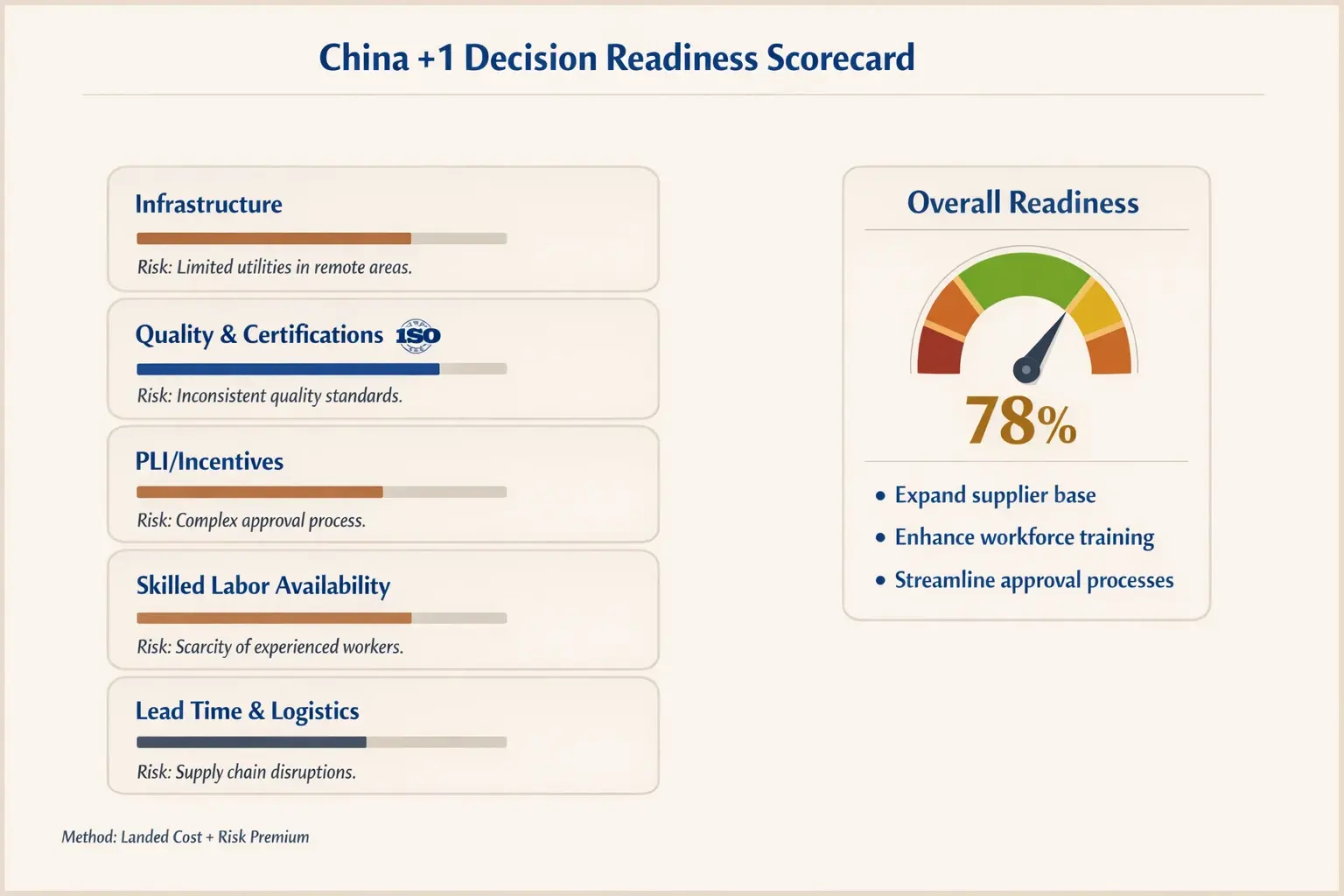
Transitioning to a China +1 model requires moving from reactive firefighting to strategic execution. Before executing a shift to the Indian market, evaluate your readiness across these critical vectors:
- Supplier Network Maturity: Do you have direct access to vetted Indian manufacturers, or are you relying on unverified online directories?
- Regulatory & Compliance Bandwidth: Are your partners equipped to handle complex hazardous-goods logistics, SDS management, and Western environmental compliance standards?
- Cost Transparency: Can your sourcing partner provide a granular breakdown of total landed costs, ensuring no surprises in freight, handling, or duties?
- Cultural and Communication Alignment: Do you have a single point of contact who understands Western procurement standards and can manage local suppliers without cultural friction?
Frequently Asked Questions
Will our chemical purity or consistency suffer if we shift production from China to India?
Not when managed correctly. While inconsistent batches are a valid fear, they are entirely preventable. Success requires partnering with an entity that provides stringent, boots-on-the-ground supplier audits, independent batch QC, and strict COA verification before shipment.
How do we navigate the hidden costs of Indian logistics?
The key is demanding end-to-end transparency. Your procurement partner must provide a detailed landed-cost structure upfront. By mapping out exact freight, duties, hazmat handling fees, and inland transportation costs, you eliminate margin-killing surprises.
Does India have the infrastructure for reliable hazardous materials transport?
Yes, but it demands localized expertise. Managing bulk, specialty, and intermediate chemicals requires deep knowledge of GHS-compliant labeling, port-specific hazmat regulations, and strict documentation. Working with a team that inherently understands these stringent global buyer requirements ensures smooth customs clearance and prevents costly port delays.
What is the most effective way to manage the cultural and communication gap?
The most significant friction point in international sourcing is misaligned expectations. Engaging an American-led partner with a deep operational presence in India bridges this gap effortlessly. You get Western communication standards, rapid quote turnarounds, and a singular point of accountability, combined with local tenacity and supplier leverage.
The Path Forward to a Resilient Supply Chain
The macro-economic data is clear: India has cemented its position as the premier destination for global businesses looking to diversify away from China. Its demographic dividend, exploding manufacturing capabilities, and strategic geopolitical positioning offer a unique competitive advantage.
However, realizing this advantage requires more than just intent. It demands a partner who can translate India’s expansive supplier ecosystem into a reliable, compliant, and cost-effective extension of your own operations. By prioritizing transparent pricing, uncompromising quality control, and rigorous logistical management, you can transform your procurement strategy from a source of risk into your company’s greatest competitive asset.