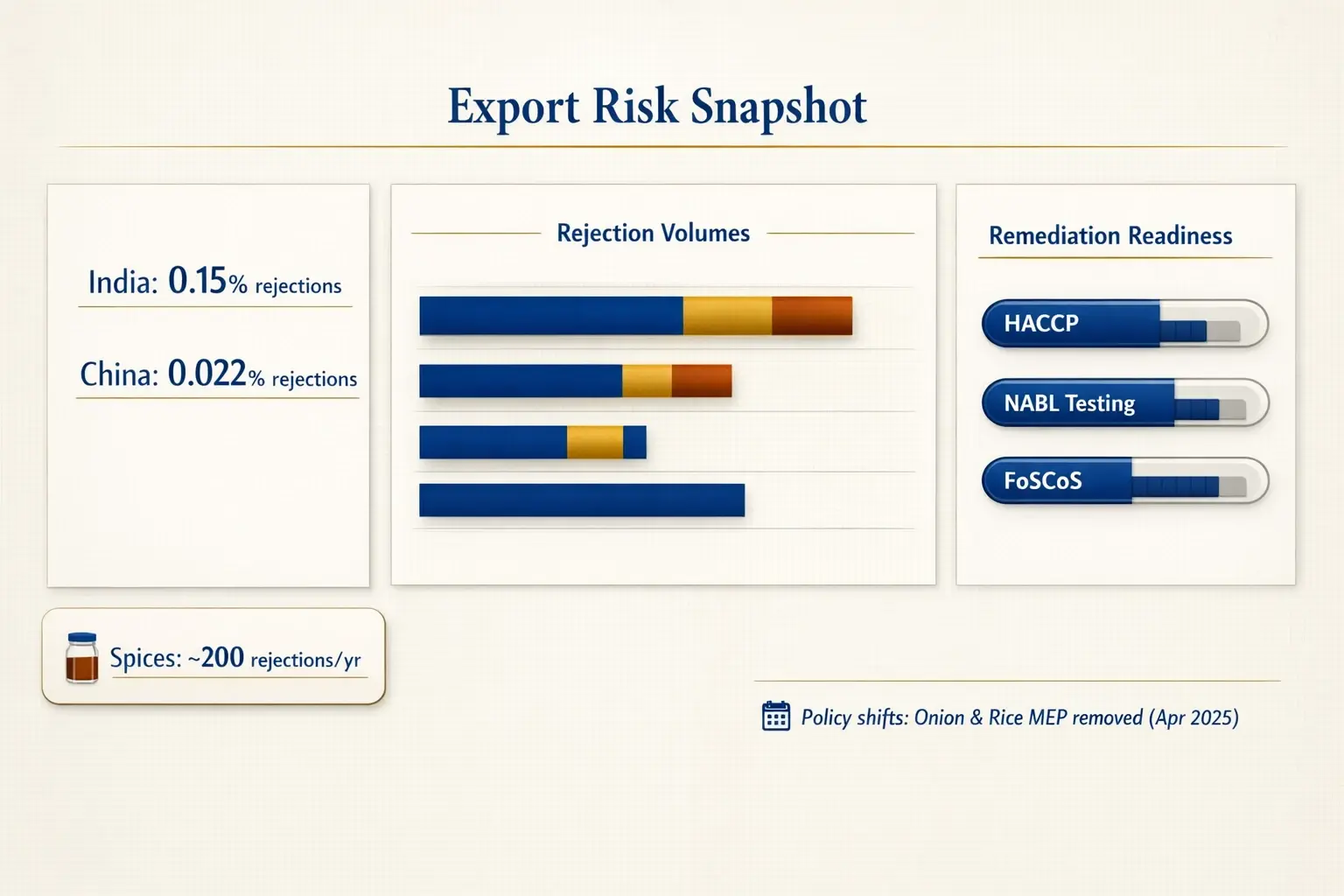
If you are a global sourcing manager or procurement director evaluating the Indian agricultural and food market, you are looking at a landscape in rapid transition. Recent regulatory shifts—such as the withdrawal of the 20% export duty on onions and the removal of the Minimum Export Price (MEP) for Basmati rice—have drastically opened up competitive sourcing opportunities.
However, seasoned procurement leaders know that landing a favorable initial quote from an Indian supplier is only the first step. The true cost of a sourced commodity isn’t just its FOB price; it’s the financial catastrophe of a seized container at the destination port.
Currently, international buyers are shifting from asking “What are the export rules?” to “How do we guarantee our shipments won’t be rejected?” You don’t just need an exporter; you need a risk-mitigation strategy built on stringent quality control, food safety, and end-to-end traceability.
The Rejection Reality: Why “Standard” Compliance Isn’t Enough
Let’s look at the hard data. According to the USDA Economic Research Service, India’s shipment refusal rate in the United States sits at 0.15%. To put that into perspective, China’s refusal rate is 0.022%. Spices represent one of the highest-risk categories, with approximately 200 consignments facing rejection annually.
Why the disparity? It comes down to a gap between Indian domestic compliance and destination-country enforcement. Government portals like APEDA and FSSAI provide the baseline rules, but they don’t give small-to-mid-sized Indian manufacturers the practical implementation steps needed to pass the uncompromising audits of the US FDA or the EU’s EFSA.
When you partner with a sourcing team that brings Western compliance expectations to the Indian ground level, you bridge this gap. We stop firefighting at the port by implementing rigorous contaminant remediation protocols directly at the processing stage.
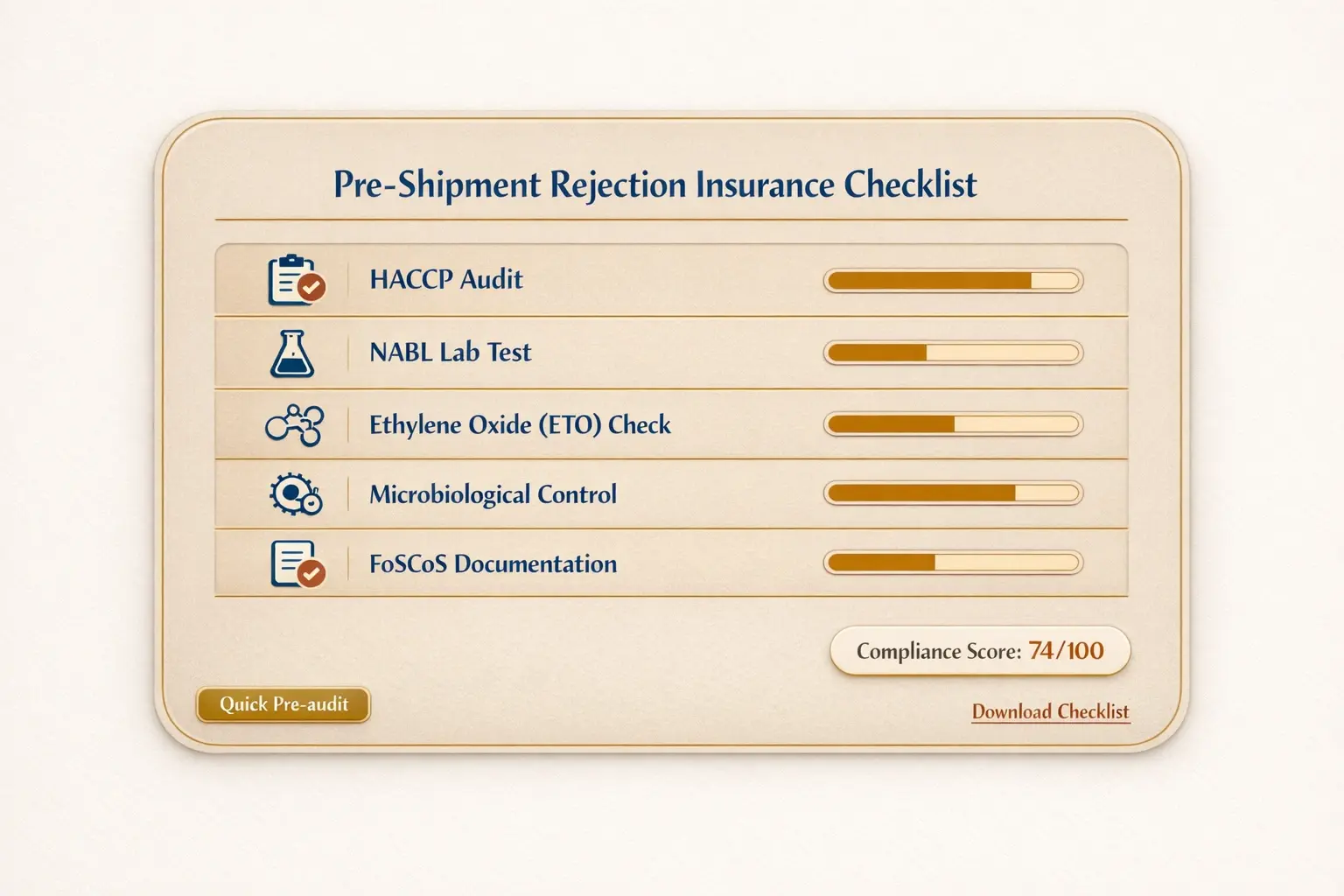
HACCP & GMP Implementation in Indian Food Processing
Standardized food safety in India took a massive leap forward during the digital transformation era under former FSSAI Chairperson Rita Teaotia. The legacy manuals and standardized hygiene initiatives from that period laid the groundwork for modern Indian food safety. Today, the challenge is ensuring suppliers actively implement Hazard Analysis and Critical Control Points (HACCP) and Good Manufacturing Practices (GMP)—not just on paper, but on the factory floor.
Boots-on-the-ground supplier audits are non-negotiable here. A supplier might have an FSSAI license, but do they have a functioning contaminant remediation protocol? We look for facilities that utilize advanced sorting technologies, strictly segregated processing zones, and documented hygiene standard operating procedures (SOPs) that align with international benchmarks.
Microbiological Testing & Contaminant Control: The “Kill List”
For global buyers, three contaminants represent the ultimate “Kill List” for Indian agri-food shipments: Ethylene Oxide (ETO), Pesticide Residues, and Aflatoxins.
ETO residue, in particular, is currently the number one reason for Indian spice rejections in Europe, as flagged consistently by the EU Rapid Alert System for Food and Feed (RASFF). Mitigating this requires a deep technical understanding of alternative sterilization methods (like steam sterilization) and strict limits on chemical fumigants during storage.
Contaminant control cannot be an afterthought. It requires proactive batch testing for Maximum Residue Limits (MRLs) specific to your destination country before the goods ever leave the warehouse.
Building End-to-End Traceability Systems for Indian Food Products
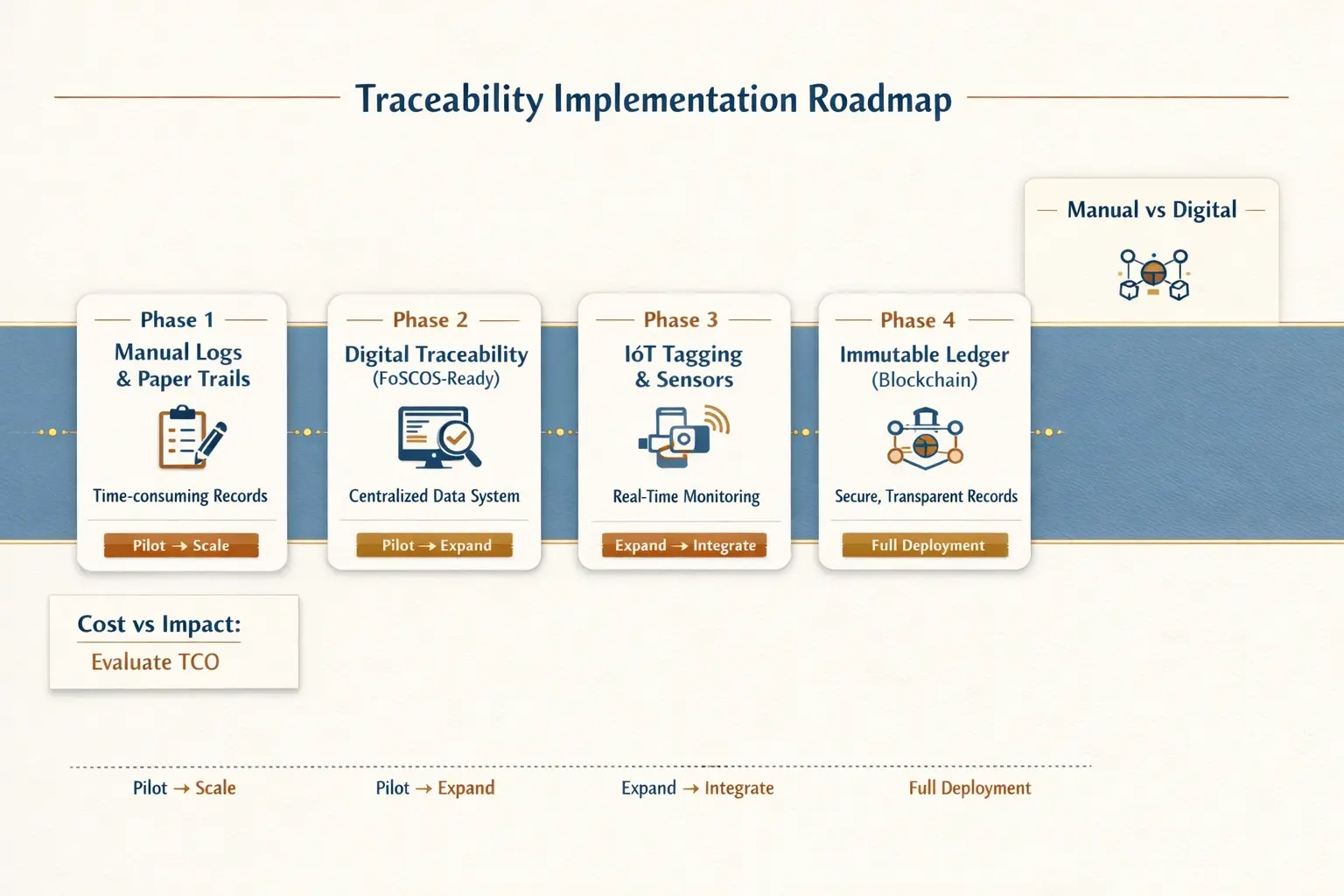
You can’t guarantee food safety if you can’t trace the product back to its origin. International regulators are increasingly demanding farm-to-fork visibility. In India, moving suppliers away from manual logs and fragmented data into integrated digital systems is a major differentiator for reliable sourcing partners.
We evaluate suppliers based on their ability to integrate with digital-first tracking platforms. The transition involves utilizing tools like the FSSAI Food Safety Connect App and the Food Safety Compliance System (FoSCoS) to maintain a digital thread of compliance. Whether upgrading to QR-coded batch tracking or evaluating advanced IoT solutions for temperature-sensitive cargo, a transparent traceability roadmap reduces your operational risk and speeds up customs clearance.
Independent Batch Testing & Quality Control for Agri-Food Shipments
Trust is good, but independent laboratory validation is better. Depending entirely on a manufacturer’s internal Certificate of Analysis (COA) is a fast track to port rejections.
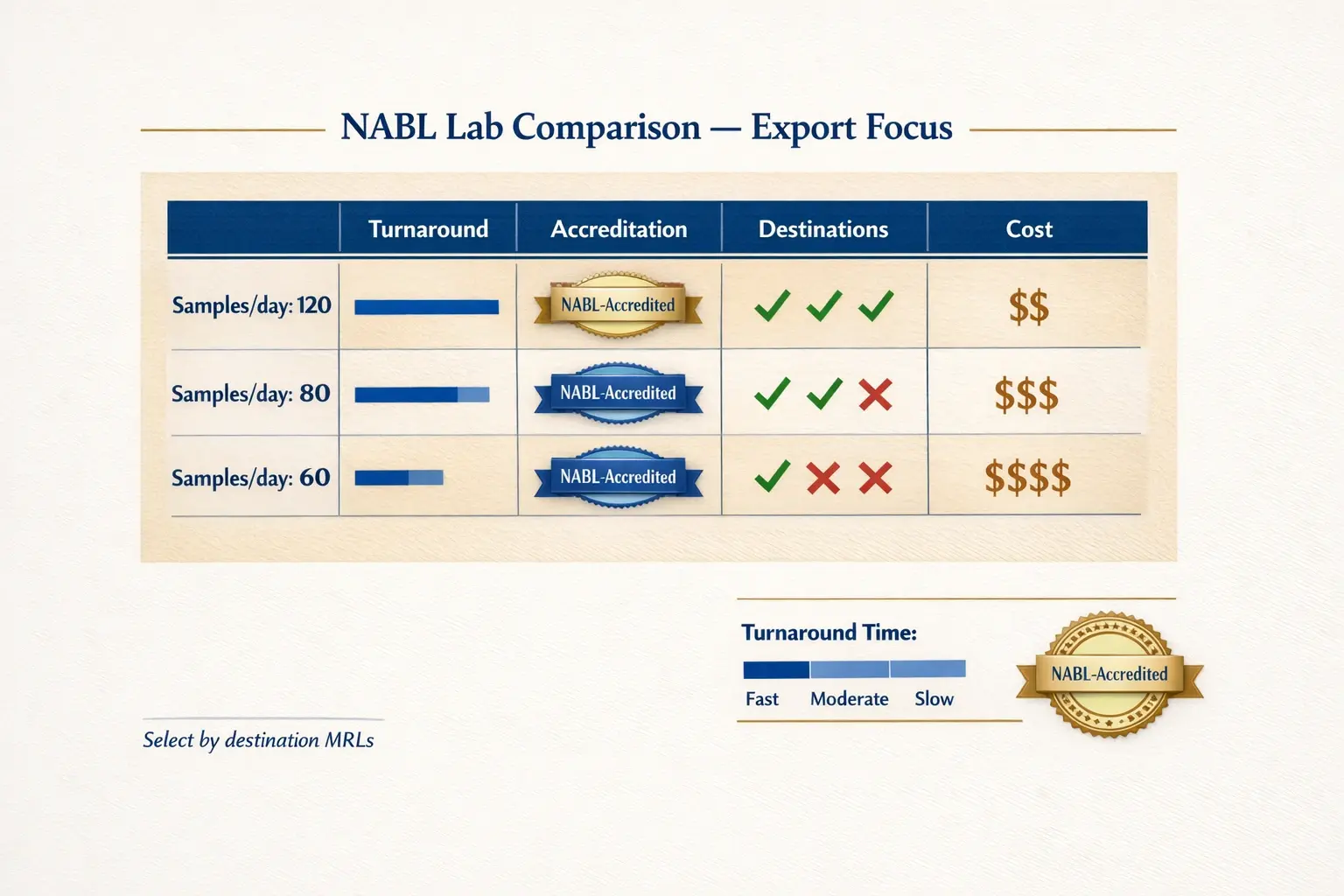
To ensure global MRL compliance, procurement leaders must demand independent batch testing through NABL-accredited (National Accreditation Board for Testing and Calibration Laboratories) facilities. But not all labs are created equal. Evaluating the right lab requires matching their testing capabilities with your exact destination’s regulatory limits—an EU MRL test for pesticides is vastly different from a US FDA requirement.
By utilizing a destination-specific MRL lookup strategy, we ensure that the independent lab tests for the precise variables that customs officials will scrutinize upon arrival.
Frequently Asked Questions (FAQ)
How can I be sure my shipment won’t be rejected due to ETO or pesticide residues?
The only way to guarantee clearance is through pre-shipment mitigation and testing. We require stringent farm-level pesticide management and alternatives to ETO sterilization at the processing stage. Every shipment must pass an independent NABL-accredited lab test mapped specifically against your destination country’s MRL standards before it is cleared for export.
What causes the hidden landed costs I keep experiencing with Indian suppliers?
Hidden costs typically stem from three areas: port demurrage due to delayed or inaccurate customs documentation, unexpected freight surcharges, and secondary lab testing required at the destination port. Working with an end-to-end partner who provides fully transparent landed-cost structures upfront eliminates these surprises.
Why should I source from India instead of sticking to my established China or Europe suppliers?
Supply-chain diversification (a “China +1” strategy) is critical for resilience. India offers highly competitive pricing, vast agricultural capacity, and recent tariff removals. The historic barrier hasn’t been product potential; it’s been operational risk and communication gaps. By partnering with an American-led sourcing team physically present in India, you get the economic advantages of the Indian market combined with Western standards of compliance and communication.
Can Indian suppliers provide the traceability documentation required by US and EU buyers?
Yes, but you have to vet for it. The top tier of Indian exporters has adapted to digital-first compliance, utilizing FSSAI’s FoSCoS portal and batch-specific QR tracking. We specifically qualify suppliers based on their traceability infrastructure, ensuring that farm-to-fork documentation is readily available to satisfy international customs authorities.
Secure Your Supply Chain with Confidence
Sourcing agricultural and food products from India doesn’t have to be a gamble. When you move beyond basic informational compliance and implement strict, evaluative risk-mitigation strategies, India becomes an incredibly lucrative and reliable pillar of your global supply chain.
You need a partner who understands exactly what procurement leaders at your level require: accurate COAs, complete traceability, transparent pricing, and zero communication barriers. By maintaining strict oversight from initial supplier vetting through independent quality control and final export logistics, you ensure that every shipment arrives exactly as promised—compliant, safe, and on time.