You’ve seen the headlines. A port shutdown, a sudden policy change, or a factory consolidation halfway across the world sends shockwaves through your supply chain. Production schedules are thrown into chaos, and you’re left scrambling for alternatives. For any procurement leader, this volatility is the stuff of nightmares. It’s why the “China +1” strategy has moved from a boardroom buzzword to an operational imperative.
But as you evaluate new sourcing destinations, there’s a critical question that’s often overlooked: What makes a manufacturing partner truly resilient?
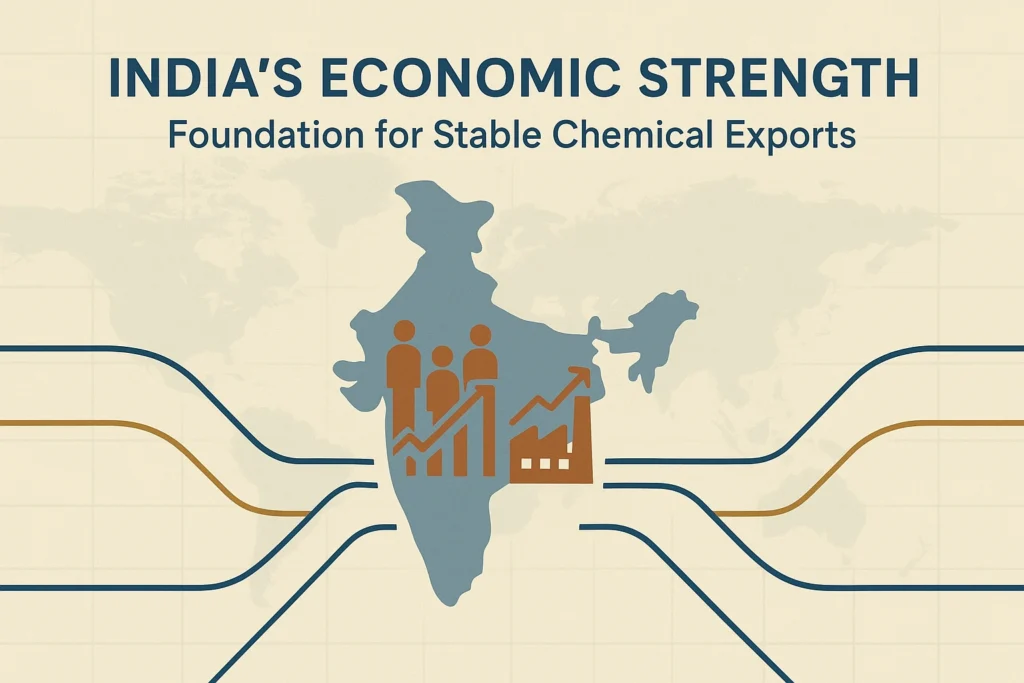
It isn’t just about low costs or production capacity. True, long-term stability comes from a place you might not expect: a thriving, demanding domestic market. An export partner with a strong home front is fundamentally different—and more reliable. This is where India’s story becomes incredibly compelling for global chemical sourcing. Its stability isn’t just a promise; it’s a byproduct of two powerful internal engines: a booming domestic demand and an unparalleled demographic dividend.
The Twin Engines of India’s Chemical Resilience
To understand why India is becoming such a reliable hub, we need to look past the factory gates and into the country’s economic DNA. Two core concepts are at play.
1. Domestic Demand: The Built-in Shock Absorber
In simple terms, domestic demand is the consumption of goods and services within a country’s own borders. For a chemical manufacturer, this means a massive, growing, and predictable customer base right at their doorstep.
Think of it like this: a manufacturer that relies solely on exports is like a ship on the open ocean, completely exposed to the unpredictable waves of global trade, currency fluctuations, and geopolitical tensions. A manufacturer with strong domestic demand, however, has a safe harbor. This local market acts as a “shock absorber,” providing a steady revenue stream that allows them to operate consistently, invest in R&D, and maintain production even when global markets are volatile.
2. The Demographic Dividend: More Than Just Numbers
You’ve probably heard that India has the world’s largest youth population. But the “demographic dividend” is far more than a statistic; it’s a dynamic pipeline of human potential. With a median age of around 28, India has a generation of young, ambitious, and increasingly educated citizens entering the workforce.
This creates a virtuous cycle: this young population not only fuels the labor force needed for manufacturing but also becomes the consumer base driving domestic demand. They are the ones buying homes that need paint, driving cars that need performance plastics, and using personal care products that rely on specialty surfactants. This synergy between a growing workforce and a growing consumer class creates a self-sustaining economic engine that benefits any global partner looking to source from India.
For a procurement manager, these two forces translate directly into what you need most: predictability and reliability.
The Flywheel Effect: How Domestic Demand Fuels Export Stability
The connection between a strong local market and a reliable export sector isn’t just theoretical; it’s a powerful “flywheel effect.” Once it gets going, it builds momentum and reinforces itself.
Here’s how it works in the Indian chemical industry:
- A Growing Middle Class Creates Demand: As millions of Indians enter the middle class, their purchasing power grows. They demand higher-quality products—from advanced agricultural solutions to protect crops, to more durable coatings for their homes, to safer ingredients in their soaps and cosmetics.
- Domestic Production Scales Up: To meet this surging local demand, Indian chemical manufacturers must scale their operations. They build larger, more efficient plants and invest in modern technology to produce consistently and cost-effectively.
- Processes Mature and Costs Fall: As production volume increases, manufacturers move up the learning curve. They master complex chemical processes, refine their quality control systems, and achieve economies of scale. This drives down the per-unit cost of production, making them more competitive.
- A Globally Competitive Export Base Emerges: Having honed their skills, quality, and cost structures to serve a demanding home market, these manufacturers are now perfectly positioned to compete globally. They aren’t just “export factories”; they are mature, resilient businesses with proven track records, ready to supply the world with high-quality, cost-effective chemicals.
[Image 1: A flowchart titled ‘The Flywheel Effect: How India’s Domestic Demand Fuels Export Stability’. It shows a cycle: 1. Growing Middle Class -> 2. Increased Domestic Consumption (Paints, Soaps, Plastics) -> 3. Production Scales Up -> 4. Lower Per-Unit Costs & Mature Processes -> 5. Globally Competitive Exports.Arrows connect each stage in a loop.]
This flywheel is why India’s per capita chemical consumption is projected to grow significantly, underpinning the entire industry’s expansion. According to McKinsey, this robust domestic foundation provides a unique buffer against the export volatility faced by economies that are purely export-driven.
The Human Element: Turning Population into a Skilled Workforce
Of course, a factory is only as good as the people who run it. The true power of India’s demographic dividend lies in its transformation from raw population numbers into a vast pool of skilled technical talent. This isn’t just about labor arbitrage; it’s about accessing a deep well of intellectual capital.
India produces one of the highest numbers of STEM (Science, Technology, Engineering, and Mathematics) graduates in the world. This translates into a readily available workforce of qualified chemists, plant managers, engineers, and quality assurance specialists who understand the technical complexities of chemical manufacturing.
[Image 2: An infographic titled ‘India’s Talent Pipeline: A Global Leader in STEM Education’. It shows a bar chart comparing the annual number of STEM graduates from India, the US, and China. India’s bar is significantly high, with a callout box that reads: “Over 2.5 million STEM graduates annually, fueling innovation in the chemical sector.”]
However, having a large talent pool is only half the equation. The real challenge is identifying the suppliers who have successfully harnessed this talent to meet global standards. On-the-ground auditing and rigorous vetting are crucial. For a deeper dive into this, see our guide on [Internal Link: “The Ultimate Checklist for Qualifying Chemical Suppliers in India” pointing to a relevant Sourcing Pros guide], which outlines the key human and technical factors to assess.
India’s Strategic Role in Your “China +1” Sourcing Plan
When you put it all together, India’s unique position in a “China +1” strategy becomes clear. The goal of diversification isn’t just to find another low-cost country; it’s to build a more resilient and less risky supply chain.
An economy that depends entirely on exports is inherently fragile. It can be crippled by a sudden drop in global demand, leading to factory shutdowns and supply disruptions for you. India’s strong domestic market acts as a ballast, keeping its industrial base steady through global economic storms.
This internal stability means that Indian suppliers are more likely to:
- Survive Economic Downturns: Their domestic sales provide a cushion, ensuring they remain operational and ready to fulfill your orders.
- Invest for the Long Term: Confidence in their home market encourages investment in new capacity, technology, and R&D.
- Maintain Quality Systems: High-volume domestic production requires robust, mature quality assurance processes, which directly benefit their export clients.
The country’s expansive manufacturing capabilities are concentrated in dedicated Petroleum, Chemicals and Petrochemicals Investment Regions (PCPIRs) and industrial clusters, creating ecosystems of innovation and efficiency.
[Image 3: A map of India highlighting major chemical manufacturing hubs and PCPIRs in states like Gujarat, Maharashtra, and Tamil Nadu. Each hub is marked with an icon representing a chemical flask, and a key indicates the primary types of chemicals produced in each region (e.g., Specialty Chemicals, Petrochemicals, Agrochemicals).]
By partnering with a supplier in India, you are not just buying a product; you are plugging into a resilient, self-sustaining industrial ecosystem. This is the foundation for a truly de-risked global supply chain. For procurement leaders exploring this shift, understanding how to structure this move is critical. We’ve outlined a comprehensive approach in our article, [Internal Link: “De-Risking Your Supply Chain: A ‘China +1’ Sourcing Strategy with India” pointing to a pillar page].
Your Questions About Sourcing from India, Answered
Navigating a new sourcing market always comes with questions. Here are some of the most common ones we hear from procurement leaders.
Is a strong domestic market a risk for exporters? What if they prioritize local orders?
This is a valid concern, but in reality, the opposite is often true. A healthy domestic business provides the financial stability for a manufacturer to build a dedicated, professional export division. The most successful Indian exporters see their international business as a critical pillar of growth and prestige. They build separate teams and allocate specific capacity to service global clients, using their domestic scale as a foundation, not a distraction.
How does the quality of chemicals made for the Indian market compare to global standards?
While quality can vary, top-tier Indian manufacturers adhere to global standards like ISO 9001 for all their production lines, whether destined for domestic or international customers. In fact, serving a demanding domestic market of over a billion people forces them to perfect their quality control systems at an immense scale. The key is identifying and vetting these high-quality producers, which requires on-the-ground presence and expertise.
With so many young workers, how do we ensure our supplier has a truly skilled team?
This gets to the heart of effective sourcing. The demographic dividend provides the potential, but rigorous supplier qualification turns that potential into a reliable reality. An effective vetting process includes auditing technical capabilities, reviewing staff qualifications and training programs, and assessing their track record with other international clients. It’s about separating the companies with a deep bench of talent from those with just a large headcount.
What chemical sub-sectors are strongest in India right now?
India has developed world-class capabilities across several key areas. The country is a global powerhouse in agrochemicals, dyes, and pigments. More importantly, it is rapidly expanding its production of high-value specialty and performance chemicals used in coatings, personal care, water treatment, and oil & gas—the very categories global companies are looking to diversify.
The Path to a More Resilient Supply Chain
Choosing a new sourcing partner is one of the most strategic decisions a procurement leader can make. It’s about more than just finding a new factory; it’s about finding a resilient ecosystem that can weather uncertainty and support your growth for years to come.
India’s stability as a chemical supplier isn’t an accident or a temporary trend. It is the direct result of its powerful internal economic and demographic engines. By understanding how its burgeoning domestic market and skilled young workforce create a uniquely resilient manufacturing base, you can make a more informed and strategic decision for your supply chain.
The ultimate insight is this: the most reliable international partners are those who aren’t solely dependent on your business. Their strength at home is what makes them a safe bet for you abroad.
Ready to explore the practical steps of leveraging India’s advantages? A great next step is understanding the end-to-end process. Dive into [Internal Link: “A Practical Guide to Sourcing Chemicals from India” pointing to a relevant Sourcing Pros blog post] to learn more.