The mandate from your board is clear: diversify the supply chain. The “China +1” strategy has moved from a forward-thinking concept to an urgent operational necessity. But while the why is simple, the where is complex.
You’re bombarded with options. Vietnam is the media darling. Mexico offers nearshoring convenience. Indonesia and Malaysia present their own unique advantages. Amid this noise, India has emerged not just as another option, but as a contender for the central pillar of a truly resilient global supply chain.
Making the right choice requires moving beyond headlines and digging into the data. This guide is designed for that purpose: to provide a clear-eyed, data-driven comparison of India against its key rivals, helping you evaluate your options with confidence.
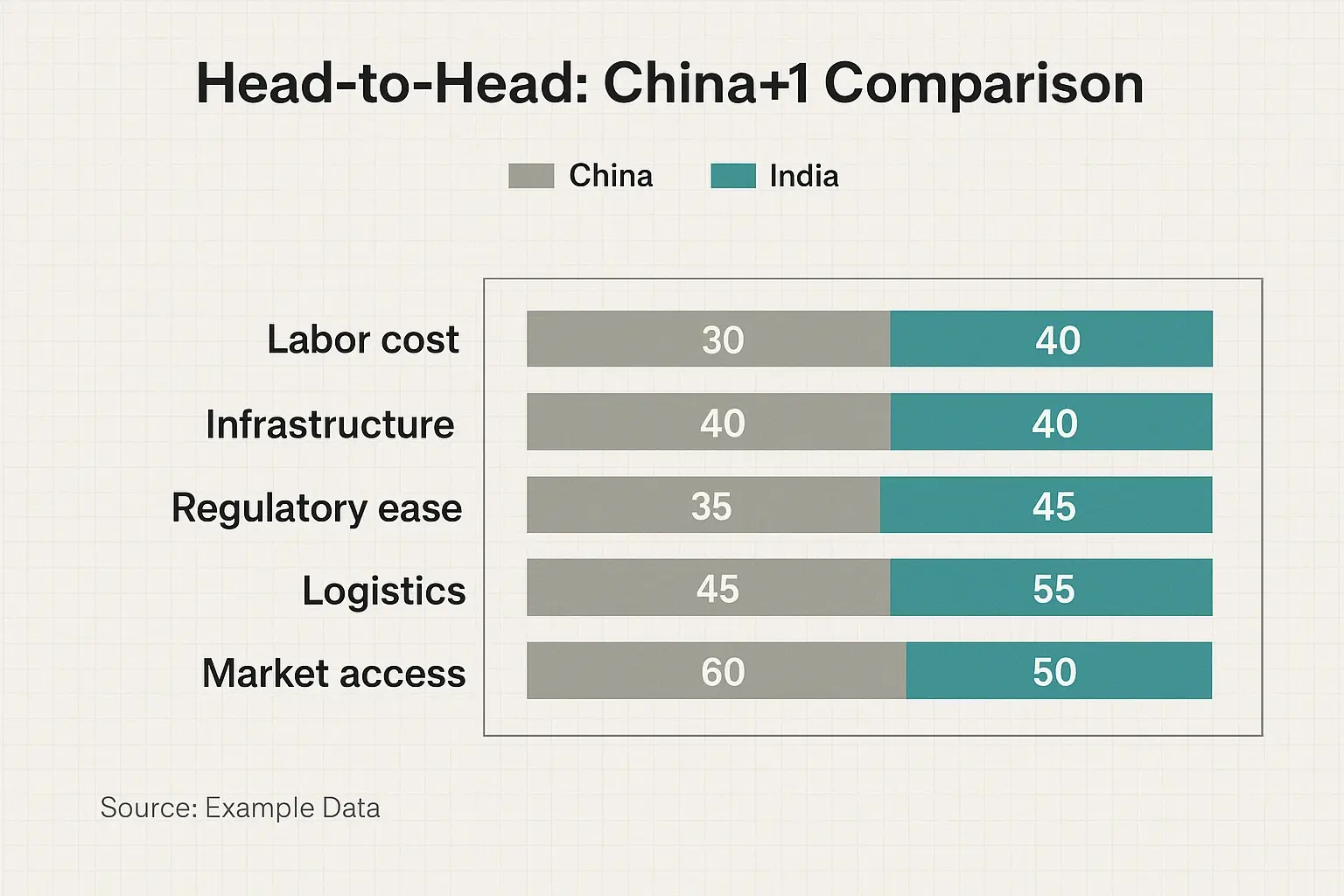 A clear head-to-head matrix that surfaces where India leads and where competitors have advantages—designed for quick evaluation by investors weighing China +1 options.
Decoding the “China +1” Calculus: Beyond Cost to Strategic Resilience
The initial push for diversification was about cost. Today, it’s about resilience. Geopolitical shifts, trade tensions, and the memory of pandemic-era disruptions have fundamentally changed the risk calculation.
Decision-makers are no longer just looking for a cheaper factory. They’re building a supply network that can withstand shocks. This means evaluating potential partners on a more sophisticated set of criteria:
- Scale: Can the country absorb high-volume production and scale with your growth?
- Talent: Is there a deep pool of skilled labor, engineers, and managers?
- Domestic Demand: Is there a local market to buffer against global downturns?
- Government Stability & Support: Are policies predictable and supportive of foreign investment?
- Infrastructure: Can goods move efficiently from factory to port?
This is the framework through which we’ll analyze India’s position as a premier “China +1” destination.
India’s Foundational Strengths: The Pillars of its Advantage
While other nations offer niche benefits, India’s proposition is built on a unique combination of scale, talent, and forward-looking policy that is difficult to replicate.
Market Size and Domestic Demand
India isn’t just an export hub; it’s one of the world’s largest and fastest-growing consumer markets. This provides a crucial strategic advantage: a built-in “demand shock absorber.” When global demand softens, a strong domestic market can help maintain production volumes, creating a more stable operating environment. For companies looking to both produce and sell globally, India offers a unique two-for-one value proposition.
Unbeatable Cost and a Deep Talent Pool
The data is unequivocal: U.S. News & World Report ranks India #1 for cheap manufacturing costs. This is anchored by competitive labor, with a minimum daily wage around $2.15.
But cost is only half the story. The real advantage lies in the depth of its human capital. India produces a massive number of engineers and technical graduates annually, and its large, young population includes a significant English-speaking professional class. This creates a scalable talent pipeline for everything from shop-floor management to complex R&D—a critical factor for companies looking to move beyond simple assembly.
Proactive Government Policy and Incentives
India’s government is actively courting global manufacturers with some of the world’s most aggressive incentive programs. The Production-Linked Incentive (PLI) scheme is a prime example, offering a 4-6% cashback on incremental sales for manufacturers in key sectors like electronics, pharmaceuticals, and specialty chemicals.
This isn’t just a tax break; it’s a strategic partnership. By tying incentives to production, India is signaling its long-term commitment to becoming a global manufacturing powerhouse, ranked #5 globally by output.
Head-to-Head: India vs. Key “China +1” Rivals
An honest evaluation means looking at the competition. While every country has its merits, India’s strategic advantages become clearer when compared directly.
The Main Event: India vs. Vietnam
Vietnam has, deservedly, earned a reputation as a China +1 success story. Its 2023 exports of $96.99 billion outpaced India’s, fueled by a strong electronics and apparel base. With 16 active Free Trade Agreements (FTAs) and a high literacy rate of 97.75%, its export-focused model is potent.
However, this is where the question of scale becomes critical.
- Cost vs. Scale: While Vietnam’s average hourly labor cost is a competitive $2.99, it’s still higher than India’s base. More importantly, Vietnam’s smaller population can lead to labor market saturation and wage inflation as more companies move in. India’s vast labor pool offers long-term stability in labor costs and availability.
- Ecosystem Depth: Vietnam is strong in electronics assembly, but India possesses a more diversified industrial base, with deep capabilities in chemicals, automotive, pharmaceuticals, and heavy industry. For businesses with complex supply chains, India offers a more robust domestic supplier network.
- Market Access: Vietnam is primarily an export play. India is both an export platform and a gateway to a massive domestic market.
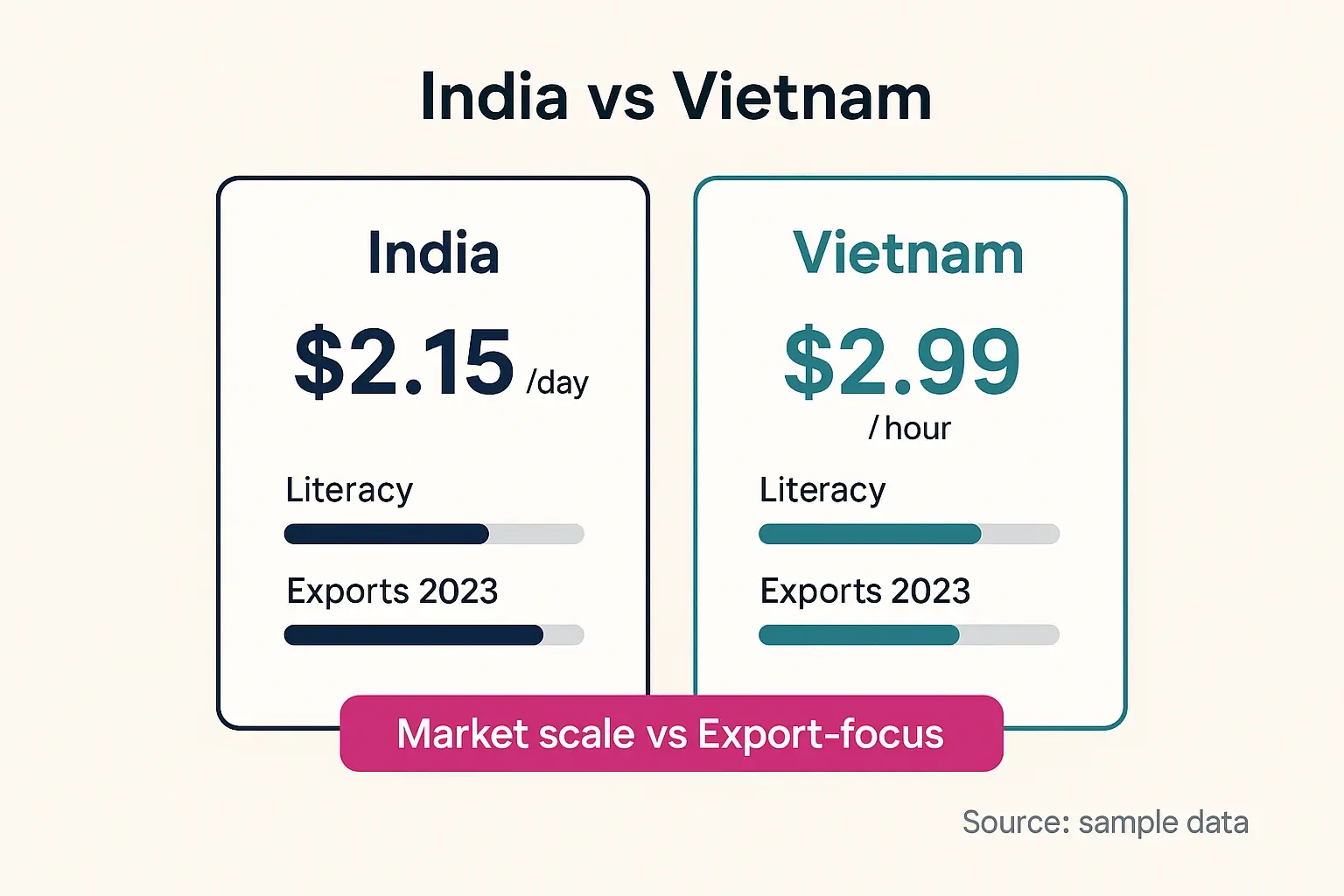 A compact India–Vietnam comparison that foregrounds cost, skills, and export-readiness to support a rapid investment decision.
The Nearshoring Rival: India vs. Mexico
Mexico’s primary advantage is geographic proximity to the United States, making it a powerful choice for companies prioritizing short lead times to the North American market. However, for businesses serving global markets in Europe, the Middle East, and Asia, India’s location is more central. Furthermore, India’s cost structure, particularly for labor-intensive manufacturing, often presents a more compelling long-term financial case than Mexico’s.
The ASEAN Alternatives: India vs. Indonesia & Malaysia
Indonesia and Malaysia are strong contenders, particularly in sectors like palm oil, rubber, and semiconductors. However, neither can match India’s sheer demographic scale or the breadth of its industrial ecosystem. For large-scale manufacturing that requires a deep and varied supplier base—from raw chemicals to precision components—India’s continental-sized economy offers advantages that island nations cannot easily replicate.
Addressing the Elephants in the Room: India’s Challenges & Progress
No country is without its challenges, and for years, conversations about manufacturing in India came with caveats about infrastructure and bureaucracy. A credible analysis must address these points directly. The good news is that the narrative is rapidly changing, backed by massive investment and targeted reforms.
Infrastructure: From Bottleneck to Backbone
The critique of Indian infrastructure is dated. The reality is a nation undergoing one of the most ambitious infrastructure upgrades in the world. Initiatives like Bharatmala (road network) and Sagarmala (port development) are transforming the country’s logistics capabilities.
While Vietnam’s infrastructure ranks 77th globally, India is aggressively closing the gap. Port turnaround times are decreasing, new highways are shrinking transit times, and dedicated freight corridors are coming online. The journey isn’t complete, but the trajectory is clear and positive. Partnering with a logistics expert who understands this evolving landscape is key to leveraging these improvements. For anyone planning a move, it’s crucial to evaluate not just the infrastructure of today, but the far more capable network of tomorrow.
A clear infrastructure readiness visualization that surfaces where India is improving and where operational bottlenecks remain—helpful for logistics planning.
Regulation: Cutting Through the Red Tape
India’s reputation for bureaucracy is well-known, but so is the government’s concerted effort to improve the ease of doing business. The introduction of digital portals for permits, the simplification of tax regimes like the GST, and state-level competition to attract investment are tangible signs of progress.
While navigating the regulatory environment still requires expertise, it is no longer the barrier it once was. The key is working with an on-the-ground partner who can expertly manage compliance and supplier qualification, turning a potential hurdle into a streamlined process.
Supply Chain Maturity: Building a Self-Reliant Ecosystem
Critics have noted that much of India’s manufacturing, particularly in electronics, has been “assembly-driven,” with a high reliance on imported components from China. This is a valid point, but one the PLI schemes are specifically designed to address. By incentivizing domestic production of components, India is actively building a more vertically integrated and resilient supply chain. For procurement leaders, this signals a future with more local sourcing options and less dependence on single-country suppliers.
Your “India +1” Roadmap: From Evaluation to Implementation
Choosing a country is the first step. The next is execution. A successful transition requires a phased approach that aligns with your specific industry and business goals.
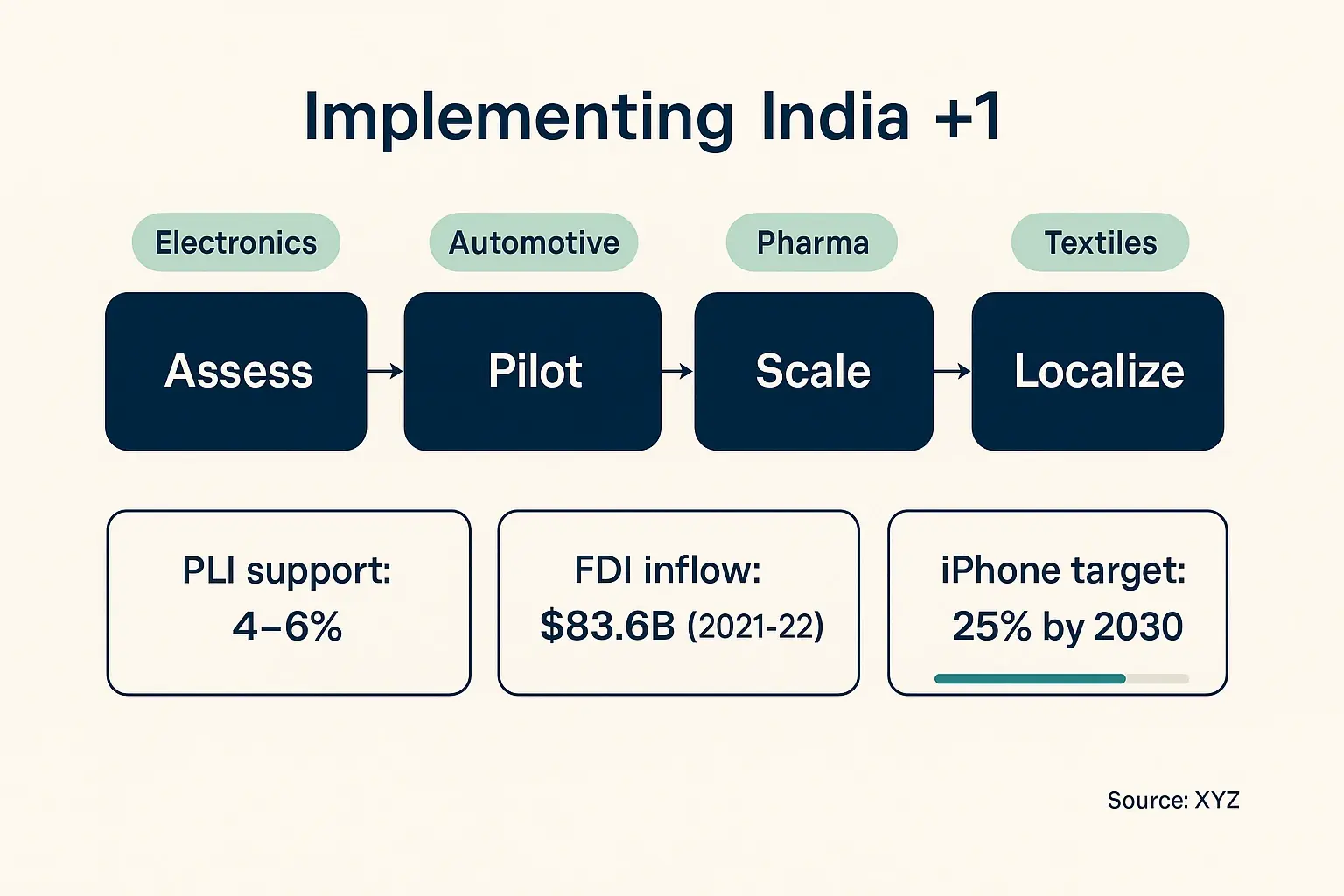 A practical roadmap tying sector suitability to phased implementation—showing clear next steps, incentives, and metrics for decision-makers.
- Phase 1: Analysis & Scoping: Identify which regions in India offer the best ecosystem for your products. Certain states have specific incentives and infrastructure for chemicals, automotive, or textiles.
- Phase 2: Supplier Qualification: This is the most critical phase. On-the-ground audits, quality control process validation, and compliance checks are non-negotiable, especially for regulated industries like chemicals.
- Phase 3: Pilot Production: Start with sample shipments and small-batch orders to test consistency, communication, and logistics before committing to high volumes.
- Phase 4: Scale & Optimization: Once the process is proven, scale production while continuously optimizing logistics and sourcing to improve landed costs.
Frequently Asked Questions
Is India’s quality consistent enough for specialty chemicals?
Absolutely, provided you have a rigorous qualification process. India has a world-class chemical industry, but quality varies by supplier. The solution is not to avoid the market but to implement robust, on-the-ground quality assurance, including pre-shipment batch testing and COA verification. This is a core part of our custom procurement solutions.
How do I manage logistics for hazardous materials from India?
Hazardous goods logistics requires specialized expertise in documentation, GHS-compliant labeling, and carrier selection. It’s a significant point of failure for inexperienced teams. Working with a partner that manages the entire process—from factory pickup to final delivery, including all customs and hazmat paperwork—is the only way to ensure smooth, compliant transit.
Vietnam has more free trade agreements. Isn’t that a major disadvantage for India?
While Vietnam’s FTA network is an advantage for certain export markets, it’s not a deal-breaker for India. First, India is actively pursuing its own trade agreements. Second, for many high-value goods, tariffs are offset by India’s lower manufacturing costs. Finally, for companies targeting India’s massive domestic market, FTAs are irrelevant. The decision should be based on a total landed cost analysis for your specific products and target markets.
How can I be sure about transparent pricing and avoiding hidden costs?
This is a valid concern in any new market. Transparency is paramount. Demand a complete landed-cost breakdown from any potential partner, including raw material costs, local transport, port fees, ocean freight, duties, and final delivery charges. Reputable partners will provide this upfront and welcome the scrutiny.
The Strategic Choice for Long-Term Growth
The “China +1” decision is one of the most consequential choices your company will make this decade. While destinations like Vietnam and Mexico offer compelling, targeted solutions, India presents a unique, strategic proposition for long-term, scalable, and resilient growth.
Its combination of unbeatable costs, a massive and skilled workforce, a vast domestic market, and a government committed to building a manufacturing superpower makes it more than just another low-cost country. It is a strategic partner for the future.
Navigating this opportunity requires local expertise and a deep understanding of the cultural and operational landscape. If you’re ready to explore what a resilient chemical supply chain anchored in India could look like for your business, we’re here to help.
Schedule a no-obligation 15 minute consultation with us to discuss your specific procurement needs.