Imagine discovering a line of authentic, high-quality Indian spices that could transform your product line. The aroma, the quality, the price—it’s a perfect fit. But between that discovery and getting the product to your customers lies a critical pathway paved with regulations, acronyms, and quality checks. For many international businesses, this is where the journey stalls.
Navigating India’s food export landscape can feel like learning a new language, with terms like FSSAI, IEC, and FoSCoS acting as gatekeepers. But what if you could see these not as barriers, but as a framework for guaranteeing the very quality that attracted you in the first place?
This guide is your friendly translator. We’ll walk you through the essentials of the Food Safety and Standards Authority of India (FSSAI) and other key certifications. By the end, you’ll understand the process, see why it matters for your business, and feel confident in taking the next step to unlock the immense potential of the Indian food market.
The Bedrock of Quality: What is FSSAI and Why Does It Matter for Exporters?
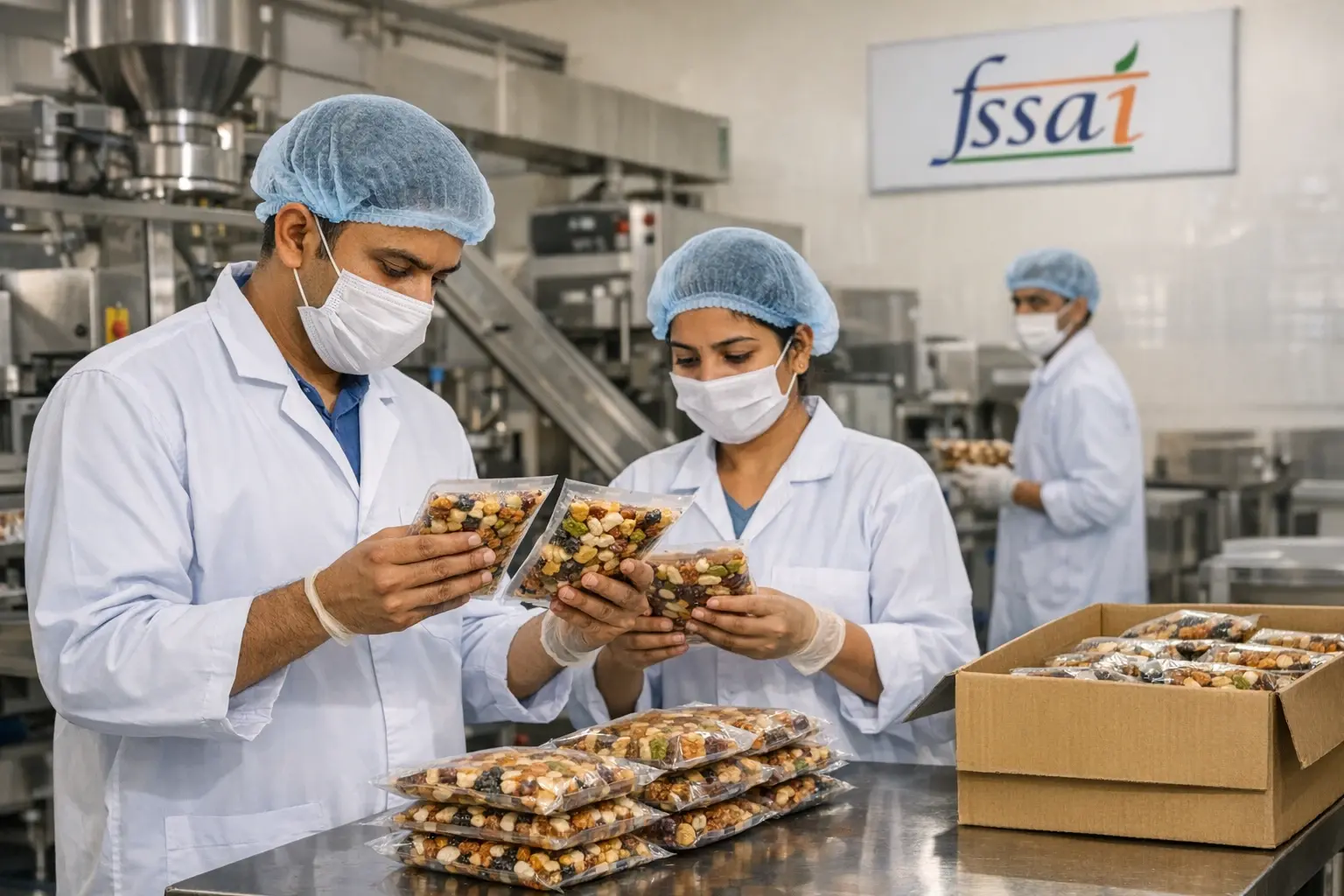
Think of the FSSAI as the guardian of food safety in India. Established to regulate the manufacturing, storage, distribution, and sale of food, its primary goal is to ensure products are safe and wholesome for consumption.
For an international buyer, an FSSAI-compliant supplier is your first and most important signal of quality and reliability. It means the manufacturer adheres to stringent hygiene and safety standards mandated by law.
But here’s a crucial point often misunderstood: FSSAI compliance isn’t just for food sold within India. According to the FSSAI’s official guidelines, any business that is a 100% Export Oriented Unit (EOU) must obtain an FSSAI Central License. This ensures that products destined for the global market meet the same—or higher—standards of safety and quality from the very beginning of their journey.
Beyond FSSAI: The Core Export Trio
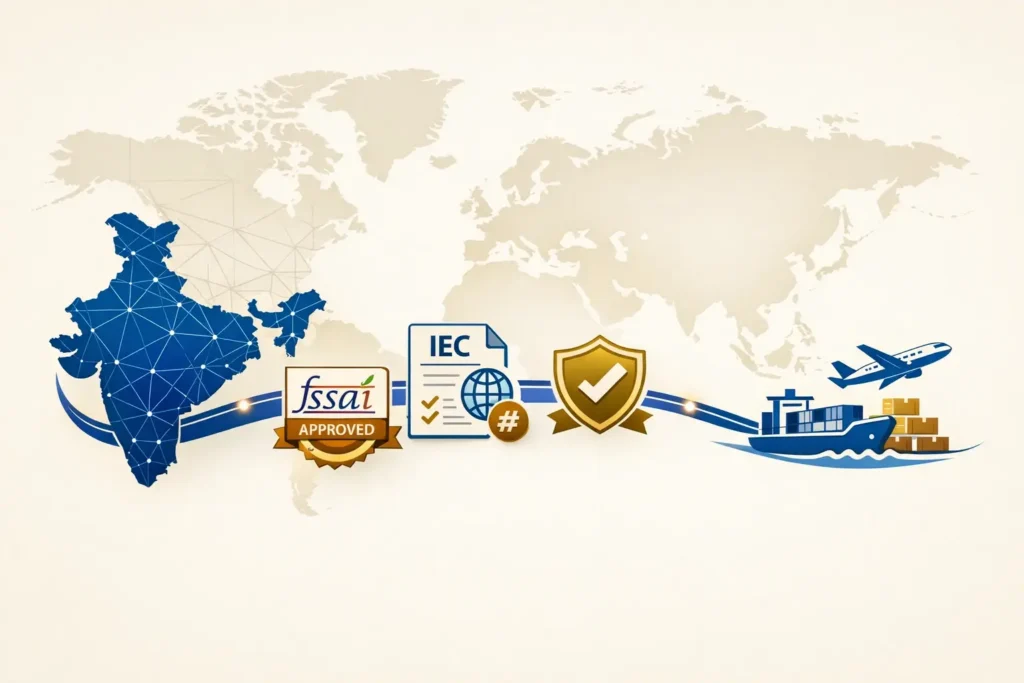
While the FSSAI license is food-specific, it works alongside other foundational registrations required for any export business in India:
- Importer-Exporter Code (IEC): This is a unique 10-digit code issued by the Director General of Foreign Trade (DGFT). No business can export from or import to India without it. Think of it as the business’s passport for international trade.
- Registration-cum-Membership Certificate (RCMC): This certificate, issued by an Export Promotion Council, validates an exporter’s credentials. For most food products, this council is APEDA (Agricultural and Processed Food Products Export Development Authority). It’s a key to accessing export benefits and proving you’re a registered, recognized exporter.
These three elements—FSSAI Central License, IEC, and RCMC—form the compliance backbone for any Indian food export operation.
Your Roadmap: The FSSAI Export Certification Process Step-by-Step
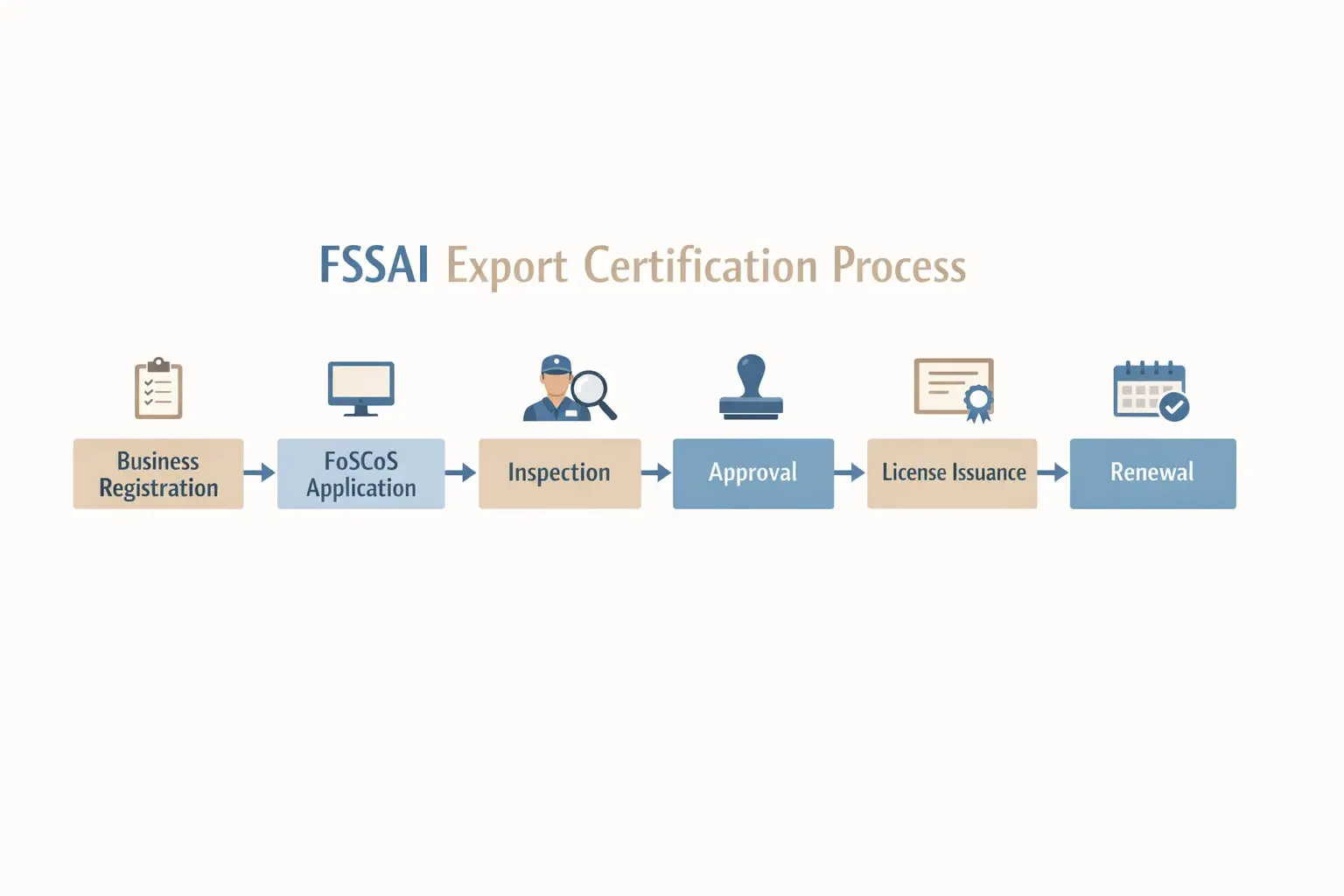
Obtaining the FSSAI Central License is a clear, systematic process managed through an online portal called FoSCoS (Food Safety Compliance System). While it requires attention to detail, it’s far from insurmountable.
Here’s a breakdown of the typical journey:
Step 1: Application on the FoSCoS PortalThe first step is to create an account and fill out Form B on the official FSSAI FoSCoS website. This is where the exporter provides all essential details about their business, the products they intend to export, and their facility.
Step 2: Uploading Critical DocumentsThis is the most detail-oriented part of the process. The system requires a comprehensive set of documents. It’s not just about having them, but ensuring they are accurate and complete. Key documents include:
- Proof of Business Premises: To verify the physical location of the unit.
- Facility Layout Plan: To show that the facility is designed for safe food handling and to prevent cross-contamination.
- List of Directors/Partners: For business identity verification.
- Food Safety Management System (FSMS) Plan: This is a critical document outlining the specific steps the facility takes to ensure food safety.
- Importer-Exporter Code (IEC): Proving the business is registered to conduct international trade.
Step 3: Scrutiny and InspectionOnce the application is submitted, an FSSAI official will scrutinize the documents. They may also conduct a physical inspection of the export unit to verify that the facility and processes match what’s described in the FSMS plan. They are checking for compliance with hygiene standards, proper record-keeping, and safe handling procedures.
Step 4: License Approval and IssuanceIf the application and inspection are successful, the FSSAI Central License is granted. This license is typically valid for 1 to 5 years and must be prominently displayed at the business premises.
Common Hurdles and How to Navigate Them
The path to certification is well-defined, but there are common pitfalls that can cause delays or rejections. Understanding these challenges ahead of time is the key to a smooth process.
Challenge 1: Mismatched Global Standards
A product that meets FSSAI standards is a great start, but it’s not the final word. Your destination country has its own set of rules. For example, the European Union has extremely strict limits on pesticide residues, which has been a point of contention for some Indian spice shipments.
Proactive Solution: The real work is in harmonization. Before sourcing a product, you need to know the specific regulations of your target market (e.g., US FDA, EU regulations). A reliable sourcing partner on the ground in India can help verify that a supplier’s testing protocols and product specifications align not only with FSSAI but also with your country’s import requirements from the outset.
Challenge 2: Incomplete or Inaccurate Documentation
A surprisingly common reason for application rejection is a simple documentation error—an outdated address, a blurry scan, or a missing signature. The FoSCoS portal is precise, and any inconsistency can flag the entire application for review, causing significant delays.
Proactive Solution: Treat documentation as a critical part of your quality control. Create a master checklist and double-check every detail before uploading. Ensure all information is consistent across all documents (e.g., the company name and address on the IEC must exactly match the application).
FSSAI Myth vs. Reality
Let’s clear up a common point of confusion.
- Myth: “I need a ‘No Objection Certificate’ (NOC) from FSSAI to export my food products.”
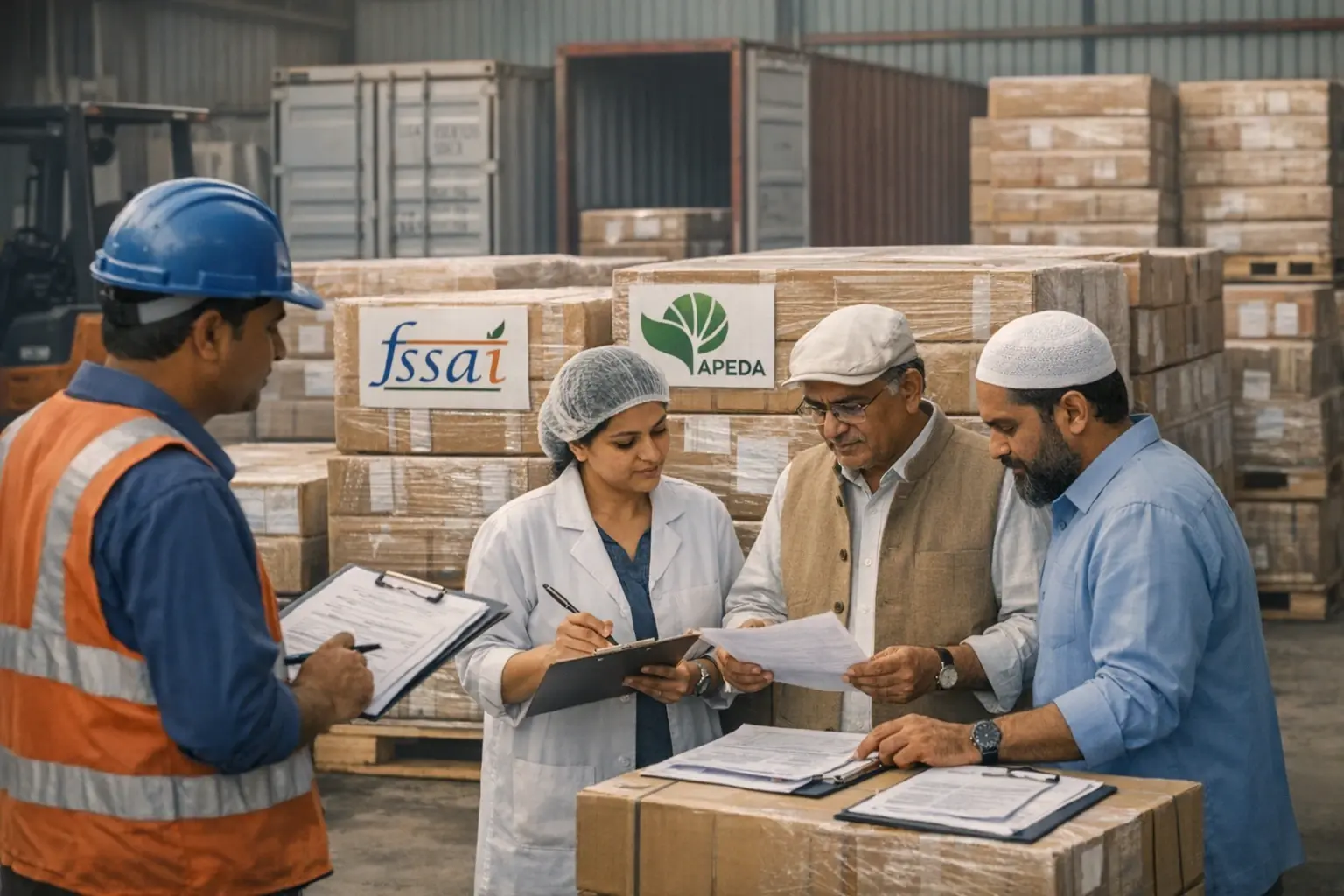
- Reality: According to the FSSAI itself, a specific NOC for each export shipment is not required. However, having the mandatory FSSAI Central License for your facility is non-negotiable. The license itself is the standing approval that your products are manufactured in a compliant environment.
The Payoff: Why Rigorous Compliance Builds a Better Supply Chain
Achieving FSSAI certification and aligning with global standards isn’t just about avoiding customs rejections; it’s a strategic advantage. It demonstrates a commitment to quality that builds trust with customers, protects your brand reputation, and ultimately leads to a more resilient and reliable supply chain.
When you partner with suppliers who have robust compliance systems in place, you’re not just buying a product; you’re investing in predictability. You’re minimizing the risk of costly delays, failed batches, and brand-damaging safety issues. This is the foundation upon which successful, long-term international sourcing relationships are built.
Frequently Asked Questions (FAQ)
1. Is an FSSAI license mandatory for exporting food products from India?Yes. If your business is a 100% Export Oriented Unit (EOU), you are required to obtain an FSSAI Central License. This ensures your products are manufactured in a facility that meets national food safety standards.
2. What is the difference between an FSSAI License and FSSAI Registration?FSSAI Registration is for very small food businesses with low annual turnover. For any exporter, a Central or State License is required, depending on the scale of operations. Given the nature of export, the FSSAI Central License is the standard requirement.
3. What is the cost of an FSSAI Central License?The government fee for a new FSSAI Central License is typically ₹7,500 per year. You can apply for a validity period of one to five years.
4. How long does it take to get the FSSAI export license?The timeline can vary, but if all documents are in order, the process can take anywhere from 30 to 60 days from the date of application submission.
5. What happens after my license expires?You must apply for renewal. The renewal process should be initiated at least 30 days before the license expires to avoid penalties and ensure continuous compliance for your export operations.
Your Next Step on the Sourcing Journey
Understanding India’s regulatory framework is the first, most crucial step toward building a transparent and successful partnership with Indian suppliers. By seeing FSSAI certification not as a bureaucratic task but as a commitment to excellence, you can confidently source products that meet the highest global standards.
As you continue to explore opportunities in the Indian market, remember that a clear grasp of these foundations will empower you to ask the right questions, vet the right partners, and build a supply chain that is both cost-effective and secure.