The debate over “Why India?” is effectively over. The data is irrefutable: with 14% of global iPhone production now successfully migrating to India—valued at $14 billion in FY24—the proof of concept for complex, high-stakes manufacturing has been established.
For procurement directors and category leads, the question has shifted from strategic justification to operational execution. You aren’t looking for another macroeconomic report on the “China Plus One” (C+1) strategy. You are looking for a blueprint on how to make it work without breaking your supply chain.
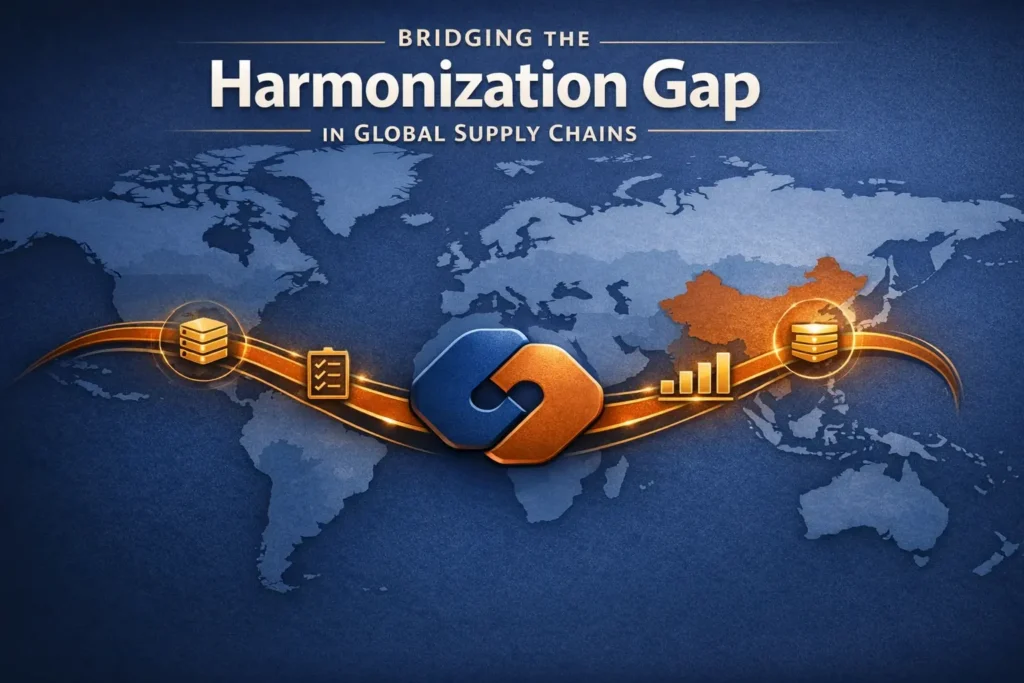
The reality of dual sourcing is that it introduces friction. Moving from a single-source model in Shenzhen to a split model involving Mumbai or Gujarat creates a “Harmonization Gap.” This is where specifications drift, communication silos form, and hidden costs regarding compliance begin to eat into margins.
Successful diversification isn’t about simply finding a vendor in India; it’s about architecting a multi-country ecosystem where quality, data, and logistics flow seamlessly between hubs. Here is the operational framework for bridging that gap.
The 80/20 Transition Protocol
Most implementation failures stem from an “all-or-nothing” mentality. Attempting to replicate China’s scale in India overnight is a recipe for disruption. Instead, successful global sourcing managers utilize a phased transition protocol.
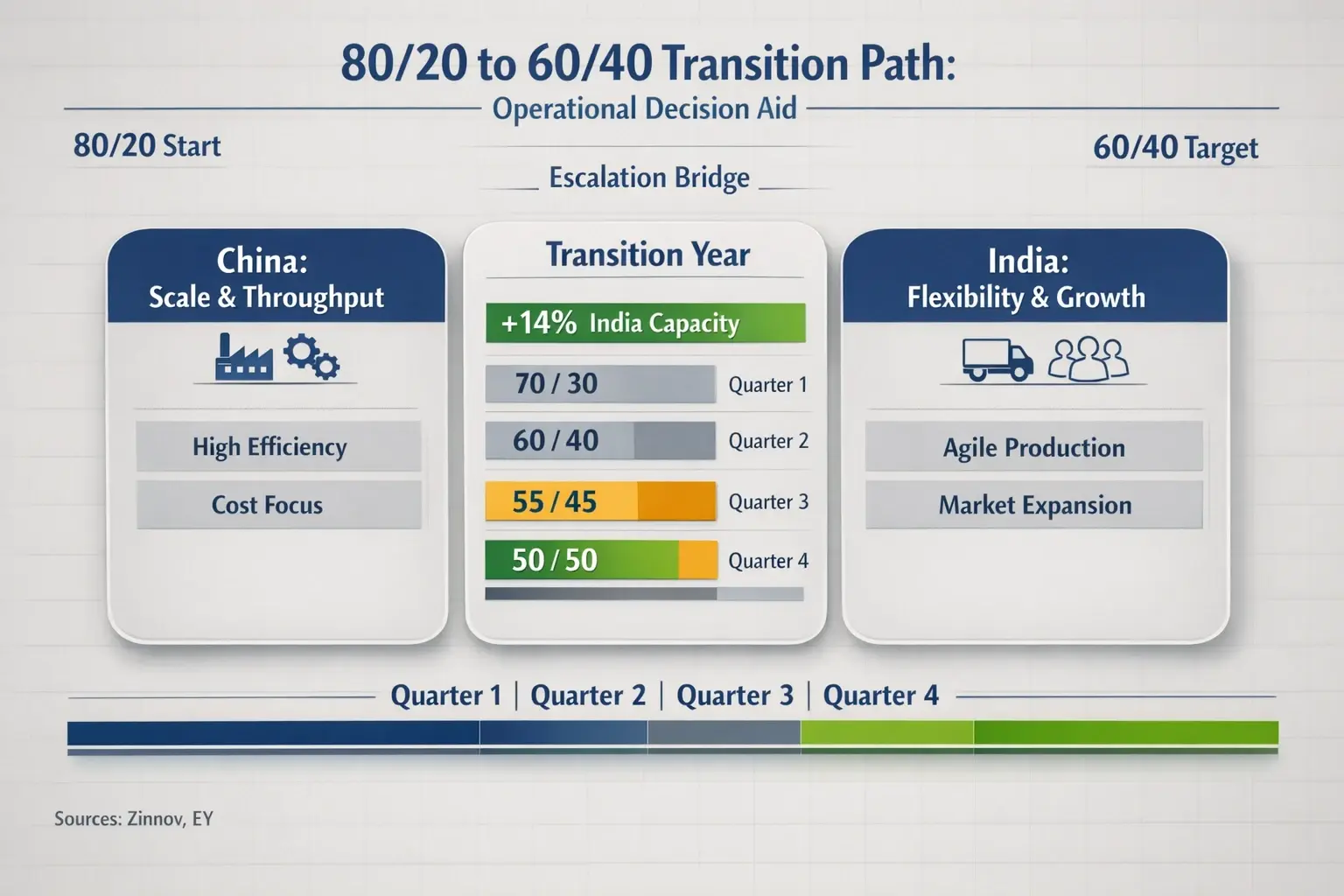
The most effective approach we see in the chemical and industrial sectors is the Transition Year methodology. This involves retaining 80% of your complex, high-volume production in your established hub (likely China) while allocating 20%—specifically new product introductions (NPIs) or secondary SKU lines—to India.
This 80/20 split serves three strategic purposes:
- Risk Calibration: It tests the Indian supplier’s ability to meet technical specs (e.g., chemical purity or steel tensile strength) without jeopardizing your core revenue lines.
- Logistics Stress-Testing: It exposes gaps in hazmat documentation or port handling before volume scales.
- Benchmark Creation: It allows you to build a “Golden Sample” standard that both geographies must eventually meet.
Once stability is proven, the ratio shifts to 60/40, eventually aiming for a balanced supply chain that is resilient to geopolitical shocks.
Harmonizing Quality: The “Shenzhen to Pune” Challenge
The most common frustration we hear from U.S. procurement leaders is inconsistency. A specification sheet that yields a perfect result in China may produce a slightly different formulation in India, even when the numbers look identical. This is rarely a lack of capability; it is a lack of Translation context.
In the chemical and coatings industry, for example, “purity” is a baseline, but the method of testing and the equipment used can vary. A 99.5% purity requirement needs to be backed by identical testing protocols in both countries.
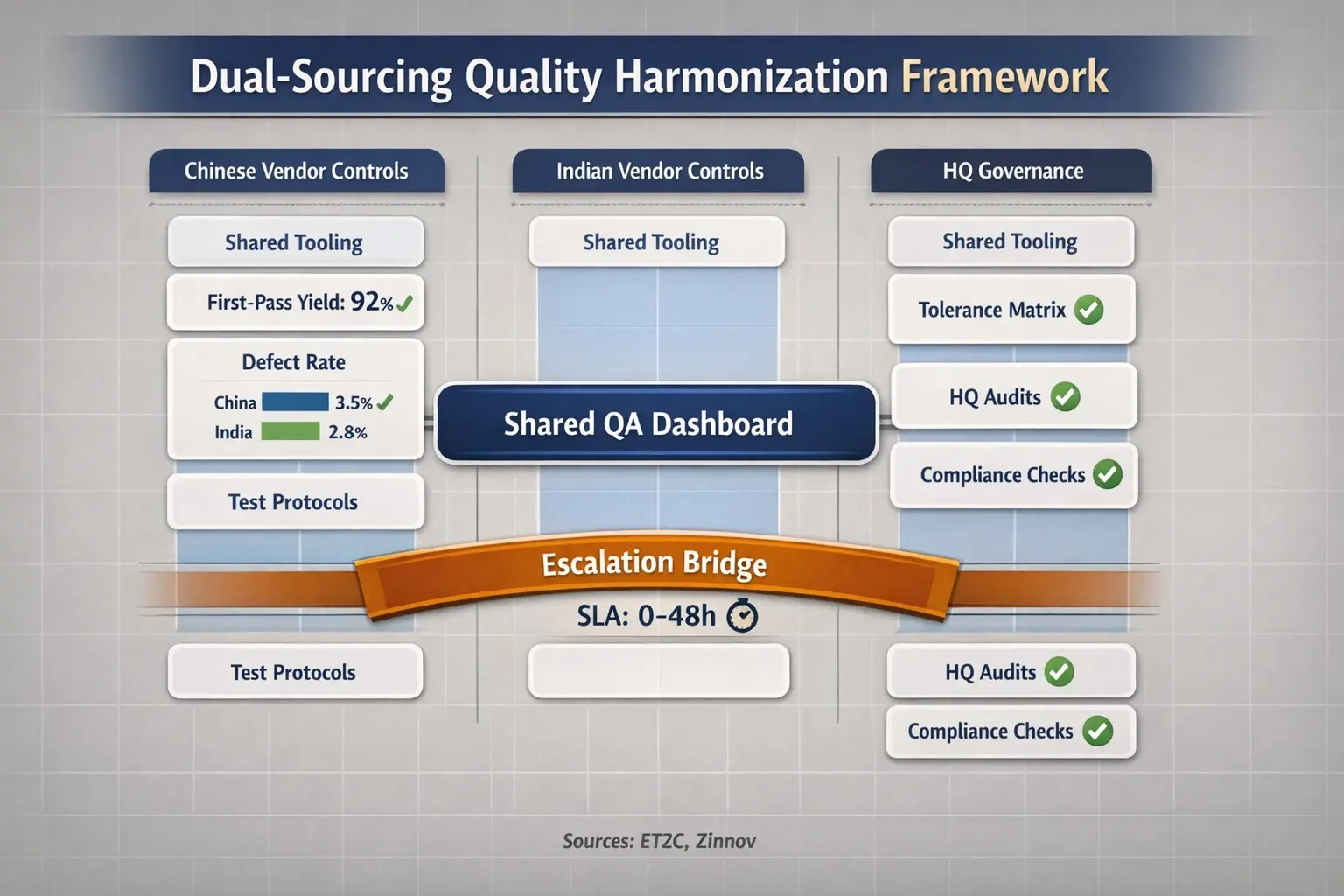
The Shared QA Ecosystem
To solve this, you cannot rely on separate quality silos. You must implement a “Harmonized Quality Framework.” This involves:
- Standardized Artifacts: Ensuring that Certificates of Analysis (COA) and Safety Data Sheets (SDS) follow the exact same template and GHS standards, regardless of origin.
- Unified Testing Methodologies: If your Chinese supplier uses a specific HPLC method for testing chemical composition, your Indian supplier must be audited to ensure they aren’t using a different, albeit compliant, method that yields varied results.
- The “Escalation Bridge”: A pre-defined protocol for when a batch fails. If a disruption occurs in China, can your Indian facility immediately interpret the specs and ramp up production?
The “Hidden” Regulatory Layer: DPDP Act & Compliance
While quality is visible, regulatory risk is often invisible until it becomes a crisis. A major blind spot for international buyers entering India is the Digital Personal Data Protection (DPDP) Act 2023.
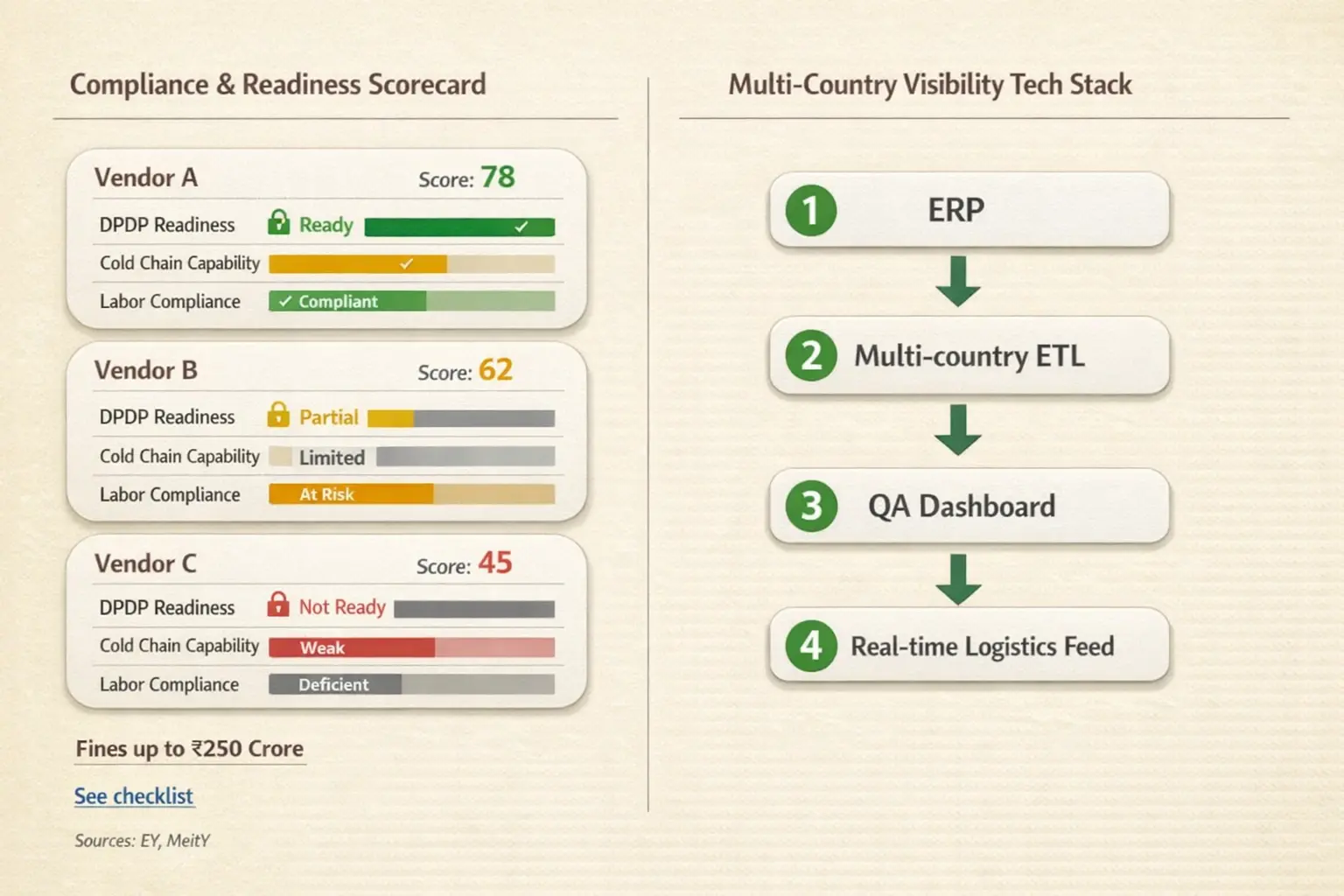
Unlike the broad strokes of GDPR, the DPDP Act has specific implications for supply chains, particularly regarding the processing of data by shared service centers. With fines for non-compliance reaching up to ₹250 Crore (~$30M), this is not a box-ticking exercise.
If you are sourcing through a vendor that manages your proprietary formulation data or supplier network details, their data architecture must be compliant. Many small-to-mid-sized manufacturers are unaware of these new liabilities.
The Compliance Audit
When evaluating Indian partners, your due diligence must extend beyond the factory floor to their data room.
- Data Fiduciary Responsibility: clearly defined roles on who controls the data.
- Cross-Border Data Flows: Ensuring that the transfer of technical drawings or chemical formulas complies with the “negative list” restrictions of the Act.
Intercultural Communication: Beyond “Boots on the Ground”
Managing a multi-country supply chain requires navigating distinct communication cultures. China is often characterized by high-context, transactional speed—suppliers may prioritize speed over debate. India, conversely, operates on a relationship-heavy model where “yes” can sometimes mean “I hear you,” not “I agree.”
This nuance is where timelines slip. A Western buyer might interpret a lack of objection as confirmation, only to find out weeks later that a raw material shortage was looming.
Effective management requires an Escalation Protocol that bridges these styles. This is where Sourcing Pros operates—translating Western expectations into local execution. We utilize American-led leadership to ensure that “boots on the ground” translates to actual accountability, not just presence.
Infrastructure and Logistics Visibility
India’s infrastructure is undergoing a massive transformation, particularly in the Cold Chain sector, which is critical for agricultural and chemical exports. The National Centre for Cold-chain Development (NCCD) reports significant shifts toward energy-efficient infrastructure, but gaps remain in last-mile connectivity.
For the chemical buyer, the concern is hazardous goods (Hazmat) logistics. Moving dangerous goods requires specialized knowledge of port regulations, which differ significantly between Nhava Sheva and Shanghai.
The Tech Stack Requirement
With over 1,700 Global Capability Centres (GCCs) in India, the talent for tech integration is there. Your supply chain needs to leverage this. You cannot manage a dual-sourcing strategy via email spreadsheets.
- Real-time Visibility: Integration of ERP systems to track inventory across both countries simultaneously.
- Landed Cost Transparency: Automated calculation of duties, freight, and handling to give you a true “apples-to-apples” cost comparison between your Chinese and Indian options.
FAQ: Evaluating Your Dual-Sourcing Readiness
1. Will dual sourcing inevitably increase my overhead costs?Initially, there is a setup cost. However, the “China Plus One” strategy is a hedge against the explosive costs of supply chain rupture. When optimized, the blended cost of India’s competitive labor and China’s scale often results in a lower average landed cost over 24 months.
2. How do we ensure IP protection when sharing specs with new Indian vendors?India has robust legal frameworks for IP, but enforcement is key. We recommend tripartite agreements that include your US entity, the Indian manufacturer, and a local management partner (like Sourcing Pros) to enforce strict non-disclosure and non-compete clauses.
3. Can Indian suppliers handle the volume of hazardous chemical exports?Yes, but vetting is non-negotiable. You must verify that the supplier has GHS-compliant labeling capabilities and pre-existing relationships with hazmat-certified freight forwarders. This is a core competency at Sourcing Pros.
4. Is the DPDP Act an immediate threat to current operations?If you are exchanging personal data of employees or vendors, yes. A compliance audit should be part of your immediate quarterly review.
The Path Forward
Diversifying your supply chain is no longer an option; it is a mandate for survival in a volatile global market. But diversification without harmonization is just chaos.
By implementing a structured 80/20 transition, harmonizing your quality artifacts, and addressing the regulatory nuances of the Indian market, you turn a risk-mitigation strategy into a competitive advantage.
You don’t have to navigate this transition alone. Whether you need to audit a chemical supplier in Gujarat or structure a compliant export channel for construction materials, Sourcing Pros bridges the gap between Western expectations and Indian capability.
Ready to build a resilient, multi-country supply chain? Let’s evaluate your sourcing roadmap.