If you are leading global procurement, you already know that a “China Plus One” strategy is no longer a boardroom talking point—it is a critical mandate for survival. Supply chain continuity, geopolitical de-risking, and margin preservation demand a diversified sourcing network.
As you evaluate alternatives, India has likely emerged at the top of your list. The Indian chemical industry is currently undergoing what we call “The Great Pivot,” transforming from a historically domestic-focused sector into a global export powerhouse. Currently valued between $220B and $260B, the market is projected by government and strategic bodies to reach $300B by 2028, and a staggering $1T by 2040.
But high-level economic data doesn’t keep your production lines running.
As a procurement leader, your mandate isn’t just finding a new supplier; it’s ensuring accurate chemical quality, maintaining strict regulatory compliance (TSCA, REACH, GHS), and locking in transparent landed costs without hidden fees. Let’s move beyond the macro-data and dive into the operational realities, competitive matrices, and strategic insights you need to confidently evaluate the Indian chemical market.
Evaluating the “China vs. India” Sourcing Matrix
For years, the industry avoided direct molecule-to-molecule comparisons between Chinese and Indian suppliers. However, making informed long-term sourcing decisions requires looking at the raw tactical data.
India now accounts for 10% of its total global exports in chemicals, shipping to over 175 countries. The core opportunity for Western buyers lies heavily in Specialty Chemicals, a segment growing at a 12% CAGR and projected to hit $64B by 2025.
When evaluating Indian suppliers against established Chinese networks, success depends on understanding structural differences in lead times, quality assurance standards (BIS vs. ISO), and long-term cost-effectiveness.
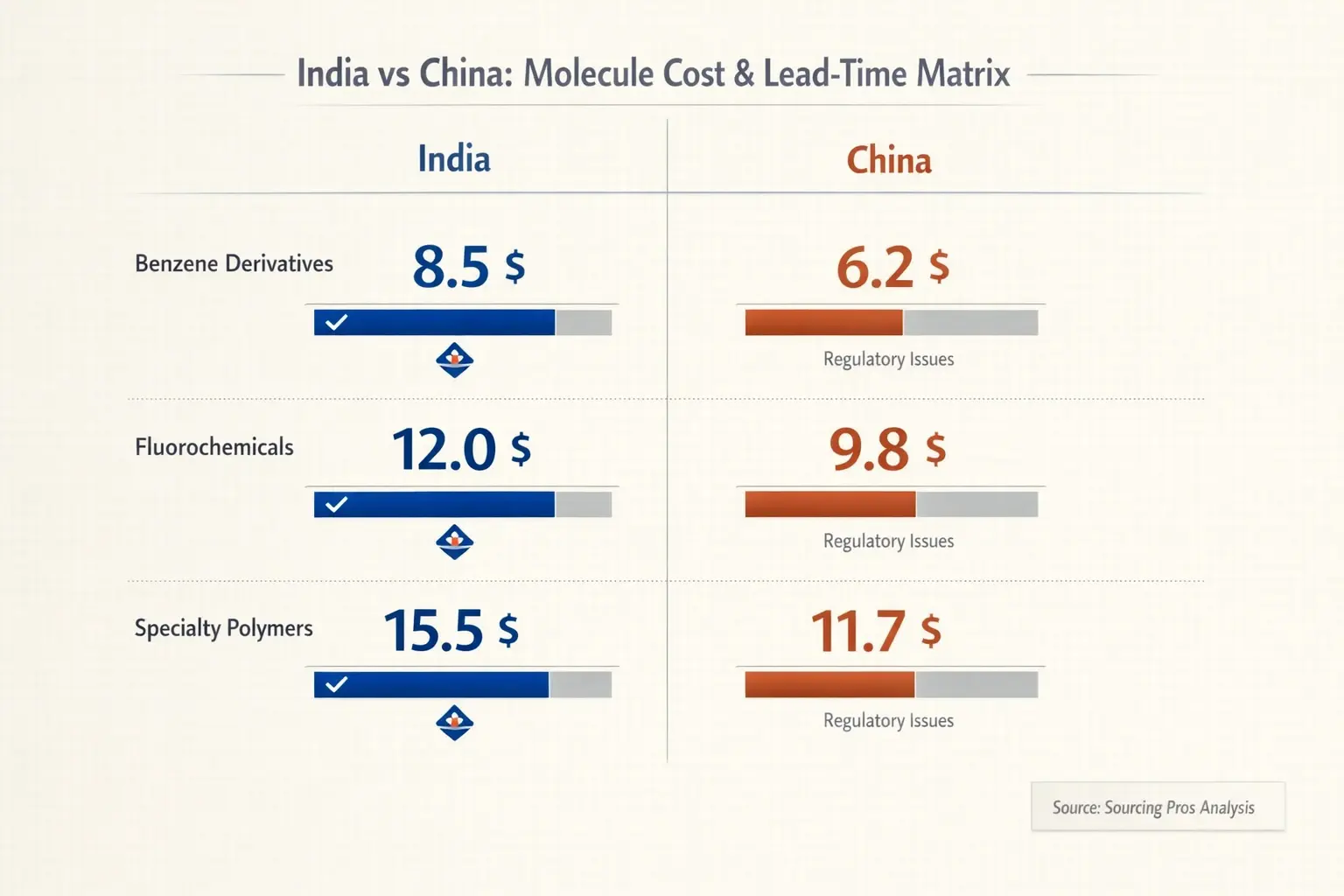
While China offers massive legacy scale, India is winning global bids through intense government incentivization (PLI schemes) and a rapidly maturing ecosystem of specialized manufacturers. However, accessing these benefits requires a partner who understands Western expectations for communication, fast quotes, and single-point-of-contact accountability.
Operational Intelligence: Decoding India’s Chemical Hubs
You aren’t just buying from “India”—you are sourcing from specific regional clusters. India has organized its chemical manufacturing into Petroleum, Chemicals and Petrochemicals Investment Regions (PCPIRs). Understanding these geographies is critical to optimizing your freight routes and reducing lead times.
The Major Petroleum and Chemical Hubs and Sourcing Efficiency
When assessing where your products will originate, geography directly impacts your landed cost and supply chain friction:
- Gujarat (Dahej): The undisputed heavy hitter. Gujarat accounts for the lion’s share of India’s chemical production. The Dahej Petrochemicals and Chemicals alone has attracted over $12B in investment. Its proximity to major western ports makes it highly attractive for US and European exports, offering robust infrastructure for bulk, specialty, and hazardous chemical logistics.
- Odisha (Paradip): Rapidly emerging as a powerhouse for petrochemicals and bulk intermediates. Strategically positioned on the east coast, it offers distinct maritime advantages for specific trade routes.
- Andhra Pradesh (Visakhapatnam) & Tamil Nadu (Cuddalore): These southern hubs are critical for agrochemicals, performance chemicals, and specialized intermediates, boasting excellent deep-water port access.
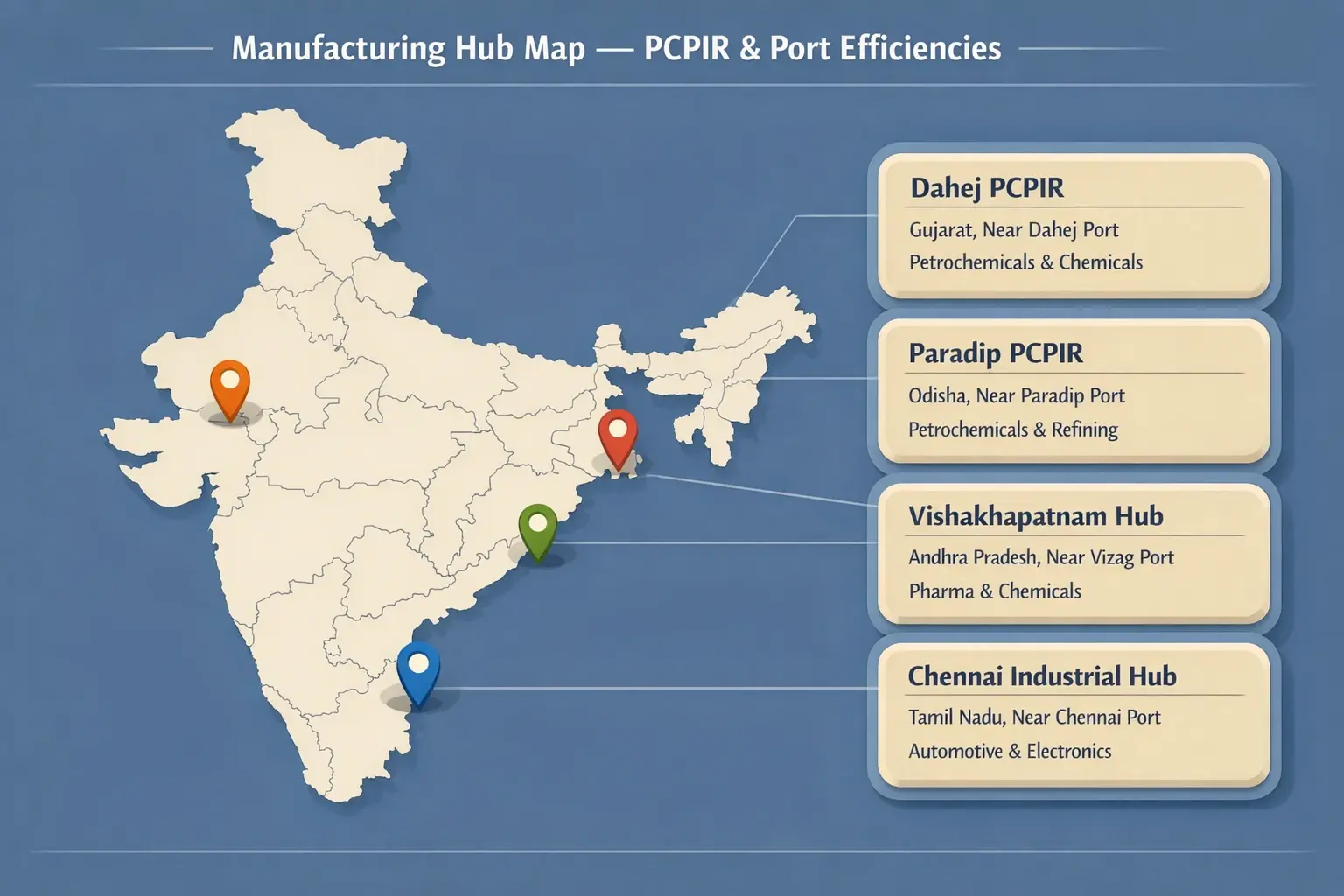
By mapping your specific molecule requirements to the right regional hub, you can significantly reduce inland transport times and mitigate hazardous-goods handling risks.
Risk Mitigation: Navigating the Regulatory Landscape
The biggest fear for any Procurement Director transitioning to a new market is a crisis: an impure batch arriving, a shipment held at customs due to weak hazmat documentation, or unexpected duties destroying margins.
The Indian government has recognized that to be a global player, quality cannot be optional. This has led to the implementation of stringent regulatory frameworks that Western buyers must actively manage.
Mastering BIS Certification and CMSR (India REACH)
- BIS (Bureau of Indian Standards) Quality Control Orders: To prevent the dumping of sub-standard chemicals, mandatory BIS certification is now active for over 150 chemical products. While this ensures higher purity and batch consistency, your sourcing partner must vigorously audit suppliers to ensure they possess valid, up-to-date BIS certifications. Missing documentation means port delays.
- CMSR (India REACH): As India aligns with global safety standards, navigating the complexities of chemical registration is vital. Proper management of SDS/COA, GHS-compliant labeling, and hazardous-goods declarations must be handled flawlessly before the product ever reaches the port.
This is where relying on fragmented brokers falls apart. Having a partner with deep on-ground presence in India and American-led compliance standards ensures that supplier vetting, batch QC, and export logistics are managed as one seamless, transparent operation.
Future-Proofing: The Rise of Green Chemistry
As Western manufacturers face increasing pressure to meet ESG (Environmental, Social, and Governance) targets, India is positioning itself as a leader in green chemistry. Driven by the ‘Make in India’ initiative, there is massive momentum behind bio-based polymers, eco-friendly agrochemicals, and sustainable water treatment solutions.
If your long-term roadmap includes sourcing more sustainable formulations without sacrificing performance, the Indian market currently offers a unique blend of high-level R&D capabilities and competitive commercial scaling.
Frequently Asked Questions (FAQ)
How do lead times from India compare to our existing China-based suppliers?
Ocean freight from India to the US or Europe generally has comparable or slightly longer transit times than China, depending on the routing. However, total lead time is often reduced when partnering with an agile, on-the-ground sourcing team that expedites sample turnarounds, secures fast quotes, and manages inland hazmat logistics efficiently.
How can we guarantee batch consistency and chemical purity?
Consistency is achieved through rigorous boots-on-the-ground supplier audits, not just desk research. By requiring strict adherence to BIS standards, enforcing pre-shipment batch QC, and maintaining flawless COA and SDS documentation, quality risks are neutralized before the product leaves the facility.
Are there hidden landed costs when sourcing from India?
Opaque pricing is a common frustration when evaluating new markets. A reliable sourcing partner eliminates this by providing a completely transparent landed-cost structure. You should have full visibility into ex-works pricing, inland freight, hazardous handling fees, port duties, and final delivery costs—with zero surprises.
Can Indian suppliers handle complex technical and packaging requirements?
Yes. India’s top-tier manufacturers are highly sophisticated, producing specialty chemicals for global giants in personal care, oil & gas, and coatings. The key is clearly translating Western technical specifications, packaging mandates, and GHS-compliant labeling requirements to the supplier—a process that requires strong, bilingual operational oversight.
Next Steps: Operationalizing Your India Strategy
Moving from market evaluation to operational execution doesn’t have to mean taking on massive operational risk or struggling through cultural and communication barriers.
A successful transition to the Indian chemical market requires an end-to-end approach. It requires bridging Western expectations for transparency, responsiveness, and compliance with the expansive capabilities of India’s supplier ecosystem.
When you are ready to diversify your supply chain, secure reliable landed costs, and partner with a team that treats your plant’s uptime as their own, you need more than a broker—you need a trusted sourcing infrastructure. By leveraging a comprehensive procurement process—from supplier qualification and batch QC to complex export logistics—you can confidently transform India into your most strategic supply chain advantage.