Imagine this: you’ve just received a highly competitive quote for food-grade sodium benzoate from a new supplier in India. The numbers look great, and it could significantly improve your margins. But a nagging question stops you from signing the PO: “How can I be certain this meets our quality and safety standards?”
You’ve heard acronyms like FSSAI and HACCP, but they feel like a complex puzzle. You worry about a shipment being rejected at port, a production batch being contaminated, or worse, a product recall—all because of a compliance detail you missed thousands of miles away.
This concern is not just valid; it’s what separates successful global sourcing from a costly mistake. For international businesses looking to tap into India’s vast chemical and food ingredient market, understanding the country’s food safety framework isn’t just a good idea—it’s the foundation of a reliable supply chain.
This guide will demystify that framework. We’ll break down the two most critical components, FSSAI and HACCP, transforming them from intimidating jargon into practical knowledge you can use to vet suppliers and source with confidence.

The Two Pillars of Food Safety in India: FSSAI & HACCP
Think of ensuring food safety like building a house. You need both a strict building code (the laws) and a solid architectural plan (the system) to ensure the final structure is safe. In India, FSSAI is the code, and HACCP is the plan.
What is FSSAI? The Official Rulebook
The Food Safety and Standards Authority of India (FSSAI) is the government body that lays down the law for food safety. It’s the central authority that regulates the manufacturing, storage, distribution, sale, and import of food products.
For a supplier of food-grade preservatives, an FSSAI license is non-negotiable. It’s their legal permission to operate. This license confirms they are registered with the government and are subject to its regulations and inspections.
Key takeaway: FSSAI sets the what—the standards, limits, and rules that must be followed.
What is HACCP? The Proactive Playbook
Hazard Analysis and Critical Control Points (HACCP) is a globally recognized system for managing food safety. Unlike FSSAI, which is a set of rules, HACCP is a proactive methodology. It’s about identifying potential hazards before they can happen and putting controls in place to prevent them.
Instead of just testing the final product and hoping it’s safe, a HACCP-certified facility has analyzed its entire process—from raw material intake to final packaging—to pinpoint and control any biological, chemical, or physical risks.
Key takeaway: HACCP provides the how—the systematic process for achieving and maintaining safety day in and day out.
How They Work Together: The Law and the System
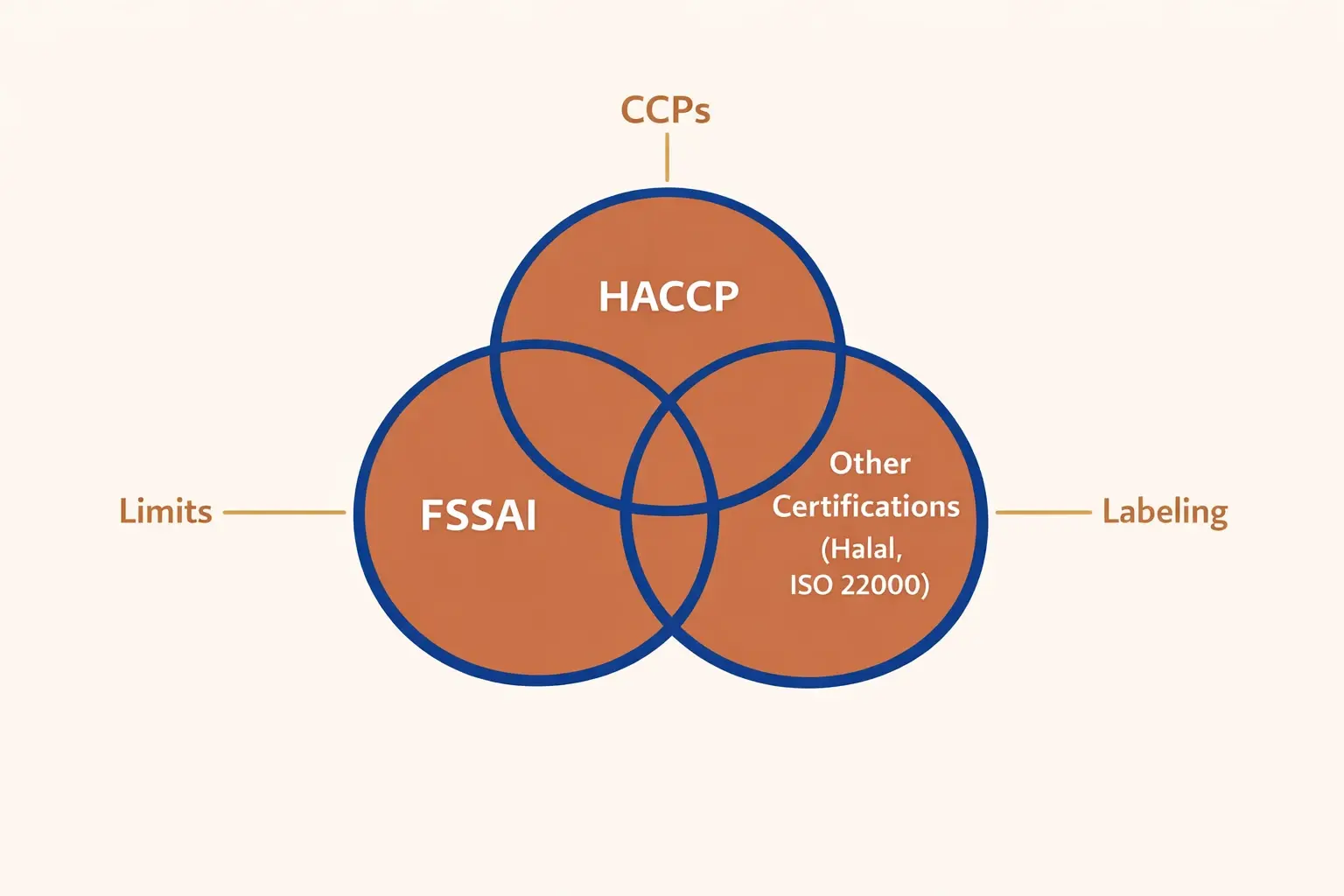
FSSAI and HACCP are not mutually exclusive; they are deeply connected. FSSAI’s regulations (the “rulebook”) often require food businesses to implement a robust Food Safety Management System (FSMS). HACCP is the most effective and internationally accepted “playbook” for building that system.
A supplier with both an FSSAI license and HACCP certification demonstrates a commitment to compliance at two levels: they are meeting the government’s legal requirements and are using a world-class system to manage their internal processes. For international buyers, this dual compliance is a powerful indicator of reliability and quality.
Decoding FSSAI Regulations for Food Preservatives
Simply knowing a supplier has an FSSAI license isn’t enough. The devil is in the details, especially when it comes to chemical additives like preservatives.
Preservative Classifications: Class I vs. Class II
FSSAI categorizes food preservatives into two main classes, and it’s crucial to know which you are sourcing:
- Class I Preservatives: These are natural preservatives. Think common salt, sugar, vinegar, honey, and spices. They are generally considered lower risk and have fewer usage restrictions.
- Class II Preservatives: These are synthetic chemical preservatives. This category includes chemicals like benzoates, sorbates, nitrites, and sulphites. They are highly effective but have strict permissible limits for use in different food products to ensure consumer safety.
Most international sourcing for industrial food production involves Class II preservatives, which fall under the highest level of FSSAI scrutiny.
The Three Biggest FSSAI Sticking Points for Preservatives
When evaluating an Indian supplier, your due diligence should focus on these three common challenge areas:
- Permissible Limits: FSSAI’s “Compendium of Food Additives Regulations” provides exhaustive tables listing which preservatives can be used in which foods and at what maximum level (measured in parts per million, or ppm). A reputable supplier must not only manufacture a pure product but also provide clear guidance on its appropriate, legal use according to these regulations.
- Labeling & Packaging: The regulations are incredibly specific about labeling. For a preservative, the label must clearly state its name, “Food Grade” designation, FSSAI license number, and other details. Incorrect labeling can cause an entire shipment to be rejected by customs.
- Documentation & Traceability: Every batch must be accompanied by a Certificate of Analysis (COA) confirming its purity and compliance with FSSAI standards. Furthermore, the supplier must be able to trace that batch back to the raw materials used, ensuring end-to-end quality control.
Implementing HACCP: A Practical Look at Preservative Safety
A HACCP certificate on the wall is nice, but what does it mean in practice? It means your supplier has a living, breathing system to prevent things from going wrong.
When discussing HACCP with a potential supplier, you’re not just asking “Are you certified?” You’re asking “How do you manage risk?” Here’s what that looks like through a preservative lens.
The 7 HACCP Principles in a Preservative Plant
A good supplier should be able to explain how they apply the core HACCP principles to their specific product.
- Conduct a Hazard Analysis: They’ve identified potential dangers. Example: The risk of heavy metal contamination from raw materials or cross-contamination from non-food-grade chemicals stored in the same facility.
- Identify Critical Control Points (CCPs): They know the exact steps in their process where control is essential to ensure safety. Example: The raw material testing stage, the chemical blending process, and the final filtration step are all likely CCPs.
- Establish Critical Limits: For each CCP, they have a defined, measurable limit for safety. Example: For the final product, a critical limit might be “Purity ≥ 99.8%” or “Lead content < 2 ppm.”
- Establish Monitoring Procedures: They have a system for continuously checking the CCPs. Example: Taking a sample from the blender every hour for lab analysis or using an in-line sensor to monitor temperature.
- Establish Corrective Actions: They have a pre-defined plan for what to do if a limit is breached. Example: If a batch test shows purity at 99.6%, the corrective action is to quarantine the entire batch and re-process it.
- Establish Verification Procedures: They regularly double-check that the whole system is working as intended. Example: Calibrating lab equipment quarterly or having a third-party audit their HACCP plan annually.
- Establish Record-Keeping: They document everything. This creates the paper trail that proves the system is functioning and provides full traceability.

Beyond the Basics: Quality Control and Export Readiness
True supply chain confidence comes from verifying the systems and standards your supplier claims to have. It’s crucial to understand how to verify a chemical supplier’s quality management system, which goes beyond just reviewing their FSSAI and HACCP certificates. It involves scrutinizing their testing methods, calibration records, and internal quality protocols.
Furthermore, as the India food certification market becomes more sophisticated, top-tier suppliers often hold additional certifications to cater to global markets. Certifications like Halal, Kosher, or ISO 22000 serve as further proof of a supplier’s commitment to quality and their capability to meet diverse international standards.
Frequently Asked Questions (FAQ)
What’s the basic difference between FSSAI and HACCP?
FSSAI is the law—a set of mandatory government regulations for all food businesses in India. HACCP is a systematic, proactive methodology for managing food safety hazards. A supplier needs an FSSAI license to operate legally and typically uses a HACCP system to ensure they meet FSSAI’s safety requirements consistently.
Are FSSAI and HACCP mandatory in India?
An FSSAI license is absolutely mandatory for any food business operator. While HACCP certification itself may not be explicitly mandated for all business types, implementing a Food Safety Management System (FSMS) based on HACCP principles is a requirement under FSSAI regulations for most manufacturers.
Can a product be FSSAI compliant but not have HACCP?
Technically, yes, a small-scale operator might have an FSSAI registration without a formal HACCP certification. However, for any manufacturer of a sensitive product like a Class II preservative, especially one intended for export, the lack of a HACCP-based system is a major red flag. It suggests a reactive, rather than proactive, approach to safety.
What are Class I and Class II preservatives again?
Class I preservatives are natural sources like salt, sugar, and vinegar. Class II preservatives are synthetic chemicals like sorbates, benzoates, and sulphites, which are subject to much stricter usage limits under FSSAI rules.
Your Path to Confident Sourcing
Navigating the world of food safety compliance can seem daunting, but it boils down to a few core principles. FSSAI provides the legal foundation, HACCP offers the operational framework, and rigorous verification ensures that the standards you expect are the standards you get.
By understanding these elements, you can move beyond simply comparing prices and start having more meaningful conversations with potential Indian suppliers. You are now equipped to ask about their systems, probe their quality control processes, and ultimately, build a resilient, safe, and compliant supply chain that serves as a competitive advantage.