You’ve found a promising supplier in India for a critical pharmaceutical intermediate. The price is right, the initial specs look good, and it could be a game-changer for your supply chain. But a nagging question keeps you up at night: “How can I be absolutely sure they meet US FDA standards?”
It’s a valid concern. The path from an Indian manufacturing plant to your US production facility is paved with complex regulatory requirements. A single compliance misstep can lead to costly delays, batch rejections, or even FDA import alerts.
But here’s the other side of the coin: India is a global powerhouse in pharmaceutical manufacturing, home to the largest number of FDA-approved plants outside the US. For every story of a compliance headache, there are dozens of success stories of companies building robust, cost-effective, and resilient supply chains.
The difference? A deep understanding of the vetting and documentation process. This isn’t about just checking a box; it’s about building a partnership grounded in quality and transparency.

First, Let’s Talk Basics: What Are We Really Sourcing?
Before diving into compliance, it’s crucial to be clear on terminology. In the pharmaceutical world, words have very specific meanings.
A Pharmaceutical Intermediate is a material produced during the synthesis of an Active Pharmaceutical Ingredient (API). It’s a stepping stone, not the final drug substance.
An Active Pharmaceutical Ingredient (API) is the biologically active component in a finished drug product. This is the substance that produces the intended therapeutic effect.
Why does this distinction matter? Because regulatory scrutiny, specifically for Current Good Manufacturing Practice (cGMP), intensifies as you move closer to the final API. According to the globally recognized ICH Q7 guidelines, cGMP standards are applied progressively from the synthesis of the first “regulatory starting material” onward. This means the compliance requirements for an early-stage intermediate might differ from those for one produced just before the final API step.
The Non-Negotiables: Understanding cGMP and the DMF
If you take away only two acronyms from this guide, make them cGMP and DMF. They are the bedrock of FDA compliance for any pharmaceutical product sourced from India.
What is cGMP (Current Good Manufacturing Practice)?
Think of cGMP as the fundamental rulebook for ensuring quality, safety, and efficacy. It’s not a one-time certificate but a continuous system governing every aspect of production and testing—from raw material receipt to final product release.
For the FDA, “Current” is the key word. It means suppliers can’t rely on outdated processes; they must continuously adapt to the latest standards and technologies. cGMP compliance covers:
- Properly maintained equipment and facilities
- Well-trained personnel
- Robust quality control and testing procedures
- Reliable and documented processes for every step
A supplier claiming cGMP compliance should be able to prove it through rigorous documentation and be ready for an audit at any time.
What is a Drug Master File (DMF)?
A Drug Master File is a confidential submission to the FDA containing detailed information about the facilities, processes, or articles used in the manufacturing, processing, packaging, and storing of a human drug.
Imagine it as the supplier’s secret recipe book. They file it directly with the FDA to protect their intellectual property while allowing the agency to review their process when you reference their DMF in your own drug application.
For intermediates and APIs, a Type II DMF is the most common. A crucial point to remember: a DMF filing is not an approval. It simply means the documentation is on file. The FDA only reviews the DMF in the context of a specific drug application. A supplier having a DMF is a sign of regulatory maturity, but it’s just the first step in your due diligence.
Beyond the Certificate: A Multi-Stage Approach to Vetting Suppliers
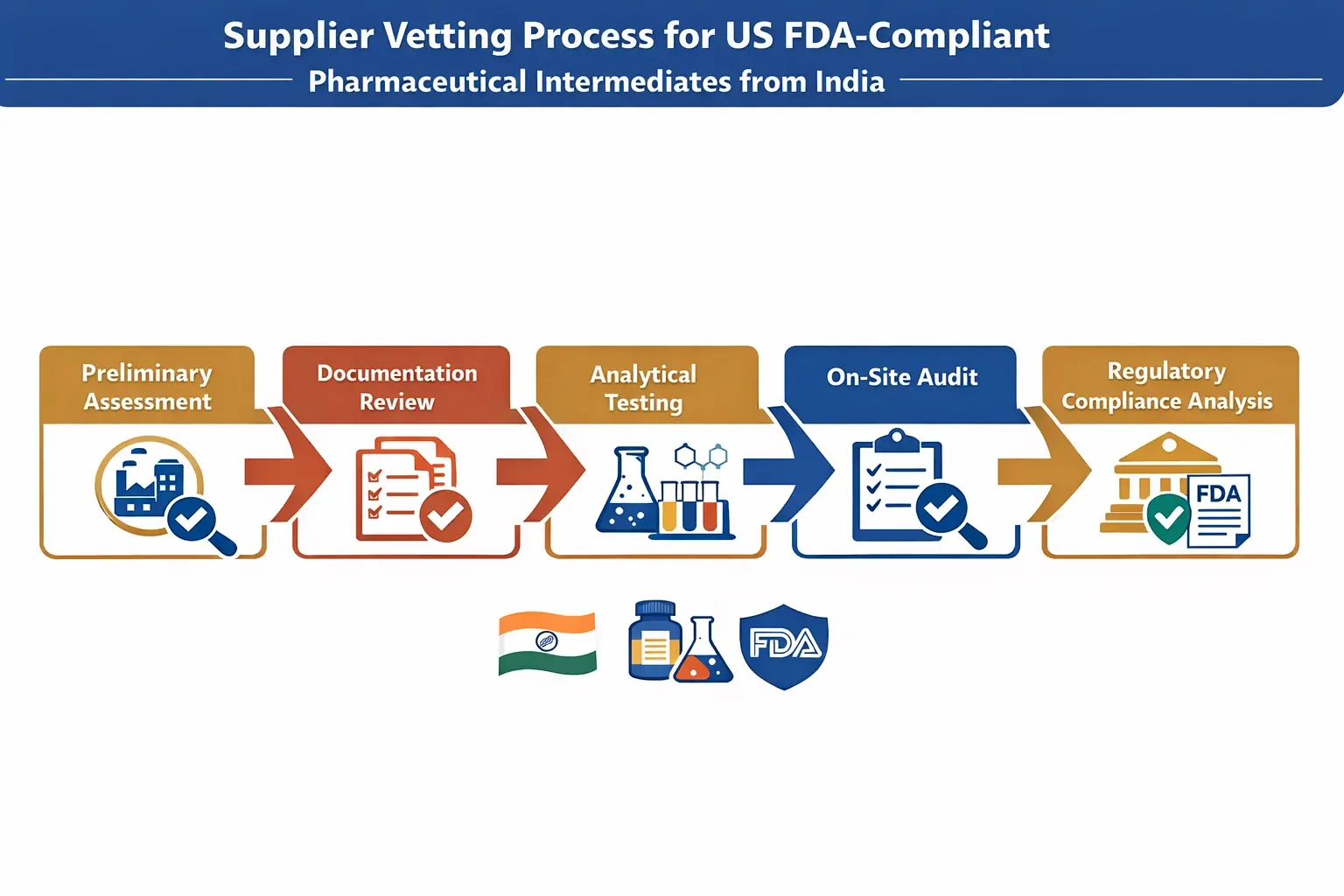
A GMP certificate and a DMF number are starting points, not finish lines. Truly vetting a supplier requires a multi-layered approach that moves from paper verification to on-the-ground reality.
Stage 1: The Initial Paper Chase (Documentation Deep Dive)
Before you even think about an audit, gather and scrutinize the essential documents.
- Request Certificates of Analysis (CoA) for multiple recent batches. Don’t just look at one. You’re searching for consistency in purity, impurity profiles, and other key specifications. Wide variations are a red flag.
- Verify the DMF status. Confirm the DMF number and its current status with the supplier.
- Review Quality Agreements. Ask if they have existing Quality Agreements with other US or European clients. This shows their familiarity with Western regulatory expectations.
Stage 2: Digging Deeper into the Regulatory Track Record
This is where you play detective. A supplier’s history with the FDA is publicly available and offers invaluable insight.
- Check the FDA Warning Letter and Import Alert databases. These are serious compliance breaches and significant red flags.
- Look for FDA Form 483s. An FDA inspector issues a Form 483 when they observe conditions that may violate regulatory standards. Look for patterns in these observations. Are there recurring issues with data integrity, laboratory controls, or handling out-of-specification (OOS) results? These can point to systemic weaknesses. A history of unresolved issues is a strong indicator of future problems, including shipment holds or a potential FDA detention.
Stage 3: The On-Site Audit (The Ultimate Litmus Test)
You can’t truly know a supplier until you see their operations firsthand (or hire a trusted partner to do it for you). An on-site audit verifies that the procedures documented on paper are actually being followed on the production floor.
Key areas to focus on during an audit:
- Traceability: Can they trace a single batch from raw materials to final shipment?
- Change Control: Do they have a robust system for managing and documenting any changes to their process?
- OOS Investigations: When a batch fails a test, do they conduct a thorough investigation to find the root cause, or do they just “test into compliance”? This is a critical indicator of a company’s quality culture.
Strategic Sourcing: Looking Beyond the Unit Price
Once you’ve confirmed a supplier meets the baseline for compliance, the next step is to evaluate them as a long-term strategic partner. This involves looking at risks that aren’t always listed on a CoA.

The Hidden Risk: India’s KSM Dependency
A crucial but often overlooked risk is India’s reliance on China for certain Key Starting Materials (KSMs)—the foundational building blocks for many intermediates and APIs. Geopolitical tensions, new environmental regulations in China, or even a localized lockdown can disrupt the flow of KSMs, creating a bottleneck that impacts your Indian supplier and, ultimately, your production line.
When vetting a supplier, ask about their KSM sourcing strategy:
- Do they have multiple KSM suppliers?
- Are any of their sources outside of China?
- What is their buffer stock strategy for critical KSMs?
Building a Resilient & Responsible Supply Chain
A truly strategic approach considers the Total Cost of Ownership, not just the per-kilo price. This includes factoring in the potential costs of delays, quality failures, and supply disruptions. Forward-thinking companies are also integrating broader ethical considerations into their vetting, evaluating suppliers on ESG standards in India & Bangladesh to ensure long-term partnership stability and corporate responsibility.
Frequently Asked Questions
What’s the main difference between sourcing an intermediate vs. a final API?
The main difference is the level of cGMP scrutiny. While cGMP principles apply to both, the requirements become more stringent the closer the material is to the final API. Documentation and process controls for a final API are typically more rigorous than for an early-stage intermediate.
Does a DMF mean the product is FDA-approved?
No. This is a common misconception. A DMF is a confidential submission that the FDA reviews only when referenced in a drug application. The existence of a DMF indicates regulatory maturity, but it is not a stamp of approval on its own.
How long does supplier qualification take?
It varies, but it should never be rushed. While the typical lead times for specialty chemical orders from India can be attractive, a thorough qualification process—from initial documentation review to on-site audit and sample testing—can take several months. Investing this time upfront prevents much costlier problems down the road.
Can small or mid-sized firms effectively source from India?
Absolutely. While smaller firms may not have the resources for a dedicated team to live on-site, they can be highly effective by leveraging experienced sourcing partners. A reliable “boots-on-the-ground” partner can manage the complexities of supplier audits, quality control, and logistics, leveling the playing field and providing access to top-tier suppliers.
Your Path Forward: From Learning to Confident Sourcing
Sourcing pharmaceutical intermediates from India presents a tremendous strategic opportunity. By moving beyond a simple price comparison and embracing a rigorous, multi-stage vetting process, you can mitigate risk and build a supply chain that is not only cost-effective but also compliant, resilient, and reliable.
The journey begins with asking the right questions—about cGMP, DMFs, regulatory history, and hidden risks like KSM dependency. By arming yourself with this knowledge, you transform the daunting task of international sourcing into a manageable, strategic process that can become a true competitive advantage.