If you are a procurement director or category lead evaluating Indian chemical suppliers right now, the regulatory landscape has just shifted beneath your feet.
As part of a broad “China +1” diversification strategy, buying chemicals from India makes unquestionable economic sense. The supplier ecosystem in hubs like Gujarat and Maharashtra is massive and highly capable. However, as of late 2025, the Indian government rescinded mandatory Quality Control Orders (QCOs) for several high-volume chemicals—including Polyethylene, PVC, Methanol, and Acetic Acid—to reduce the compliance burden on micro, small, and medium enterprises (MSMEs).
According to CIRS Group and ChemRadar, while this deregulation speeds up local production, it fundamentally shifts the burden of quality assurance directly onto your shoulders. When regulatory training wheels come off, the unspoken risks of the MSME-dominated Indian supply chain—specifically batch inconsistency and Certificate of Analysis (COA) forgery—become your primary operational threats.
This guide moves beyond generic surface-level inspection advice. We are going to look specifically at how to implement chemical-specific quality assurance, advanced analytical testing, and end-to-end batch traceability when sourcing from India, ensuring the batch of specialty chemical you buy today performs identically to the one you bought last month.
Verifying Certificates of Analysis (COA) for Indian Chemical Exports
Let’s address the most common frustration for global sourcing managers: you receive a pristine COA, but the bulk chemical arrives and when adding feedstock to production, its specifications are not as promised, not only do you have a bad batch, you also have to halt production. QIMA’s recent industry reports (Supply Chain Barometers) highlight that India consistently shows higher violation rates in health, safety, and compliance practices compared to other Asian hubs. This discrepancy often begins with documentation.
Evaluating an Indian supplier requires treating the COA not as a guarantee, but as a claim that requires verification. The reality is that document doctoring is a known risk among lower-tier suppliers trying to bypass strict export requirements.
To protect your supply chain, you need a systematic evaluation framework before you ever approve a sample.
The 5-Point COA Audit for Indian Suppliers
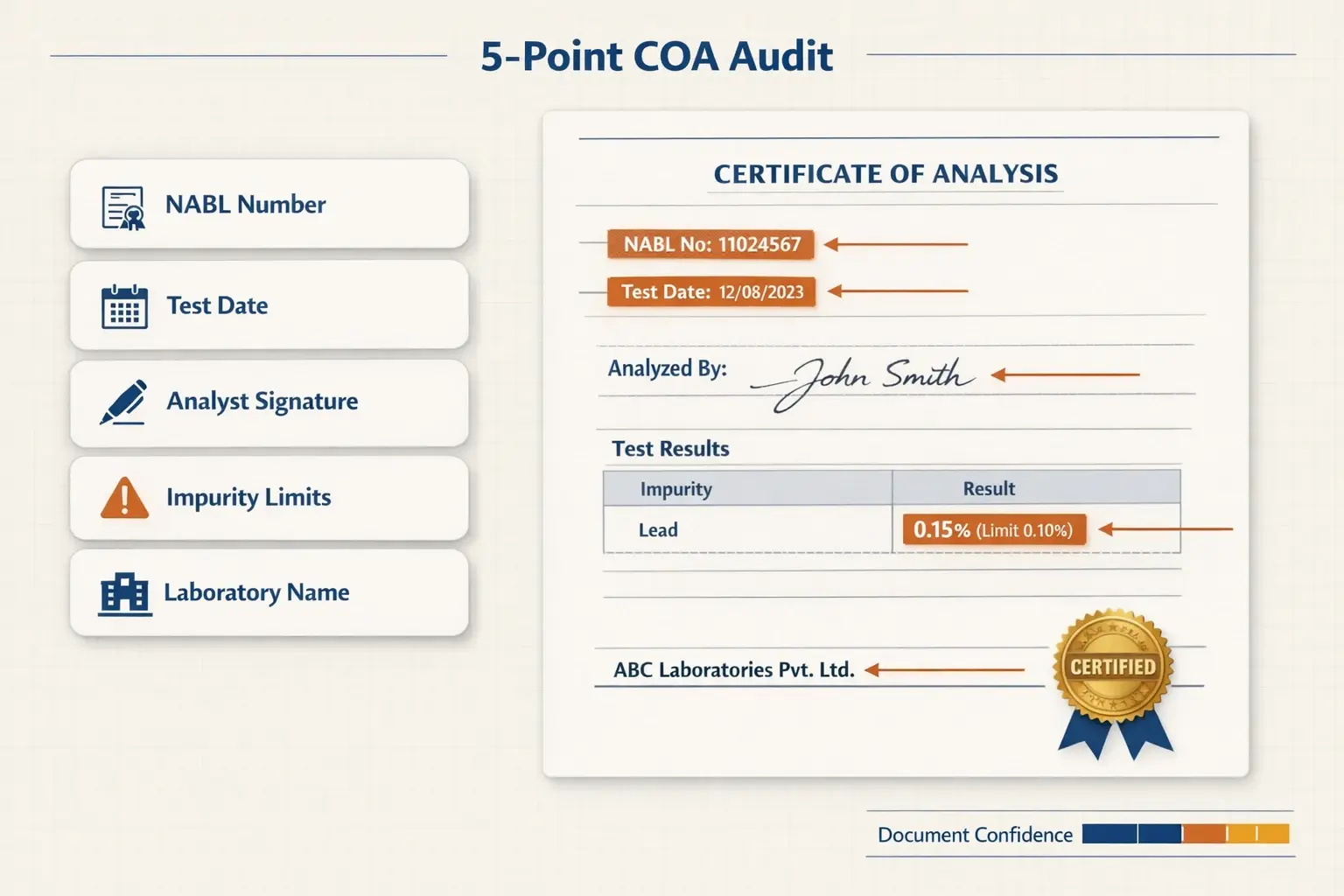
When reviewing a COA from a prospective Indian vendor, put it through this rigorous 5-point check:
- NABL Accreditation Verification: Do not just look for the NABL (National Accreditation Board for Testing and Calibration Laboratories) logo. Look for the specific certificate number and cross-reference it on the NABL India portal to ensure their accreditation is active for the specific chemical scope being tested.
- Date Stamping & Metadata: A common red flag is a test date that predates the manufacturing date, or metadata in the PDF that shows recent edits to a supposedly older document.
- Equipment Specification: A legitimate COA for specialty chemicals will list the exact methodology used (e.g., GC-MS, HPLC). If the COA simply states “Titration” for a high-purity pharmaceutical intermediate, push back immediately.
- Signatory Cross-Check: Verify the lead chemist’s name on LinkedIn or via direct inquiry. High-turnover labs sometimes use signatures of personnel who left the company months prior.
- Impurity Range vs. Exact Value: Be highly skeptical of COAs that perfectly list the specification limit (e.g., <0.01%) rather than the actual detected analytical value (e.g., 0.004%). True lab results are rarely round numbers.
Advanced Analytical Testing & Impurity Profiling for Chemicals from India
Standard pre-shipment inspections are fine for verifying drum counts and GHS-compliant labeling, but they cannot tell you if an agrochemical intermediate has drifted in its impurity profile.
When evaluating Indian chemical suppliers, the conversation must shift from “What is the purity?” to “What are the impurities?” A 99% pure chemical leaves 1% of unknown variables—and in industries like personal care, oil & gas, or coatings, that 1% can cause catastrophic formulation failures.
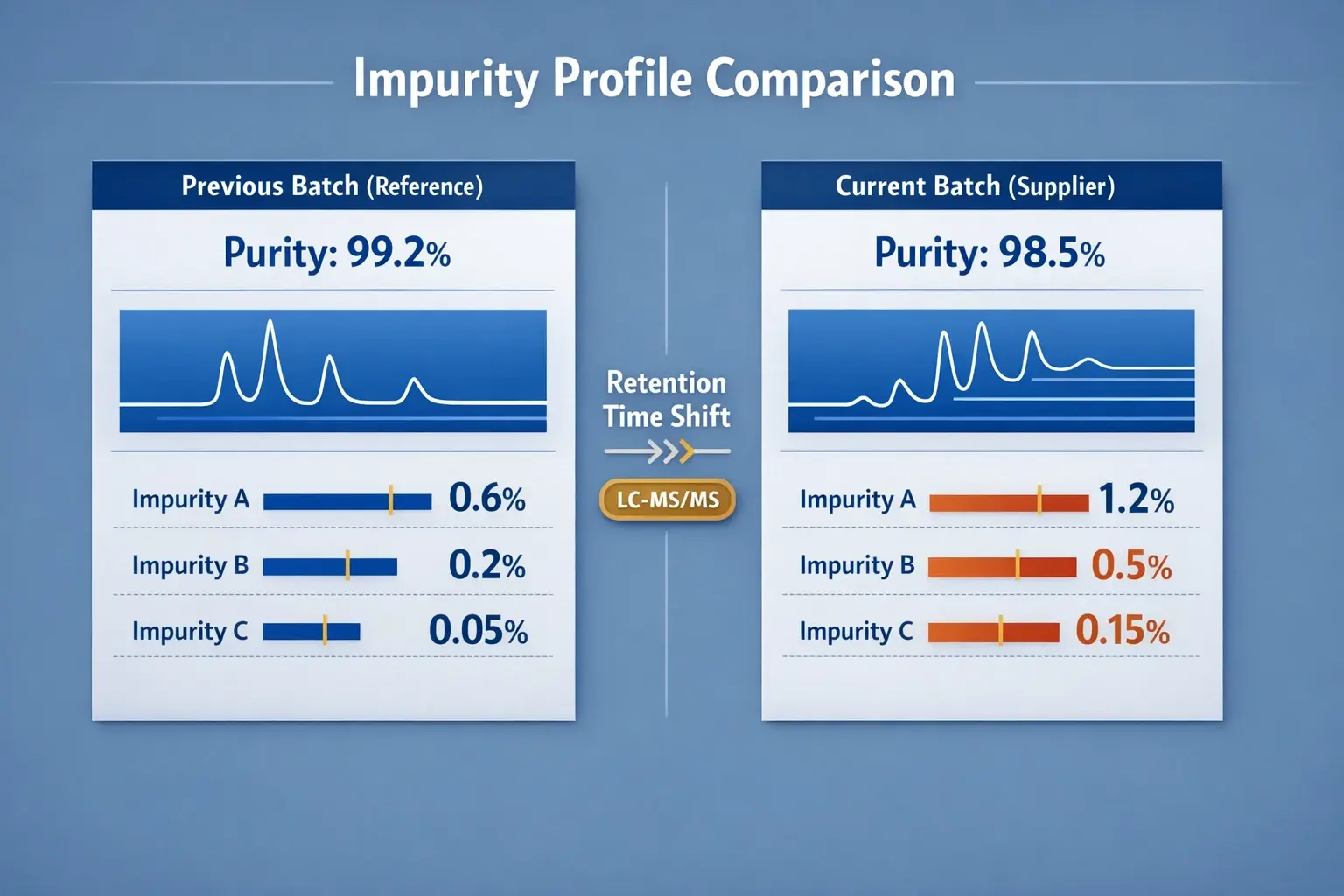
You need to know how the factory’s output aligns with your domestic standards. For example, Indian BIS (Bureau of Indian Standards) limits for heavy metals might be perfectly legal for domestic consumption but fail EU REACH or US TSCA standards.
To bridge this gap, top-tier sourcing operations require advanced analytical testing frameworks:
- Liquid Chromatography-Mass Spectrometry (LC-MS/MS): Essential for detecting trace organic impurities in specialty and performance chemicals.
- Inductively Coupled Plasma Mass Spectrometry (ICP-MS): The gold standard for identifying heavy metal contamination, frequently utilized by trusted local labs like ITC Labs.
When setting up your supplier agreement, mandate that impurity profiling is conducted on the first three commercial batches. This establishes a baseline and proves whether the supplier’s manufacturing process is truly stable or prone to erratic thermal degradation.
Implementing Batch Traceability Systems for Indian Chemical Supply Chains
Traceability is the ultimate insurance policy against batch-to-batch inconsistency. However, implementing it in India requires understanding the technological reality of the landscape.
According to analysis by TCS iON, only the top 10% to 15% of Indian chemical firms have adopted IoT with Blockchain for tamper proof and decentralized supply chain traceability. The remaining 85% still rely on manual data entry or legacy ERP systems. You cannot expect a mid-sized formulator in Ahmedabad to seamlessly integrate with your cloud-based SAP system on day one.
You need a practical bridge between their physical factory floor and your digital requirements.
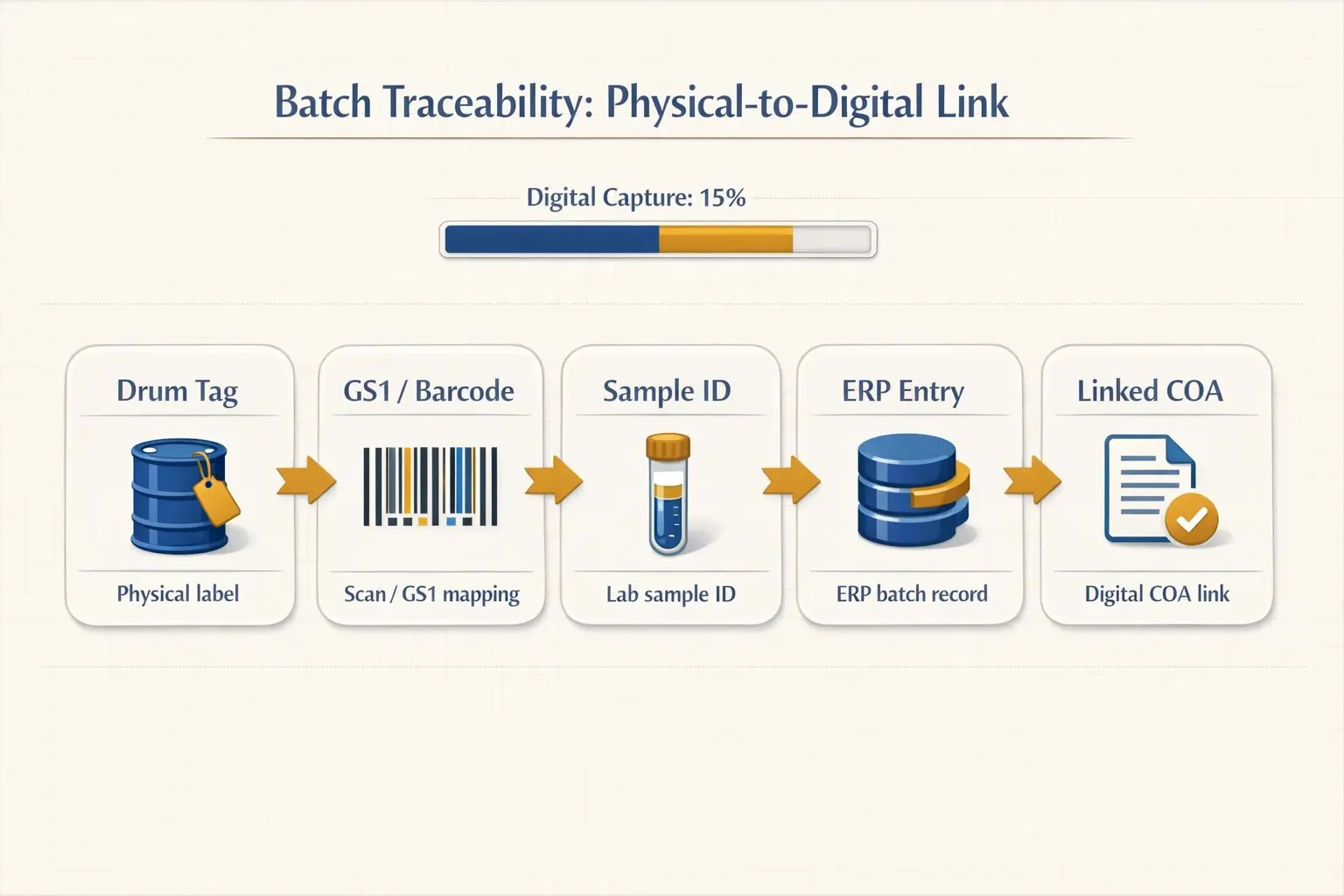
Bridging the Physical-to-Digital Gap
The key to robust traceability in the Indian market is standardizing the physical labeling before it leaves the factory. Implementing GS1 India standards allows you to link a physical drum sticker directly to its corresponding digital footprint.
Your on-the-ground team should ensure that:
- Raw Material Tracking: The supplier can prove exactly which batch of domestic raw materials went into your finished product.
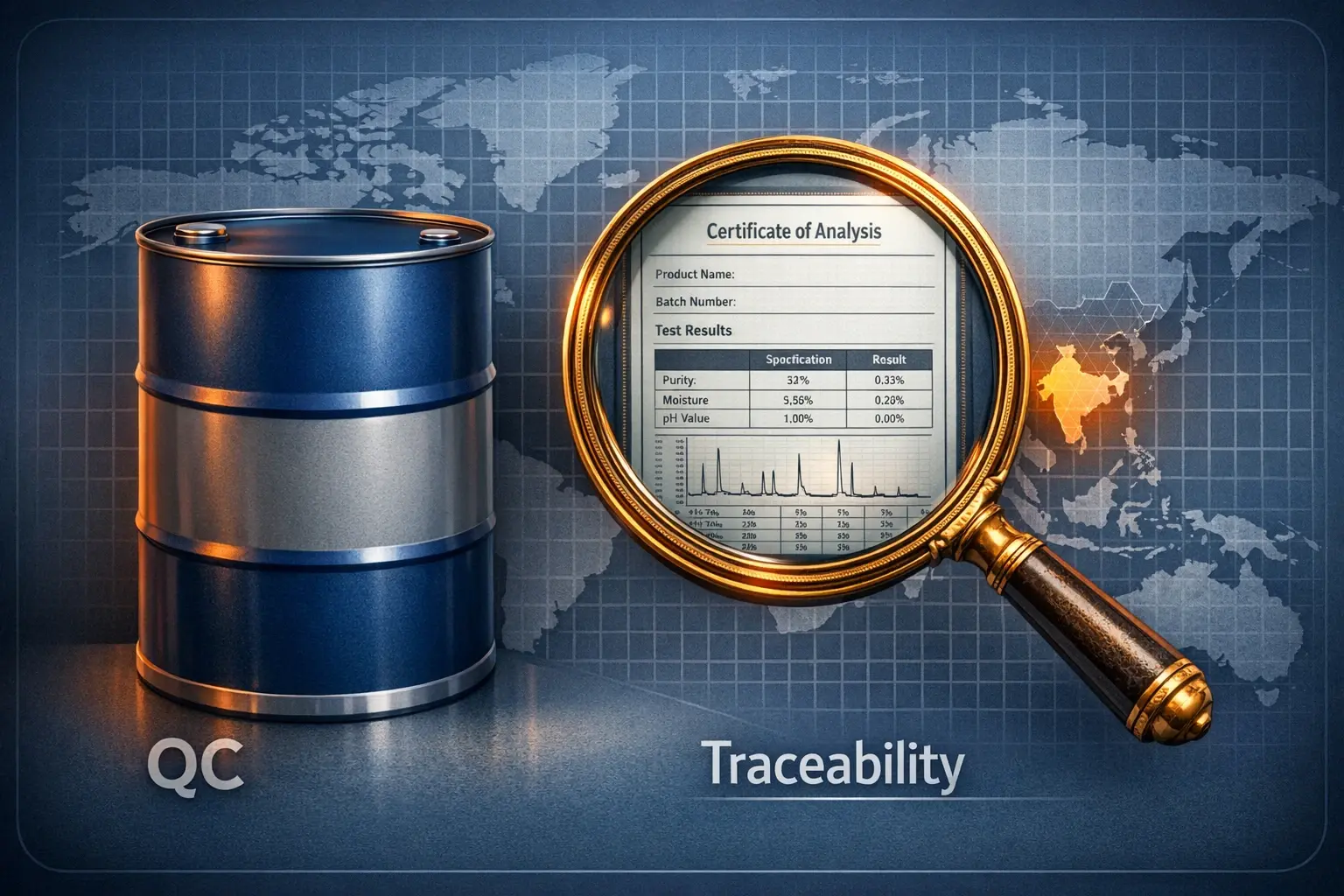
- Batch Serialization: Every drum, IBC, or ISO tank receives a unique identifier that ties back directly to the time-stamped LC-MS/MS chromatogram.
- Chain of Custody Documentation: From the factory floor in Gujarat to the port in Mumbai, ensuring hazardous-goods logistics and SDS/COA packets move in lockstep with the physical cargo to avoid customs delays.
Independent Lab Testing & Quality Verification: Selecting the Right Partner
You know you need third-party verification, but who should actually pull the sample and run the test? In India, buyers typically choose between massive global Testing, Inspection, and Certification (TIC) companies and highly specialized regional laboratories.
Global giants like QIMA and SGS provide excellent high-level authority and deep “E-A-T” (Expertise, Authoritativeness, Trustworthiness). They are ideal for baseline factory audits and container loading supervision. However, for deep, chemical-specific analytical testing, specialized Indian labs—such as Vimta Labs (leading Indian contract research and testing organization) or ITC Labs—often provide faster turnaround times, localized supply chain context, and deeper analytical depth for complex formulations.
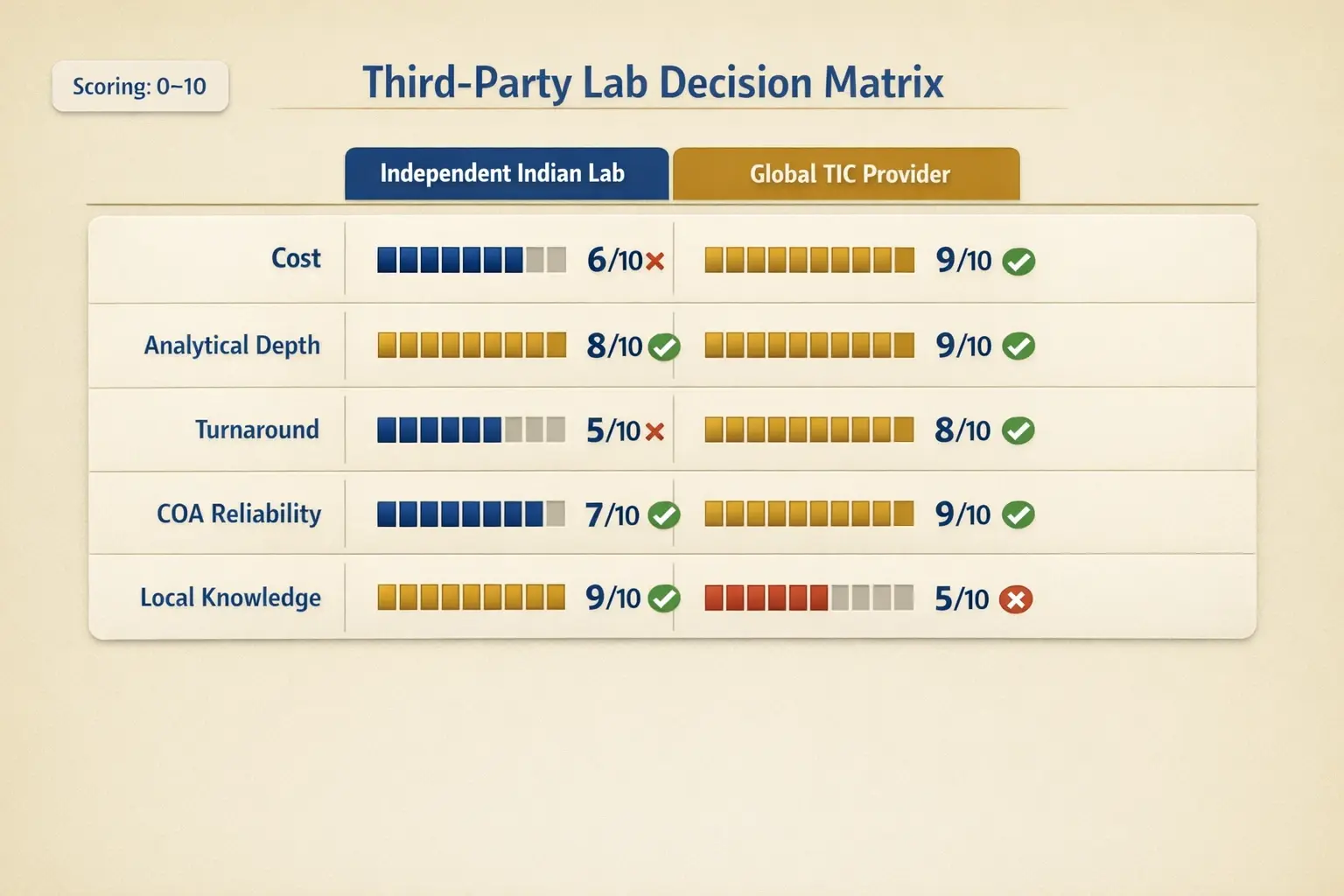
The most secure approach is a hybrid model: use an on-the-ground procurement partner who understands Western expectations to physically draw the sample at the factory, and then route that sample to an independent, NABL-accredited Indian lab for specific impurity profiling. This removes the supplier’s ability to “cherry-pick” the golden sample they send out for testing.
Strategies for Managing Batch-to-Batch Consistency in Indian Sourcing
Procurement leaders often fear that working with India means sacrificing the consistency they enjoy with their legacy European or domestic suppliers. It doesn’t have to be that way, provided you replace assumptions with process.
To manage consistency over the long term, you need boots on the ground. You cannot effectively audit a specialty chemical facility in Maharashtra from a desk in Chicago.
Partnering with an American-led, India-based sourcing operation bridges this cultural and operational divide. It gives you the tenacity and compliance discipline of a Western team, seamlessly integrated into India’s expansive supplier ecosystem. By having a single point of contact manage supplier vetting, batch QC, hazardous-goods logistics, and transparent landed-cost structures, you transform a reactive supply chain into a strategic advantage. You maintain plant uptime, eliminate hidden costs, and confidently access India’s manufacturing power without the operational risk.
Frequently Asked Questions
How do the recent 2025 QCO rescissions affect my chemical imports from India?
The rescinding of Quality Control Orders for chemicals like Polyethylene, PVC, and Methanol reduces mandatory BIS certification burdens on Indian MSMEs. While this improves supplier availability and pricing, it shifts the responsibility of quality assurance directly to you. You can no longer rely on government BIS marks as a default guarantee of purity; strict, independent COA auditing is now mandatory.
What is the most common reason for chemical shipments getting delayed at Indian ports?
Weak or non-compliant hazardous materials (hazmat) documentation. Mismatched batch numbers on the physical drum labels versus the SDS/COA documents will trigger immediate customs holds. Utilizing GS1 standard traceability and having an expert manage the export logistics prevents these paperwork mismatches.
How can I ensure the landed cost quoted is accurate and free of hidden fees?
Hidden costs in chemical sourcing usually hide in inland freight, hazardous handling surcharges, and port duties. Work with a sourcing partner who provides full landed-cost visibility upfront. Ensure your initial quote includes specific line items for batch testing, export documentation, and hazmat logistics.
Can mid-sized Indian suppliers meet US and EU compliance standards (TSCA/REACH)?
Absolutely. Many Indian MSMEs possess state-of-the-art manufacturing capabilities but lack the internal regulatory teams to handle TSCA or REACH paperwork smoothly. An experienced end-to-end sourcing partner acts as the compliance bridge, ensuring the factory’s output is mapped flawlessly to your domestic regulatory requirements.
What should I do if a supplier’s sample is perfect, but the commercial batch shows different impurities?
This is known as impurity drift. To prevent it, stipulate in your contract that an independent, NABL-accredited lab must draw samples from the actual commercial production line before container loading. Compare the LC-MS/MS impurity profile of the bulk batch against the initial sample baseline before approving shipment.