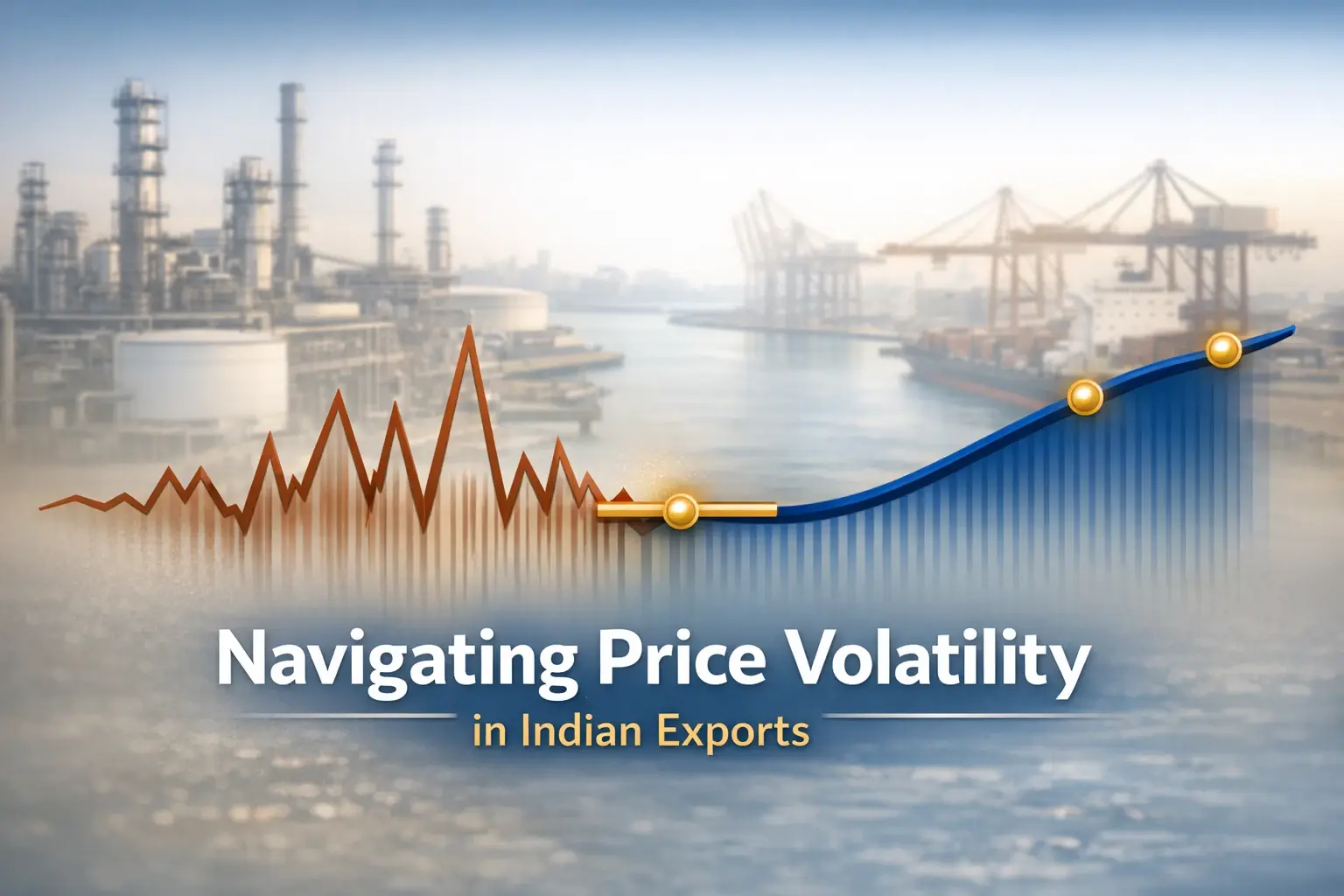
You’ve done the work. You’ve vetted suppliers, negotiated terms, and budgeted for your next chemical shipment from India. Then, an email arrives. Due to a sudden spike in feedstock prices due to the Strait of Hormuz blockade, your supplier has to revise their quote upwards. A stable commodity has veered into the spot market. Your carefully planned budget is now at risk, and you’re left scrambling to understand what happened and how to prevent it next time.
If this scenario feels familiar, you’re not alone. As international buyers are increasingly exposed to a complex and often misunderstood factor: raw material price volatility, India is emerging as a reliable emerging manufacturer that can meet demand at high volumes and high standards. Understanding this volatility isn’t just a market research exercise; it’s the key to achieving the transparent, predictable landed costs your business depends on.
This guide will demystify the forces driving Indian chemical costs, show you how they ripple through the supply chain to your final invoice, and equip you with practical strategies to manage the risk.
The Hidden Driver: Why Raw Material Prices Dictate Your Landed Costs
At its core, raw material price volatility is the unpredictable fluctuation in the cost of basic feedstocks used to manufacture chemicals. For India’s chemical industry, these are primarily derivatives of crude oil and natural gas.
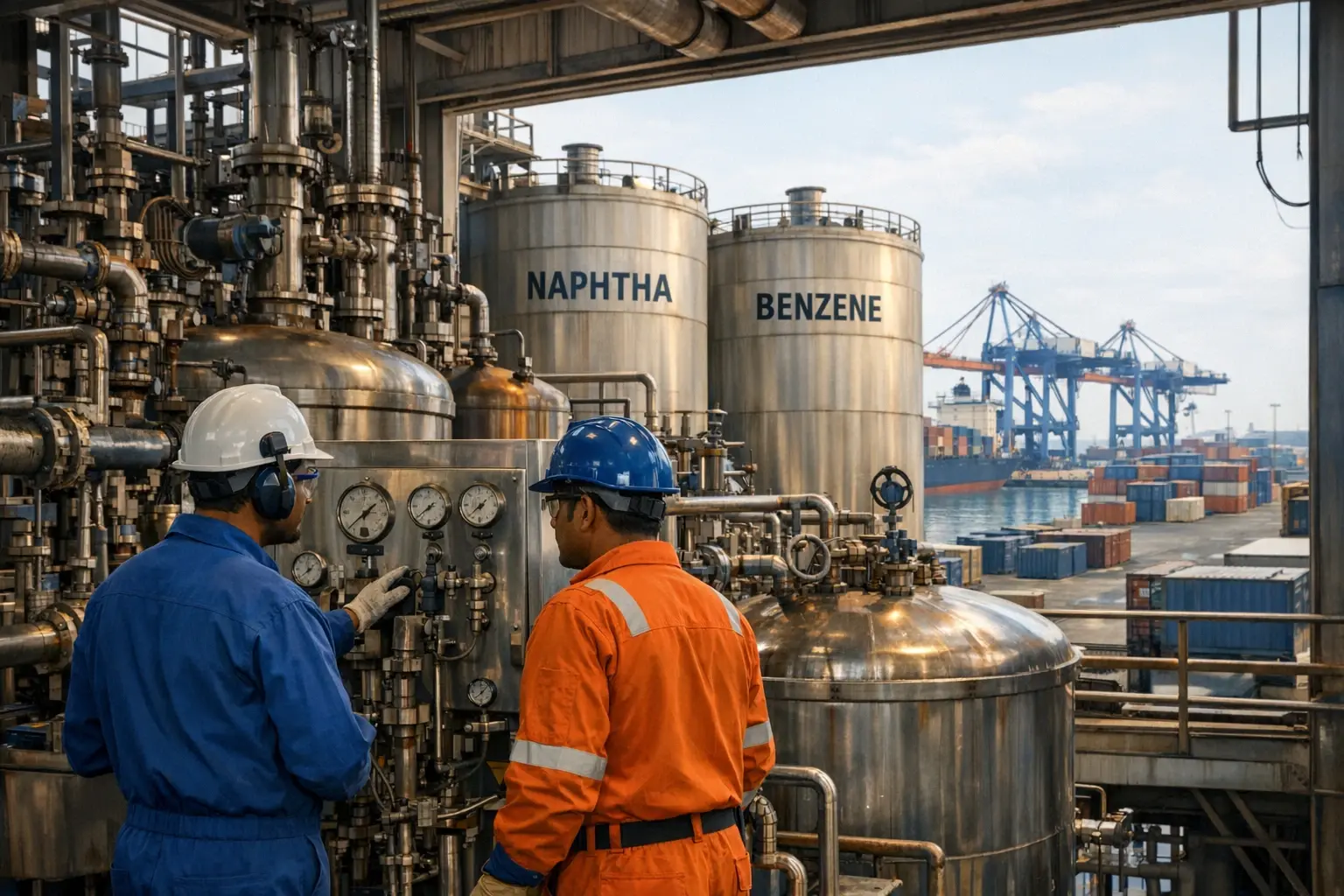
The most influential feedstocks include:
- Naphtha: A primary building block for producing plastics, solvents, and other organic chemicals. Its price is directly tied to global crude oil prices.
- Benzene: A key intermediate used to make everything from plastics and synthetic fibers to resins and lubricants.
- Ethylene & Propylene: Foundational chemicals for a vast range of polymers and industrial products.
A 2023 report from India’s Ministry of Chemicals and Fertilizers highlighted that raw material costs can account for 40-60% of the total production cost for many specialty chemicals. This means a seemingly small 10% jump in the price of naphtha doesn’t just raise costs by a little—it can trigger a significant increase in the final export price you pay.
As more companies adopt a “China +1” strategy to diversify their supply chains, understanding these fundamental cost drivers in India becomes critical for maintaining a competitive edge.
From Feedstock to Your Dock: Tracing the Cost Journey
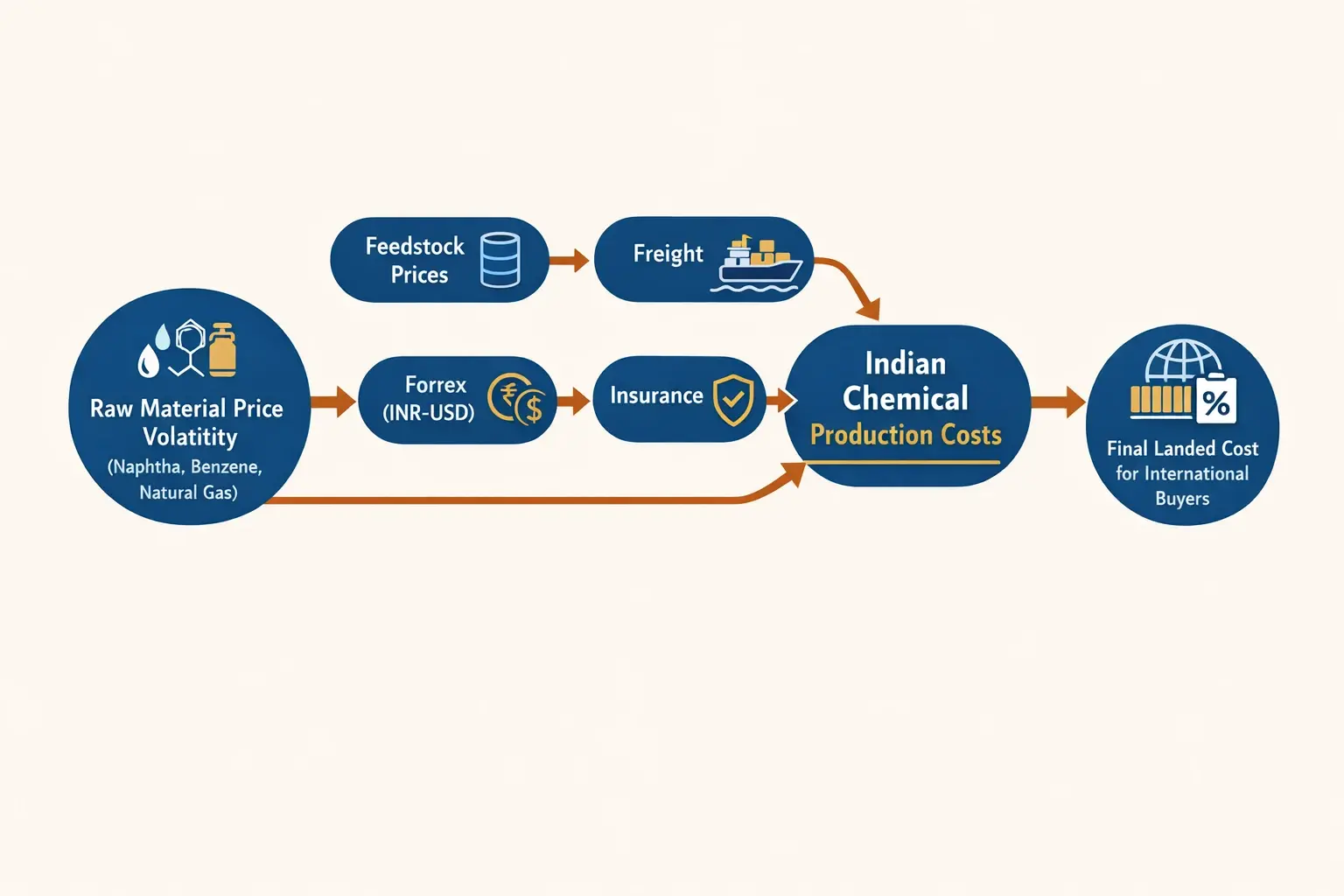
It’s easy to see price volatility as a single, abstract problem. In reality, it’s a chain reaction where global events translate directly into the numbers on your landed cost sheet.
Here’s how it works:
- Global Event Trigger: A geopolitical event in the Middle East, a change in OPEC+ production quotas, or shifts in China’s industrial demand causes global crude oil prices to spike.
- Feedstock Price Increase: Since India is a major importer of crude oil, the cost for Indian refineries to produce feedstocks like naphtha and benzene rises almost immediately.
- Producer’s Cost Rises: The Indian chemical manufacturer who uses that naphtha to produce a specialty solvent now faces higher input costs. This pressure is compounded by volatile energy costs (linked to natural gas) and domestic logistics expenses.
- Export Price Adjustment: The manufacturer passes this increased cost into their Free on Board (FOB) export price to protect their margins.
- Landed Cost Impact: This new FOB price is just the beginning for you, the buyer. The final landed cost also includes ocean freight, insurance, customs duties, and currency conversion—all of which can have their own volatility.
This entire process creates a ripple effect where a headline about oil prices one week can become a budget variance on your desk a few weeks later.
An “Aha” Moment on Currency: The Rupee Myth
Many buyers assume that a weakening Indian Rupee (INR) against the US Dollar (USD) automatically means cheaper imports. This is a common and costly misconception.
While a weaker Rupee can theoretically lower the USD-denominated price, savvy Indian exporters often see it as an opportunity to reclaim margin lost to rising raw material costs. Instead of passing the currency savings on to you, they may hold their USD price steady. The result? The supplier benefits, while you see no reduction in your landed cost. True cost transparency requires looking beyond just the exchange rate.
Mastering the Uncertainty: A Strategic Playbook for International Buyers
Volatility is a market constant, but it doesn’t have to cause chaos in your supply chain. Proactive procurement leaders can mitigate these risks with a combination of smart negotiation, financial awareness, and strong supplier partnerships.
Proactive Procurement & Supplier Collaboration
Your relationship with your Indian supplier is your first line of defense. Instead of just negotiating on price, focus on building a transparent partnership.
- Discuss Price Adjustment Clauses: For long-term contracts, consider negotiating pricing formulas tied to a public index for the key raw material (e.g., Platt’s for naphtha). This creates a predictable, transparent system for price adjustments that feels fair to both sides.
- Demand a Landed Cost Breakdown: A trustworthy supplier or sourcing partner should be able to provide a clear, itemized breakdown of your total landed cost. This allows you to see exactly where costs are coming from—FOB price, freight, insurance, duties—and identify which components are most volatile.
- Prioritize Supplier Reliability: When sourcing from a new market, a comprehensive supplier qualification is non-negotiable. A reliable supplier is more likely to provide advance warning of price changes and work with you to find solutions.
Financial Risk Management Tools
While your Indian supplier manages their own risks, your organization has tools to manage its exposure as well.
- Forward Contracts: Your treasury or finance department can use forward contracts to lock in a specific exchange rate for a future payment, removing currency fluctuation from the equation.
- Commodity Hedging: For very large, consistent purchases, your company may be able to use financial instruments like futures or options to hedge against dramatic swings in the underlying commodity (e.g., crude oil). This is an advanced strategy but is a powerful tool for achieving budget certainty.
Building Supply Chain Resilience
Price isn’t the only volatile element. Logistics in a vast country like India can also introduce uncertainty.
- Factor in Logistics Variables: Work with a partner who understands the nuances of Indian logistics—from domestic trucking costs to seasonal port congestion. Building a buffer into your lead times can prevent production stoppages caused by unforeseen delays.
- Understand Total Cost of Ownership: The cheapest FOB price isn’t always the best value. A supplier with robust quality control and reliable logistics may save you far more in the long run by preventing bad batches and production downtime, a key element in navigating hazardous goods from India.

Your Transparent Landed Cost Toolkit
Managing volatility starts with visibility. Here’s a simple framework for building an internal toolkit:
- Identify Key Cost Drivers: For each chemical you source, work with your supplier to identify the primary raw material feedstock that drives its cost.
- Track Key Indices: Find public sources to monitor the price of that feedstock (e.g., ICIS, S&P Global Platts), the INR/USD exchange rate, and a relevant ocean freight index (e.g., Freightos Baltic Index).
- Build a Simple Model: Create a spreadsheet that tracks these variables. This won’t predict prices perfectly, but it will help you understand the direction of cost pressures and have more informed conversations with your suppliers.
- Partner for Transparency: The most effective tool is a reliable sourcing partner on the ground in India. They can provide the context behind the numbers, anticipate market shifts, and ensure you always have a transparent view of your true landed costs.
Frequently Asked Questions (FAQ)
What exactly is raw material price volatility?
It’s the fluctuation in the market price of basic inputs—like naphtha, benzene, and natural gas—used to produce chemicals. Because these costs are a large percentage of a chemical’s total production cost, their volatility directly impacts the final price paid by international buyers.
Which raw materials have the biggest impact on Indian chemical prices?
For a large portion of India’s organic and specialty chemical exports, crude oil derivatives are the most significant driver. This includes feedstocks like naphtha, benzene, and ethylene. For other categories, like certain agrochemicals, natural gas prices can be the dominant factor.
Does a weaker Indian Rupee always make my imports cheaper?
Not necessarily. While it can lower the cost for the Indian producer in their local currency, they may not pass these savings on to the international buyer, especially if their own raw material costs have risen. It’s a common misconception to rely solely on the exchange rate for cost forecasting.
How can I protect my budget from these price swings?
The best strategies involve a combination of proactive measures: negotiating flexible but predictable pricing clauses in long-term contracts, demanding full transparency on your landed cost components, and working with a sourcing partner who provides on-the-ground market intelligence to help you anticipate changes.
The Path to Predictable Sourcing
Raw material price volatility is an inherent part of the global chemical industry. But for international buyers sourcing from India, it doesn’t have to be a source of constant surprises.
By moving beyond a simple focus on FOB price and embracing a deeper understanding of the entire cost chain—from feedstock to your final delivery—you can transform volatility from an unknown threat into a manageable business variable. Armed with the right knowledge and the right partners, you can unlock the immense potential of the Indian market with confidence and predictability.