For global sourcing managers and procurement directors, diversifying away from a single-country supply chain is no longer a theoretical exercise—it is a boardroom mandate. However, evaluating “China +1” destinations requires moving past high-level geopolitical narratives and digging into the hard data of landed costs, regulatory compliance, and execution risk.
India has rapidly transformed from a high-potential alternative into a realized manufacturing powerhouse. As of early 2025, the Indian government has cleared 806 projects under its Production Linked Incentive (PLI) schemes, driving over US$21 billion (₹1.76 lakh crore) in realized investments.
But for chemical category leads and industrial supply chain heads, the question isn’t just about what the policies are. The question is: How do these incentives practically reduce supply chain risk and lower transparent landed costs for my organization?
The Evaluation Matrix: India vs. Alternative Hubs
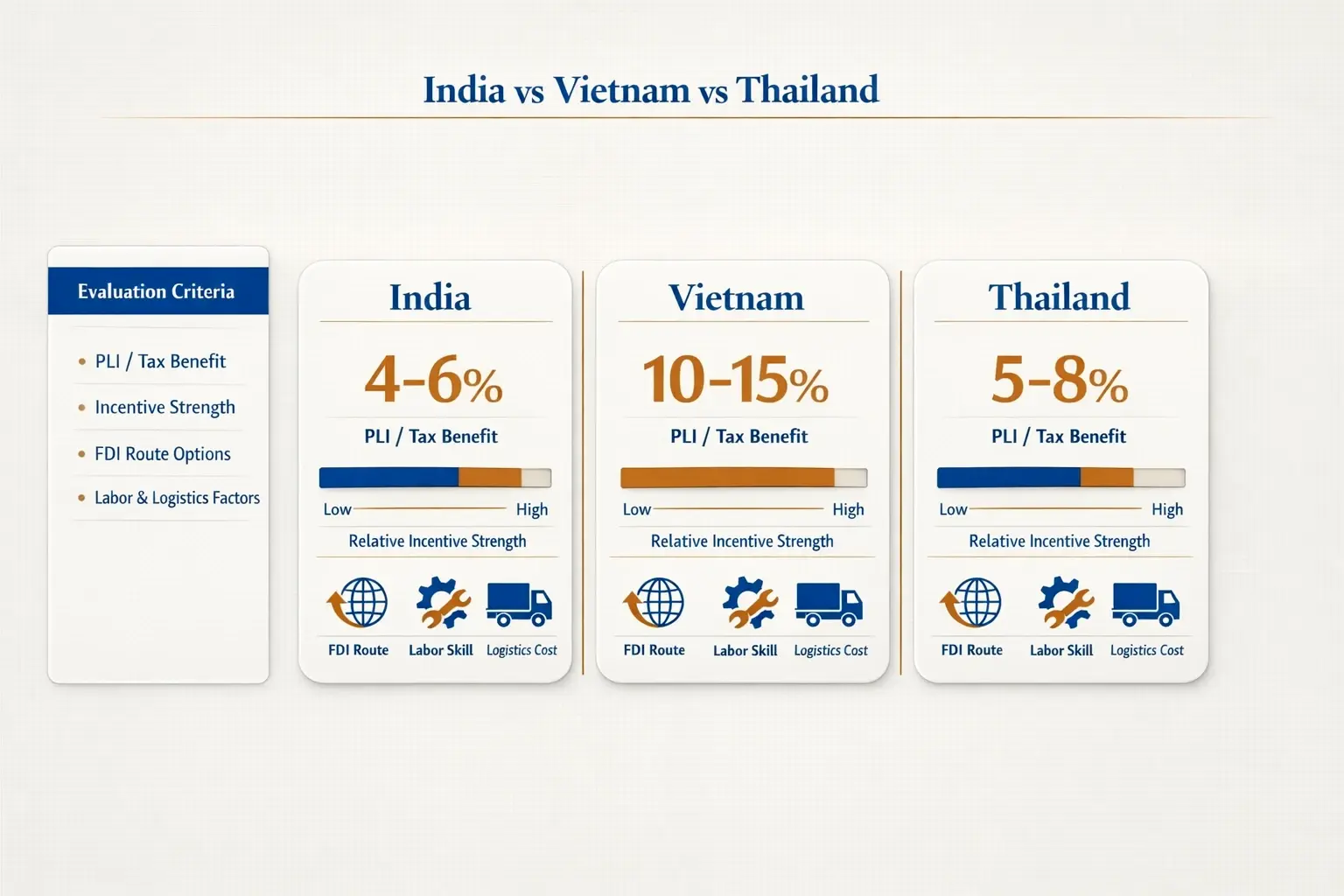
When evaluating supply chain diversification, procurement leaders typically weigh India against Vietnam and Thailand. A close look at 2025 incentive structures reveals distinct strategic advantages depending on your sourcing requirements.
While Vietnam aggressively courts final-assembly operations with 10-15% tax holidays, its depth in upstream raw materials—particularly bulk, specialty, and intermediate chemicals—is limited. Thailand focuses heavily on smart manufacturing, yet maintains a restricted sectoral list for foreign investment.
India differentiates itself by offering a 100% automatic route for Foreign Direct Investment (FDI) in manufacturing. More importantly, India pairs this barrier-free entry with a massive domestic ecosystem. The goal isn’t just to assemble; it is to build deep, resilient tier-2 and tier-3 supply chains. For buyers of industrial materials and chemical formulations, this means access to fully integrated suppliers rather than surface-level aggregators, ensuring better batch consistency and long-term supply continuity.
Decoding the 2025 PLI Architecture for Manufacturers
The backbone of India’s manufacturing renaissance is the Production Linked Incentive (PLI) scheme, spanning 14 critical sectors. By offering direct 4-6% rebates on incremental sales, the government effectively subsidizes the scaling of quality-compliant manufacturing.
The results are already reshaping global trade balances. Electronics production surged 146% since FY2021 to reach US$60.7B in FY2025. But the most telling data point for procurement leaders evaluating process-heavy industries is the “Pharma Flip.” India moved from a massive bulk drug trade deficit in 2021 to a ₹2,280 crore surplus in 2025.
This transformation proves that India’s chemical and pharmaceutical ecosystems can rapidly scale to meet strict Western compliance standards, including complex COA, SDS, and batch QC requirements.
Master Implementation Matrix: Sector ROI & Budget Availability
Understanding where the Indian government is deploying its capital helps procurement teams anticipate which supply bases will offer the most competitive pricing and the most reliable infrastructure in the coming years.
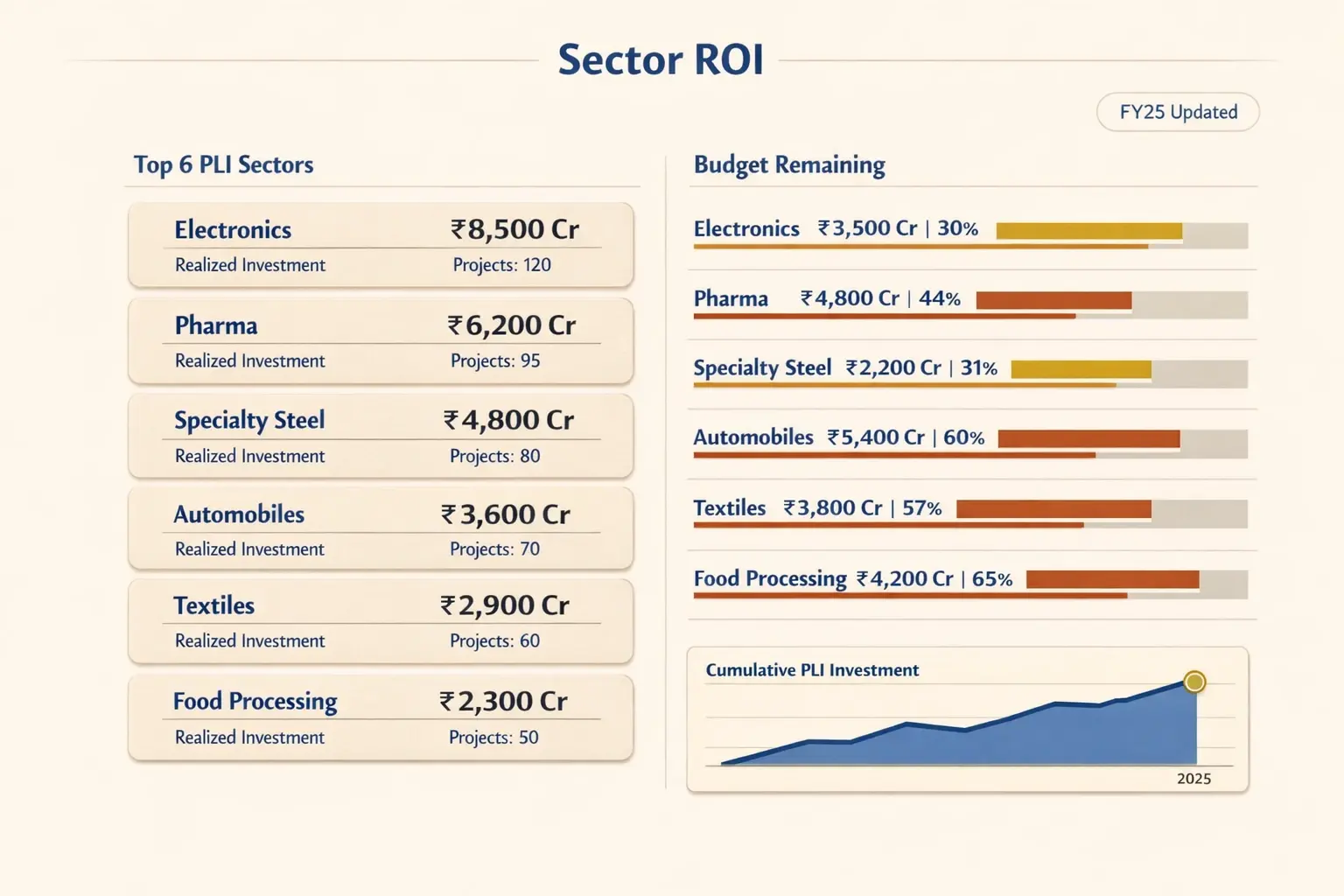
While mega-corporations like Apple and Foxconn dominate the headlines, the resulting downstream effect is a highly competitive, heavily capitalized network of industrial and chemical suppliers eager for international export partnerships.
Navigating the Ecosystem: From Policy to Factory Gate
Favorable policy means nothing if your cargo is delayed at the port or if your landed cost calculations are destroyed by hidden inland freight fees. Historically, a major objection to sourcing from India was its logistics infrastructure.
To address this, the government launched the PM Gati Shakti initiative—a digital master planning platform for multi-modal connectivity. By aligning rail, road, and port infrastructure, this framework is aggressively reducing India’s logistics costs from a historical 14% of GDP down toward a target of 8%. For buyers moving hazardous chemicals or bulk industrial materials, this structural reform translates directly into reliable lead times and predictable freight pricing.
Furthermore, long-term stability markers are highly visible. International collaboration networks, historically highlighted by events like the India Innovation Series and partnerships with global entities like the Norway Business Association, demonstrate a maturing, globally integrated business environment that understands Western expectations.
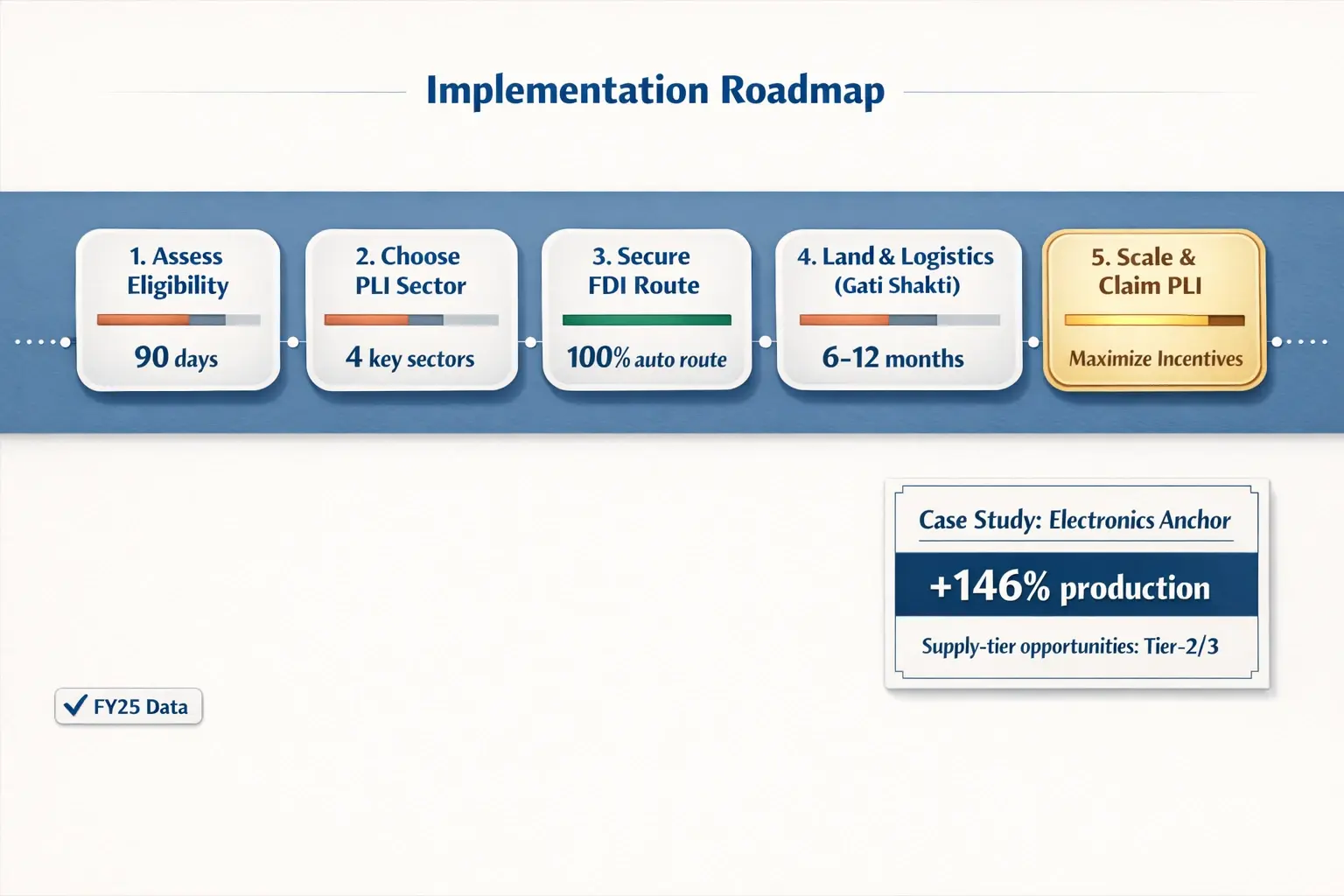
5-Step Regulatory Shortcut for Fast Market Entry
You don’t need to build a factory to benefit from these policies. Sourcing directly from PLI-backed suppliers allows you to leverage government-subsidized efficiency without capital expenditure.
- Leverage the 100% Automatic FDI Route: If you do choose to establish a legal entity or joint venture, manufacturing falls under the automatic route, bypassing bureaucratic approval delays.
- Target PLI-Integrated Suppliers: Audit suppliers not just for current capacity, but for their participation in government incentive schemes, which ensures they are continuously investing in facility upgrades.
- Utilize SEZ Export Benefits: Source from manufacturers located in Special Economic Zones (SEZs) to legally bypass specific domestic duties, driving down your final landed cost.
- Map the Gati Shakti Corridors: Only partner with suppliers situated along newly completed infrastructure corridors to eliminate the risk of inland transit delays.
- Demand Western Compliance Upfront: Ensure your on-the-ground partners can execute flawless GHS-compliant labeling, TSCA/REACH documentation, and hazardous goods logistics before the first sample is shipped.
Frequently Asked Questions
Does India’s chemical manufacturing quality meet Western standards?
Yes, but supplier qualification is critical. The recent chemical and pharma export surpluses prove the capability is there. However, ensuring consistent chemical purity, accurate COAs, and batch-to-batch reliability requires boots-on-the-ground quality control and rigorous supplier audits.
How do we avoid hidden landed costs when transitioning to Indian suppliers?
Hidden costs typically arise from misunderstood inland freight, port handling, and export duty structures. Partnering with a sourcing provider that offers fully transparent landed-cost structures—and understands the logistics improvements under the Gati Shakti framework—eliminates this margin risk.
Can Indian logistics handle complex hazardous goods?
Exporting specialty chemicals requires flawless hazmat documentation and specialized freight forwarding. While the top tier of India’s logistics network handles this seamlessly, port delays are often caused by weak regulatory paperwork from unvetted tier-3 suppliers. Having an expert single point of contact managing end-to-end hazardous transport is essential to maintain plant uptime.
Executing Your China +1 Strategy
India’s 2025 policy landscape has systematically removed the historical barriers to entry, replacing them with aggressive incentives and world-class infrastructure projects. However, translating these macro-economic policies into a secure, cost-effective, and compliant supply chain requires bridging the gap between Western procurement expectations and India’s expansive supplier ecosystem.
Success in India doesn’t require navigating the complexities alone. It requires partnering with a team that combines American-led communication standards, uncompromising integrity, and deep, on-the-ground execution capabilities. By demanding end-to-end visibility—from initial supplier vetting and batch QC to hazardous goods logistics—you can confidently build a resilient, diversified sourcing network that turns government policy into your competitive advantage.