When you source agricultural products and food-grade raw materials from India, the greatest hidden cost isn’t freight or seasonal price fluctuations—it’s compliance failure.
For a Global Sourcing Manager or Procurement Director, a rejected container at a U.S. or European port is a worst-case scenario. It means disrupted production schedules, emergency spot-buying at premium rates, and a scramble to fill the supply chain gap. The reality is that the regulatory landscape governing Indian food exports is shifting rapidly. Relying on compliance data from even two years ago is a fast track to border rejections.
The late-2022 EU delisting of several Indian certifiers proved that having a piece of paper isn’t enough; you need certification from verified, accredited bodies. Furthermore, with the mandatory implementation of the i-CAS Halal system in late 2024 and the NPOP 8th Edition that came into effect in 2025, the baseline for export readiness has been completely redrawn.
India’s organic food market reached $1.6 Billion in 2023 and is projecting a 6.23% CAGR through 2033. The supply capacity is massive, but accessing it requires a bulletproof approach to certification.
Here is your authoritative guide to navigating international food certifications in India, mitigating risk, and building a resilient, compliant supply chain.
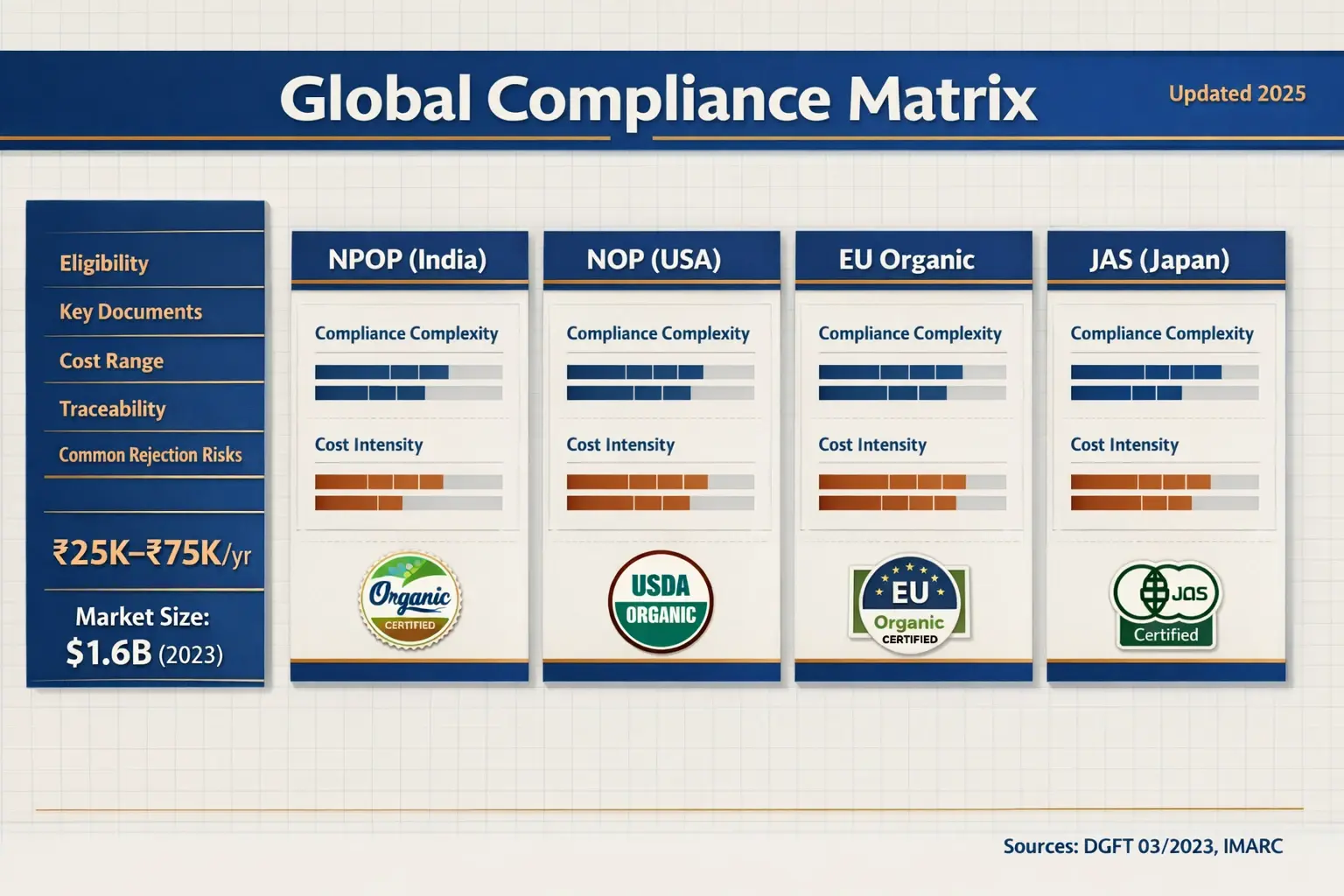
The Global Compliance Matrix: NPOP, NOP, EU, and JAS
Understanding the nuances between domestic Indian certifications and international destination requirements is the first step in protecting your supply chain. Many procurement teams mistakenly assume that India’s domestic standard automatically translates to global compliance.
NPOP vs. NOP: Bridging the India-to-US Gap
India’s National Programme for Organic Production (NPOP) is managed through APEDA’s TraceNet system. While NPOP is rigorous, the US market requires the USDA’s National Organic Program (NOP) certification.
A common and costly mistake is paying for separate NPOP and NOP audits. Instead, strategic sourcing involves working with accredited certifiers who conduct dual audits. The NPOP 8th Edition in 2025, the documentation bridging these standards became more stringent, focusing heavily on batch traceability and residue testing.
Mitigating the EU Rejection Risk
In 2022, the European Union delisted multiple Indian certification bodies due to non-compliance with ethylene oxide (EtO) regulations and tracing failures. If you are importing to Europe, your supplier’s NPOP certificate must be issued by an agency that retains full EU equivalence recognition, such as Ecocert or Indocert. Sourcing Pros leverages a boots-on-the-ground presence to audit these exact credentials long before a purchase order is ever signed.
The 2024 Halal i-CAS Update: What You Must Know Now
If your category covers processed foods, meat, or specific functional ingredients bound for Halal-sensitive markets, the rules changed fundamentally on October 16, 2024.
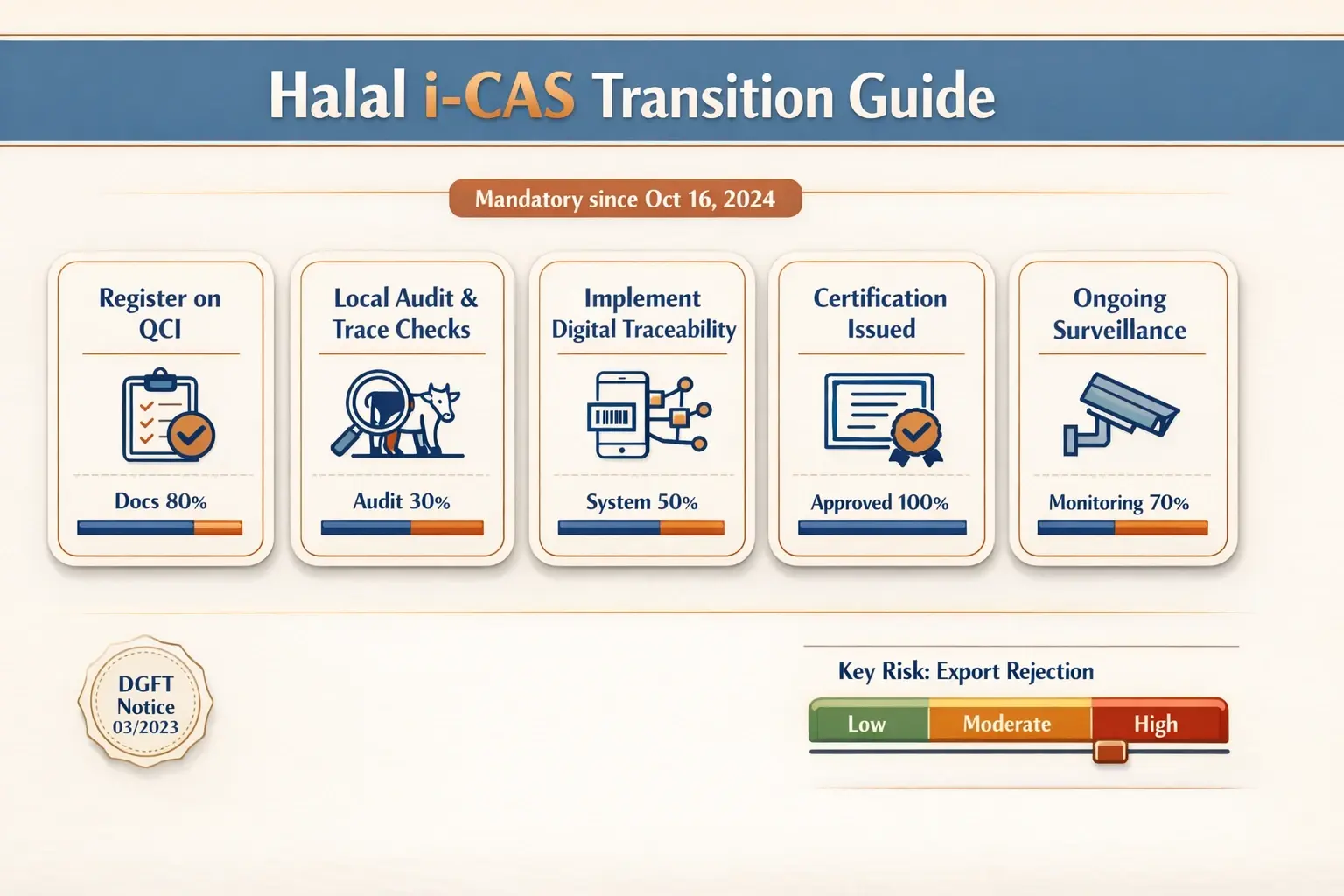
Under DGFT Notification No. 03/2023, the Indian government made the India Conformity Assessment Scheme (i-CAS) Halal certification mandatory for specific exports. Previously, suppliers could use various private Halal boards, leading to inconsistent standards and buyer mistrust.
Now, all facilities must be registered and cleared through the QCI (Quality Council of India) i-CAS portal.
- The Risk: Consignments bearing unrecognized legacy Halal certificates are currently subject to immediate port hold or rejection.
- The Solution: Verify that your Indian suppliers have transitioned to an i-CAS approved certification body. Request their updated registration documentation before initiating any new shipments.
FDA Traceability Rule (FSMA 204): Navigating US Import Requirements
For U.S. buyers sourcing agricultural products, the FDA’s Food Safety Modernization Act (FSMA) Section 204—the Food Traceability Final Rule—is the most critical compliance hurdle today.
FSMA 204 targets high-risk foods on the Food Traceability List (FTL), which heavily impacts Indian exports like spices, nuts, and leafy greens. You can no longer rely on a simple Certificate of Analysis (COA) or an outdated Material Safety Data Sheet (SDS) for transport.
To clear US Customs smoothly, your Indian supply chain must maintain and provide Key Data Elements (KDEs) at every Critical Tracking Event (CTE)—from the farm level in Madhya Pradesh or Sikkim straight through to your US receiving facility. Your sourcing partner must possess the operational infrastructure in India to enforce this level of documentation transparency.
Evaluating the ROI of Certification
Upgrading a supplier to meet global certification standards requires capital and time. Is the investment worth it?
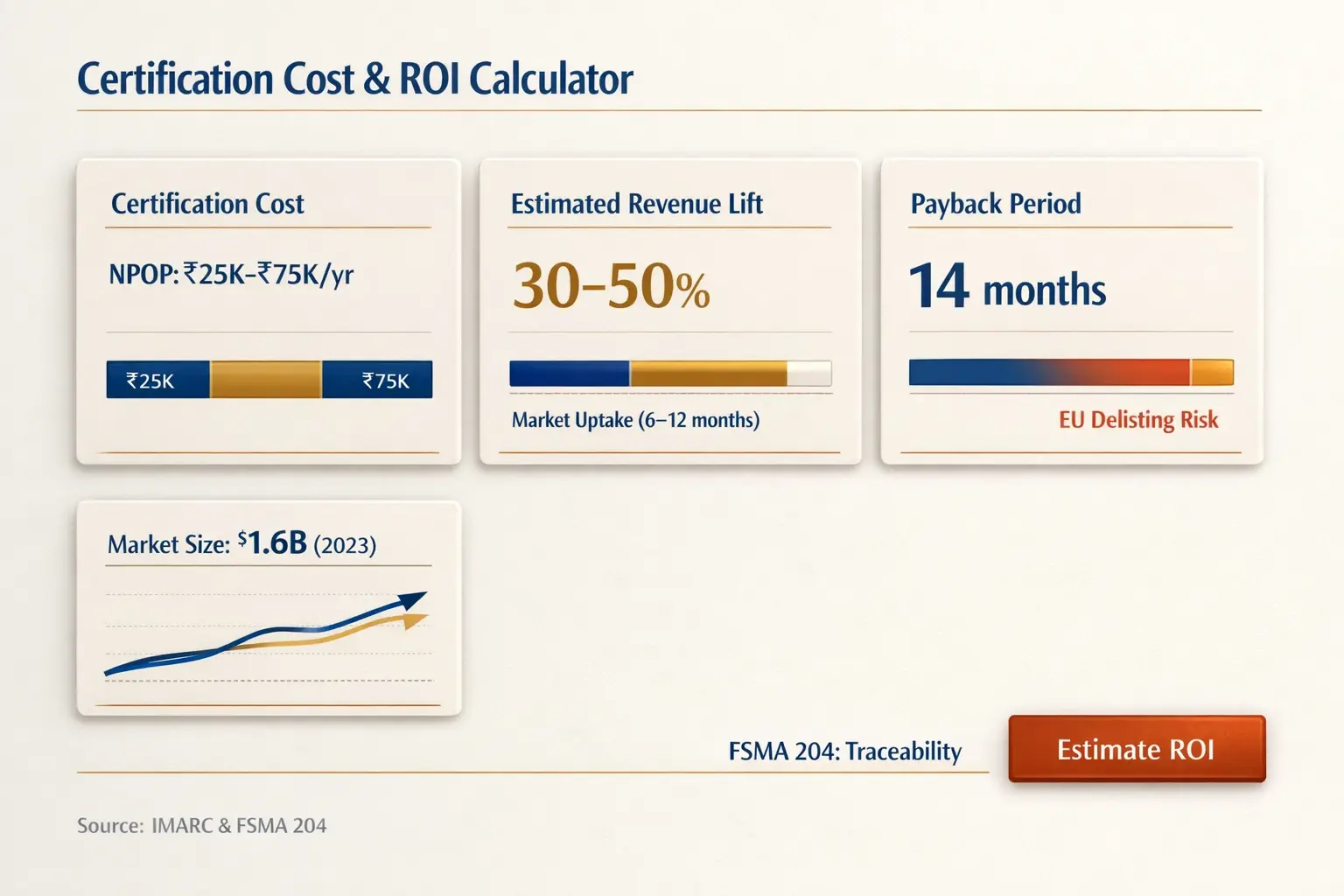
Basic NPOP certification in India currently ranges from ₹25,000 to ₹75,000 per year, depending on the scale of the farm or processing facility. However, this base cost does not include the rigorous batch testing, residue analysis, and administrative overhead required to maintain compliance.
When evaluating supplier landed costs, don’t just look at the raw material price. Factor in the cost of risk. A supplier offering prices 10% below market average but possessing weak TraceNet documentation or outdated Halal certificates is a massive liability. Working with a dedicated sourcing partner gives you transparent landed-cost structures with no hidden regulatory fees, ensuring that what you buy is exactly what arrives.
How Sourcing Pros Protects Your Supply Chain
Navigating these regulatory shifts requires more than just Google searches—it requires a physical presence and a deep understanding of Western expectations.
At Sourcing Pros, we bridge the gap between rigorous US/EU requirements and India’s expansive supplier ecosystem. Our American-led team demands total transparency. We don’t just collect certificates; we conduct boots-on-the-ground supplier audits, verify GHS-compliant labeling, manage complex logistics for sensitive goods, and ensure every COA matches the actual batch purity.
You need a partner who acts as your single point of contact from supplier vetting to final delivery, ensuring you maintain plant uptime and predictability.
Frequently Asked Questions
What is the difference between NPOP and NOP for organic imports?
NPOP (National Programme for Organic Production) is India’s domestic organic standard. NOP (National Organic Program) is the USDA standard required for US imports. While they share similarities, a product certified only under NPOP cannot be sold as organic in the US. Suppliers must be audited to NOP standards, ideally through a dual-certification process to save time and costs.
How does the 2024 DGFT Notification 03/2023 impact my current orders?
As of October 16, 2024, all specified meat and Halal-sensitive food exports must be certified under the QCI’s i-CAS Halal system. If your Indian supplier is still using a private, non-i-CAS accredited board, your shipments face severe risk of export rejection at Indian customs or import rejection at the destination.
Why were Indian organic certifiers delisted by the EU?
In late 2022, the European Commission delisted several Indian certifiers due to repeated failures to detect ethylene oxide (EtO) contamination and inadequate traceability protocols. To ensure safe export to the EU, buyers must verify that their supplier’s certifier retains current European equivalence.
How do I ensure my Indian supplier complies with FDA FSMA 204?
You must implement a strict traceability matrix. Your supplier needs to track Key Data Elements (KDEs) across all Critical Tracking Events (CTEs) from the farm level to export. Utilizing a managed sourcing partner in India guarantees that these document trails are verified before the container ever leaves the port.
Secure Your Supply Chain Today
Regulatory compliance should never be an afterthought in your procurement strategy. As global standards tighten, working with a partner who actively monitors, audits, and enforces these certifications is the only way to guarantee supply continuity.
Stop firefighting customs delays and start sourcing with confidence. Reach out to the Sourcing Pros team today to audit your current Indian supply chain and ensure your next shipment is 100% globally compliant.