You’ve done the research. Your company is diversifying its supply chain, and two countries are at the top of your list: India and Vietnam. The numbers look promising, the manufacturing capabilities are there, and you’ve sent out initial inquiries.
To your supplier in Vietnam, you send a direct, bullet-pointed email outlining your technical requirements and desired timelines. You receive a polite, brief acknowledgment, but the detailed answers you need are slow to arrive.
To your potential partner in India, you send the same email. Within hours, you get a call. The conversation is warm and wide-ranging, touching on your family and background before circling back to business. You get answers, but also a dozen new questions about building a long-term relationship.
Welcome to the first, and most critical, lesson in global sourcing: the RFQ is the easy part. The real challenge—and opportunity—lies in navigating the intricate cultural fabric that defines how business is done. For Western procurement teams, understanding the communication styles, negotiation tactics, and relationship-building norms of India versus Vietnam isn’t just a soft skill; it’s a core strategic advantage.

This guide is your first step toward building that cultural intelligence. We’ll move beyond stereotypes to provide a practical, comparative look at what to expect when building sourcing partnerships in these two dynamic, but distinctly different, economic powerhouses.
Foundation: Understanding the Cultural Bedrock
Before diving into specific business scenarios, it’s helpful to understand the foundational values shaping professional interactions in India and Vietnam. While generalizations are always imperfect, established cultural frameworks give us a lens to see why our counterparts may approach business differently.
Think of it in terms of a few key dimensions:
- Communication Context: The West, particularly the U.S., operates in a low-context culture. We value direct, explicit language where “yes” means yes, and the message is in the words themselves. India and Vietnam are high-context cultures. The message is often found in the context—body language, tone, and what is not said. Building a relationship is essential to understanding the full picture.
- Power Distance: This dimension reflects how a culture views hierarchy. In Vietnam, influenced by Confucian values, there’s a high degree of respect for age, status, and formal hierarchy (high power distance). Decisions often flow from the top. India also has a hierarchical structure, but it can be more fluid and complex, influenced by relationships, family ties, and individual charisma.
- Individualism vs. Collectivism: Western cultures are highly individualistic. We celebrate personal achievement and autonomy. Both India and Vietnam are collectivistic, prioritizing the group (the family, the company, the community) over the individual. This impacts everything from negotiation—where consensus is key in Vietnam—to relationship building, which is foundational in India.
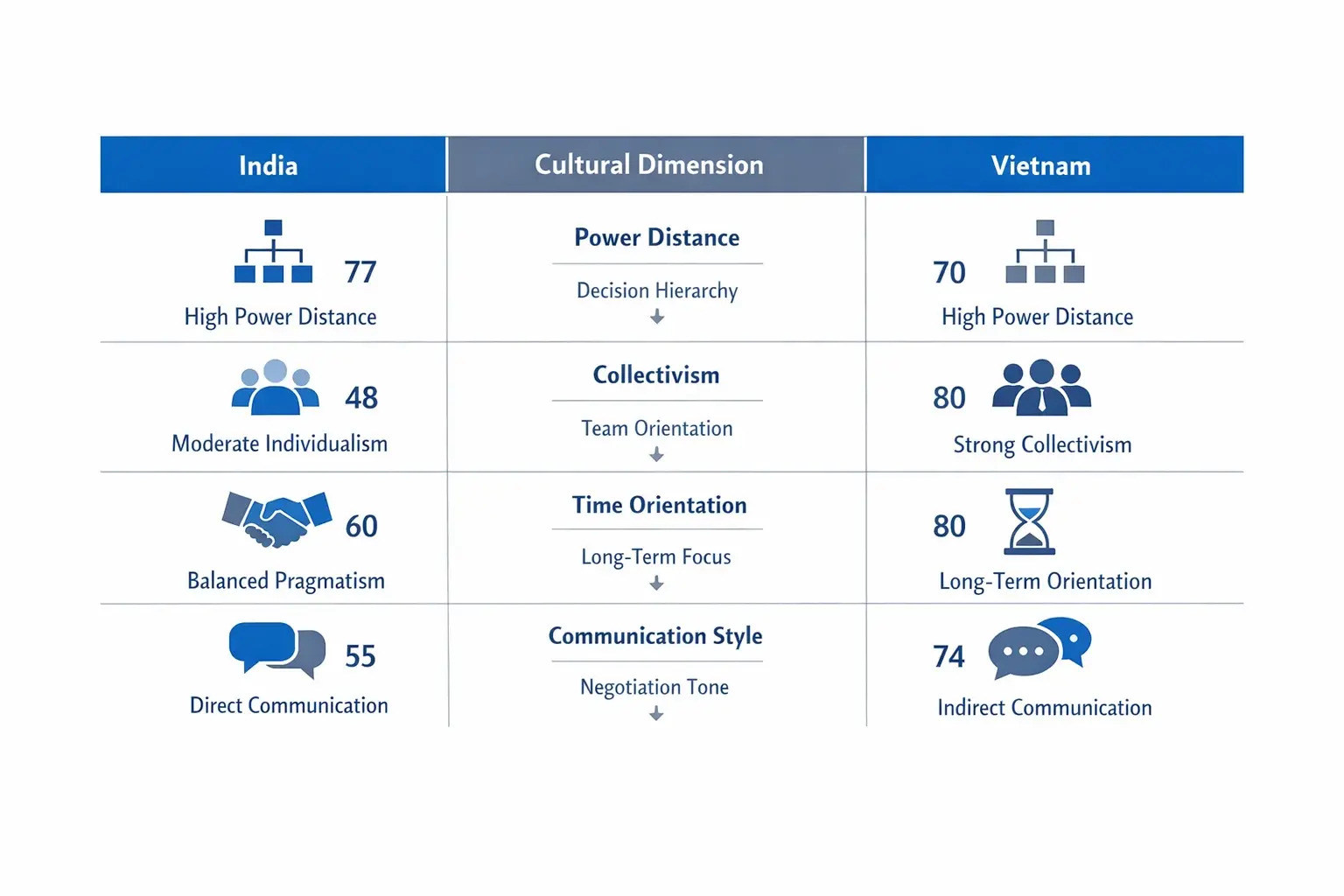
These core differences are the source code for the business behaviors you’ll encounter. Let’s see how they play out in the day-to-day work of procurement.
Communication, Negotiation, and Relationships: A Comparative Playbook
Success in sourcing hinges on clear communication, effective negotiation, and trusted relationships. Here’s how to adapt your approach for India and Vietnam.
Communication Styles: Reading Between the Lines
A common frustration for Western buyers is misinterpreting a “yes.” In high-context cultures, “yes” can have many meanings, and understanding the nuance is critical.
In India:
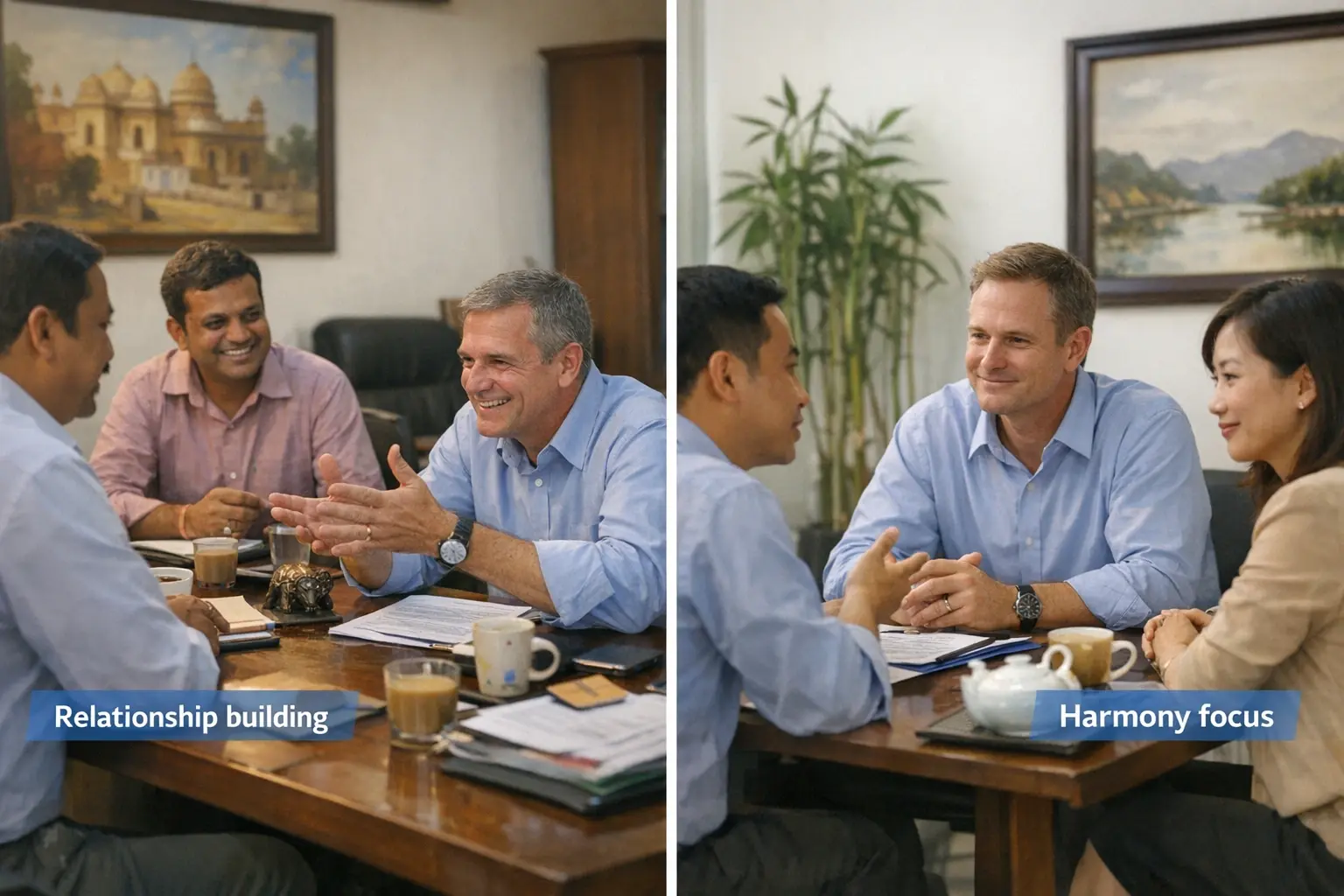
- Style: Expressive, warm, and relationship-oriented. Expect conversations to be fluid, often starting with personal questions before moving to business. This isn’t wasted time; it’s the process of building trust.
- The “Yes”: An Indian “yes” can mean “I understand what you’re asking,” “I will try my best,” or “I hear you.” It is not always a firm commitment. Affirmative language is often used to maintain positive momentum in the conversation.
- English Nuances: While English is widely spoken in business, certain phrases can have different meanings. For example, “prepone” (the opposite of postpone) is common. Pay attention to the enthusiasm and follow-up actions, not just the words.
- Actionable Tip: After a verbal agreement, follow up with a detailed email summarizing the key points and action items. This creates a low-context record that confirms mutual understanding without causing offense.
In Vietnam:
- Style: Reserved, respectful, and indirect. Maintaining harmony and avoiding conflict are paramount. Direct questions, especially in a group setting, can be seen as confrontational.
- The “Yes”: A Vietnamese “yes” is often used to acknowledge that they have heard you and will consider your request. It’s a way to be polite and save face for both parties. A direct “no” is rare, as it’s considered impolite.
- Reading Silence: Silence is a powerful communication tool. It can mean contemplation, disagreement, or a desire to consult with the team. Don’t rush to fill the void; allow your counterparts time to process.
- Actionable Tip: Phrase questions indirectly. Instead of “Can you meet our deadline of May 15th?” try “What challenges do you foresee in meeting a May 15th delivery date?” This opens the door for an honest discussion without forcing a direct “yes” or “no.”
Negotiation Strategies: The Art of the Deal
Your standard Western negotiation tactic—getting straight to the point and focusing on price and terms—requires significant adaptation.
In India:
- Pace: Flexible and dynamic. Negotiations are rarely linear. Points you thought were settled may be revisited as part of a holistic bargaining process. Patience is key.
- Focus: Relationship first, then business. The goal is to find a mutually agreeable path forward with a trusted partner. The contract is important, but the strength of the personal relationship is what ensures its execution.
- Decision-Making: While hierarchical, the decision-maker can often be influenced by trusted advisors and a strong personal connection with you. A compelling argument delivered with respect can go a long way.
In Vietnam:
- Pace: Methodical and deliberate. Negotiations often involve a team, and decisions require internal consensus. Rushing the process will be counterproductive.
- Focus: Building long-term trust and demonstrating respect. Your first meeting is about establishing credibility, not closing a deal. The concept of “face” is critical; never cause your counterpart to feel embarrassed or lose respect, especially in front of their team.
- Decision-Making: Strictly hierarchical. You must win the approval of the senior leader in the room, even if they say very little. Show respect for age and seniority at all times.
Advanced Applications: From Theory to Practice
Understanding the culture is one thing; applying it to solve real-world procurement challenges is another.
Addressing Quality Issues and Delays
This is where cultural intelligence is truly tested. A direct, accusatory approach will backfire in both cultures.
- In India: Frame the issue as a shared problem. Leverage the personal relationship you’ve built. A phone call is often better than a formal email. Say, “We have a challenge with the last batch, and I was hoping we could work together to find a solution.” This approach emphasizes partnership over blame.
- In Vietnam: Be extremely indirect and private. Causing a supplier to lose face can permanently damage the relationship. Address the issue by focusing on the process, not the people. For example, “How can we adjust our quality assurance process to prevent this variance in the future?” Using a trusted intermediary can also be highly effective.
A robust supplier qualification process is your first line of defense, but when issues arise, a culturally-aware response is your best tool for resolution.
On-the-Ground: Supplier Audits and Site Visits
Factory visits are invaluable opportunities to build rapport and verify capabilities.
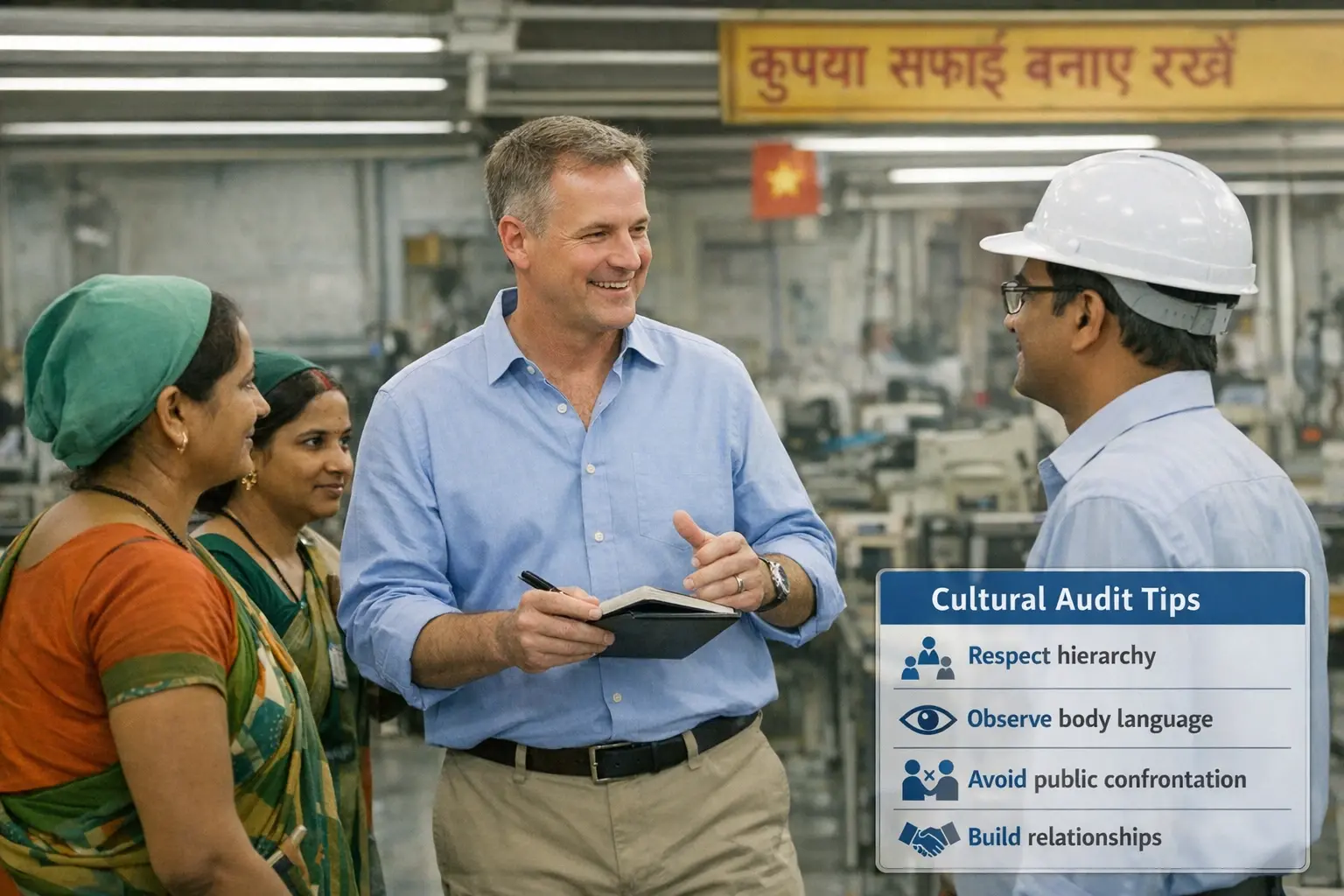
- Hospitality: In both cultures, you will be treated as an honored guest. Accept offers of tea or coffee; refusing can be seen as rude.
- Respect for Hierarchy: When you arrive, make a point to greet the most senior person first. In Vietnam, a slight bow is a sign of respect.
- Gift-Giving: In Vietnam, a small gift from your home country is appreciated. In India, gifts are common but should be chosen carefully to avoid any implication of bribery.
- The Audit Process: Frame the audit as a collaborative exercise to meet your end-customer’s requirements, not as a test of the supplier. This collaborative framing is key for both cultures. A well-managed audit is a crucial part of your custom procurement strategy and ensures your standards are met from day one.
Successfully navigating these interactions is about more than just etiquette; it’s about demonstrating a genuine commitment to understanding your partner’s world. This is particularly vital when managing the complexities of international shipping and compliance, where clear, trusted communication is essential for smooth export logistics.
Frequently Asked Questions (FAQ)
What is the single biggest cultural difference for Westerners to understand?
For India, it’s the paramount importance of personal relationships. Business moves at the speed of trust. For Vietnam, it’s the concept of “face” and maintaining harmony. Avoiding direct confrontation is essential.
Is English proficiency a reliable indicator of communication style?
No. Excellent English fluency in both countries can mask deep-seated cultural communication patterns. A supplier might speak perfect English but still communicate indirectly, value harmony over candor, and use “yes” in a high-context way.
How important is hierarchy in decision-making?
Very important in both, but it functions differently. In Vietnam, the hierarchy is more rigid and formal; decisions come from the top after consensus is built. In India, hierarchy is also strong, but a charismatic leader may make faster, more intuitive decisions, and personal relationships can sometimes allow for more fluid communication across levels.
What’s the most common mistake Western procurement teams make?
Rushing the relationship-building phase. Western efficiency drives us to “get down to business” immediately. In both India and Vietnam, this is seen as rude and transactional. Investing time in personal connection and building trust isn’t a preliminary step—it is the business.
Your Path Forward: From Awareness to Advantage
Sourcing from India or Vietnam offers incredible opportunities to build resilient, cost-effective, and innovative supply chains. But long-term success isn’t found in a spreadsheet. It’s built on a foundation of cultural understanding, empathy, and adaptability.
The differences are not obstacles; they are simply different ways of doing business. By learning to read the cultural context, you can build stronger, more transparent, and more profitable partnerships.
The journey starts with education, but true mastery comes from having a partner on the ground who bridges these cultural and communication gaps for you—someone who understands Western expectations for transparency and deadlines while fluently navigating the local business landscape. This is the key to transforming cultural complexities from a risk into your greatest competitive advantage.