Imagine this: a container of your premium Indian spice blend, eagerly awaited by your customers, gets red-flagged at the port of entry. The issue? An undeclared allergen. A microscopic trace of peanut protein, a whisper of sesame from a shared production line. Suddenly, your entire supply chain grinds to a halt.
This isn’t just a hypothetical nightmare. For businesses sourcing food products from India, it’s a real and costly risk. The global appetite for Indian cuisine is booming, but with it comes the non-negotiable demand for world-class food safety.
Successfully navigating this landscape hinges on mastering two critical disciplines: allergen management and cross-contamination prevention. This isn’t just about ticking compliance boxes; it’s about protecting consumers, building an unshakable brand reputation, and unlocking the full potential of India’s rich agricultural bounty.
This guide is your first step. We’ll break down these complex topics into a clear, actionable framework, think of it as a friendly conversation over coffee, designed to help you source from India with confidence.
The Foundation: Understanding the Stakes of Food Safety
Before we dive into the “how,” let’s get grounded in the “what” and “why.” At its core, this is about preventing unintended ingredients from ending up in the final product.
What Are Food Allergens?
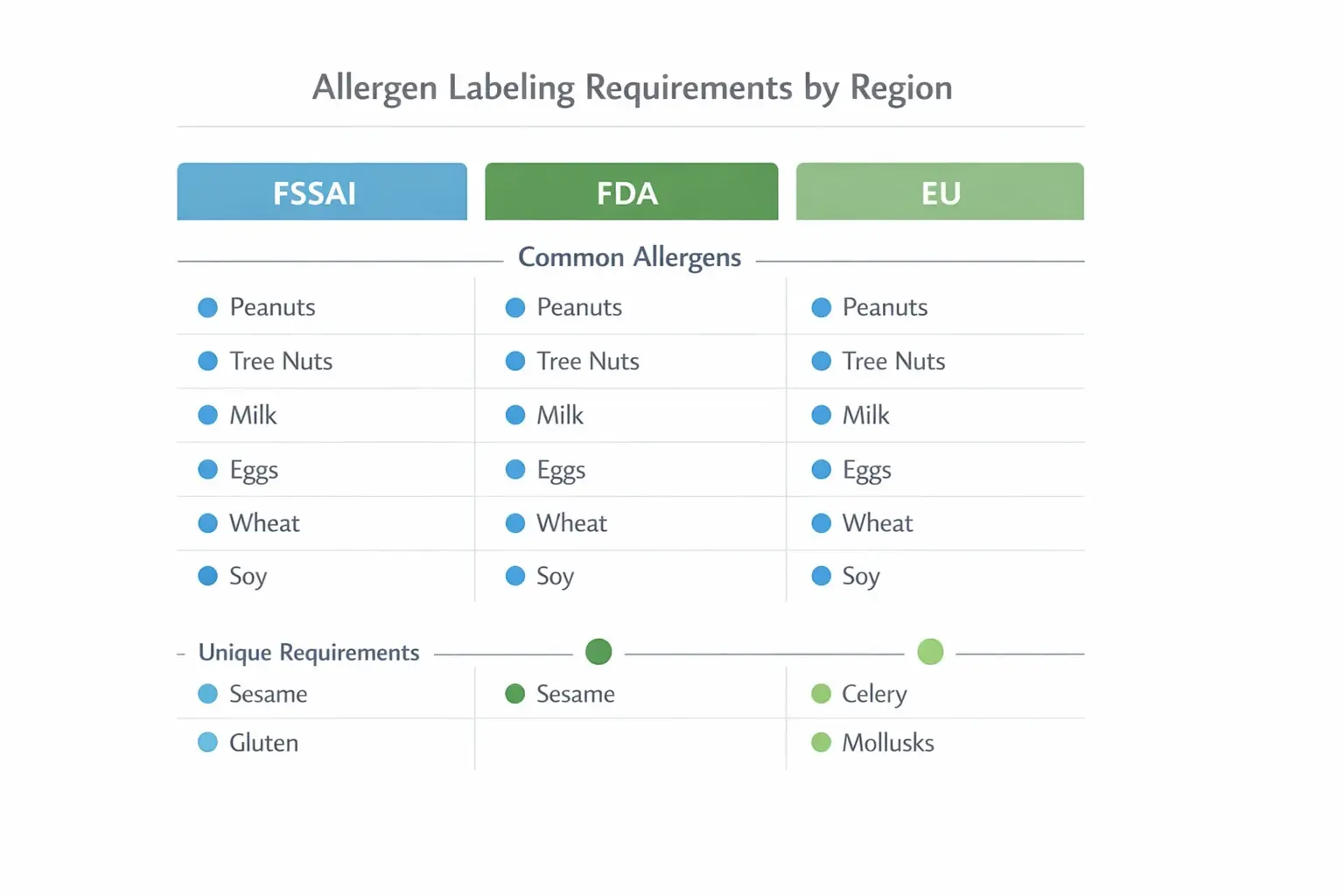
Food allergens are specific proteins in food that can trigger an immune response in sensitive individuals. While hundreds of foods can cause reactions, a small group accounts for the majority of severe cases. Global regulations focus on these key players.
For an Indian exporter, this means being fluent in multiple regulatory languages. You must adhere to India’s own Food Safety and Standards Authority of India (FSSAI) guidelines while simultaneously meeting the stringent requirements of your target market.
- The US “Big 9”: Milk, eggs, fish, crustacean shellfish, tree nuts, peanuts, wheat, soybeans, and sesame.
- The EU “Big 14”: The US list plus celery, mustard, lupin, and molluscs.
- FSSAI Requirements: India mandates labeling for cereals containing gluten, crustaceans, milk, eggs, fish, peanuts, tree nuts, soybeans, and sulphites (>10 mg/kg).
The key takeaway? Your product labeling must be flawless for the destination country. A product perfectly compliant in India could be a major violation in the EU if it contains mustard that isn’t declared.
What is Cross-Contamination (and Cross-Contact)?
While often used interchangeably, there’s a subtle difference:
- Cross-Contamination: The transfer of harmful bacteria or viruses from one surface or food to another. Think of raw chicken juices touching a fresh salad.
- Allergen Cross-Contact: The transfer of an allergenic protein from one food to another. This is our primary focus. Unlike bacteria, allergens can’t be “killed” by cooking. Even a minuscule amount can cause a severe reaction.
In a busy Indian food processing facility that might handle everything from lentil-based snacks to cashew-rich sweets, the opportunities for cross-contact are everywhere: shared equipment, airborne dust from spice grinding, or even an employee’s gloves.
The Pillars of Safety: Your HACCP & GMP Framework
Think of Good Manufacturing Practices (GMP) as the daily rules of the road for your facility—the foundational hygiene and operational standards. Hazard Analysis and Critical Control Points (HACCP) is your strategic roadmap for identifying and controlling specific hazards, with allergens being a major one.
Under HACCP, allergen management isn’t just a suggestion; it’s a Critical Control Point (CCP). This means you must treat the unintended presence of an allergen as a serious hazard that needs a specific, monitored control plan.
Your HACCP plan for allergens should answer these questions:
- Hazard Analysis: Which allergens are present in our facility? Where could they come from?
- Identify CCPs: At what specific points in our process can we control the risk of cross-contact? (e.g., ingredient receiving, scheduling, cleaning).
- Establish Critical Limits: What is the measurable standard for control? (e.g., “no visible residue after cleaning” or a negative result on a protein swab test).
- Monitor: How will we check that our controls are working? Who is responsible?
- Corrective Actions: What do we do if monitoring shows a failure? (e.g., re-clean equipment, hold product).
- Verification & Record-Keeping: How do we prove our system is effective and maintain documentation for audits?
This framework transforms food safety from a reactive chore into a proactive, documented system—exactly what international buyers and regulators want to see.
From Theory to Factory Floor: An Export-Ready Allergen Management Plan
A plan on paper is useless without flawless execution. Here’s a step-by-step guide to building a robust system tailored for the realities of Indian food processing.
Step 1: Lock Down Your Supply Chain
Your control starts long before ingredients reach your facility.
- Supplier Vetting: Don’t just ask, verify. A robust [supplier qualification] process requires detailed questionnaires about the allergen status of their ingredients and their own facility’s cross-contact risks.
- Ingredient Specifications: Your purchase orders must clearly state allergen requirements. If you need “peanut-free” gram flour, it must be in writing.
- Receiving & Storage: Upon arrival, ingredients should be clearly labeled. Allergenic materials must be stored separately from non-allergenic ones. A simple strategy is “bottom-shelf storage” for allergens like powdered milk or wheat flour to prevent airborne dust from settling on other goods.
Step 2: Smart Facility Design & Segregation
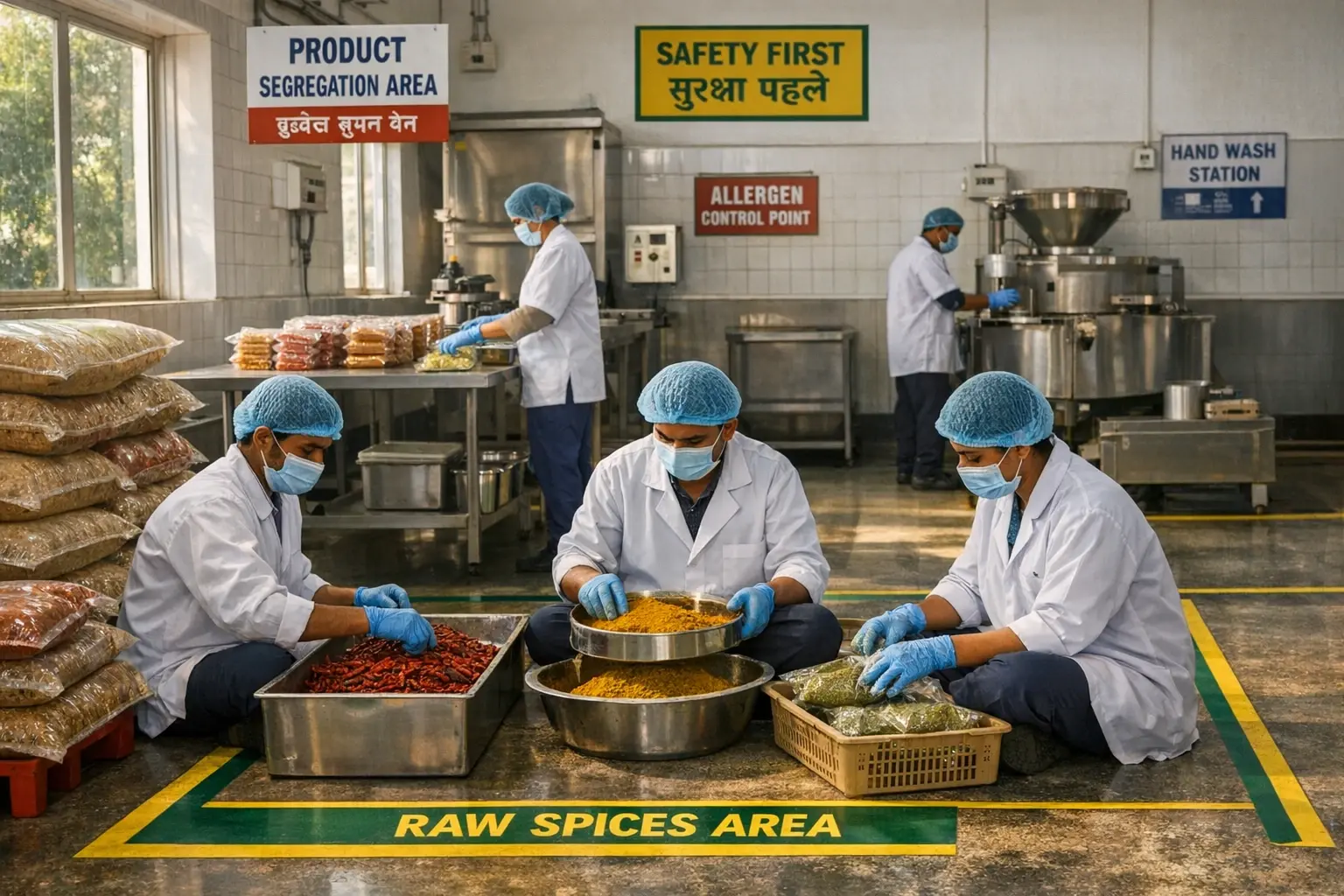
Ideally, you’d have separate facilities. Realistically, most Indian SMEs operate in multi-product environments. Smart segregation is key.
- Zoning: Designate specific areas, lines, or even rooms for processing products with major allergens.
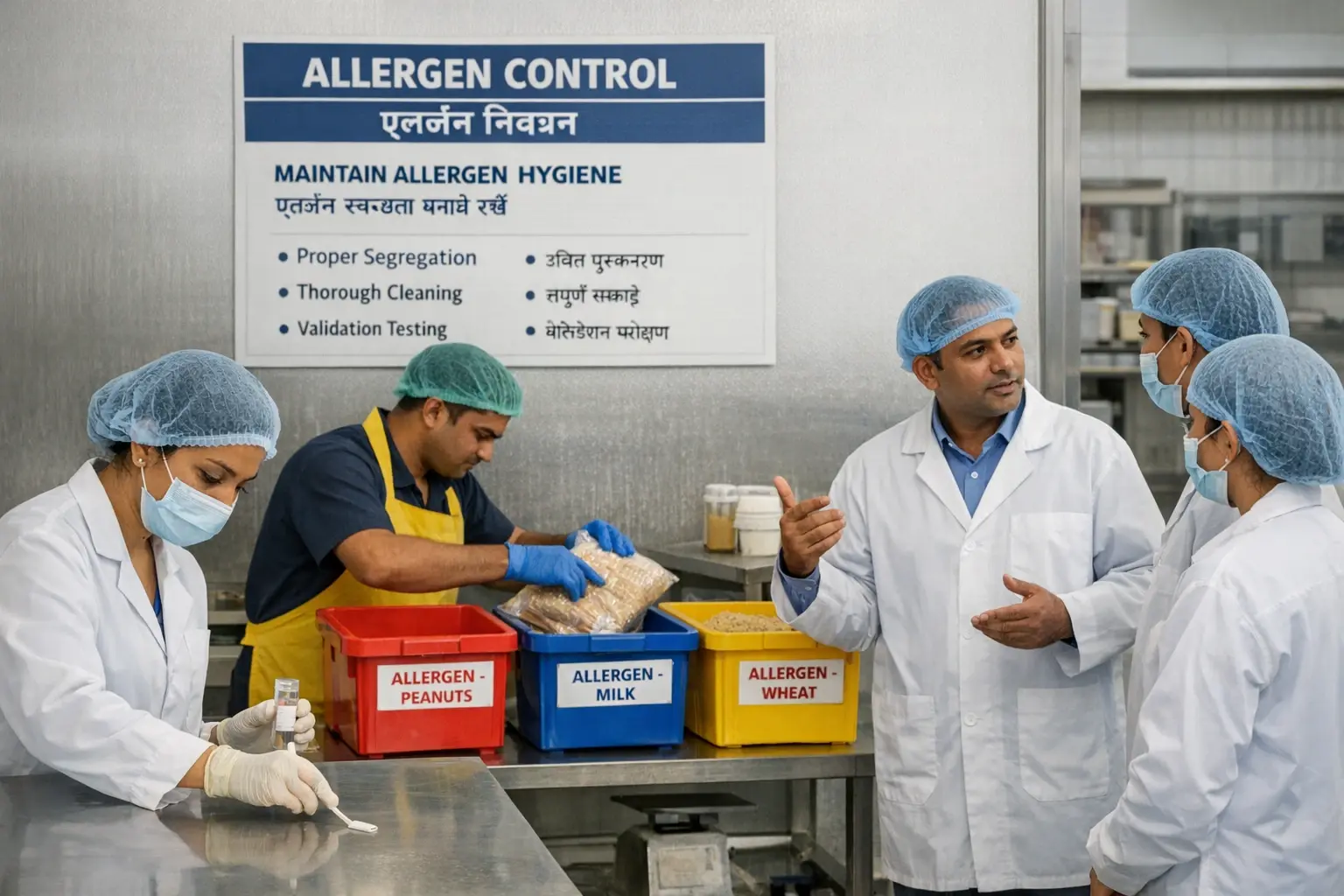
- Color-Coding: Use color-coded utensils, containers, and cleaning tools for different allergens (e.g., red for peanuts, blue for dairy). This is a simple, visual cue that transcends language barriers.
- Airflow Management: In areas where powders are used (like spice blending), consider air pressure and ventilation systems to prevent allergenic dust from traveling.
Step 3: Master Production Scheduling & Cleaning
This is where many facilities fail. It’s a common finding in audits.
- Schedule Smart: If you must use the same equipment, run non-allergen products first after a full deep clean. Process your peanut-based snack mix at the end of the day, not before the gluten-free lentil chips.
- Cleaning Validation: “Visibly clean” is not enough. You must validate that your cleaning process effectively removes the allergenic protein. This can be done using commercially available protein swabs or more advanced lab tests like ELISA. This is a non-negotiable step for export compliance.
Step 4: Empower Your People (The Most Critical Step)
Your systems are only as strong as the people implementing them. This is where many Indian facilities have a hidden vulnerability. A study published by the NCBI found significant knowledge gaps among food handlers—including in India—regarding proper sanitation and cross-contamination prevention.
This is your “aha moment.” An auditor can approve your plan, but if a line worker thaws meat at room temperature or uses the same scoop for different spices, your entire system fails.
Effective training must be:
- Continuous: Not a one-time event.
- Visual & Practical: Use pictures and hands-on demonstrations.
- Language-Appropriate: Conducted in the local language.
- Specific: Address the exact risks in your facility, like why they must change aprons after handling wheat flour.
Beyond the Basics: Mastering Compliance at Scale
As your export business grows, your systems must evolve. This is where you move from being compliant to being a leader.
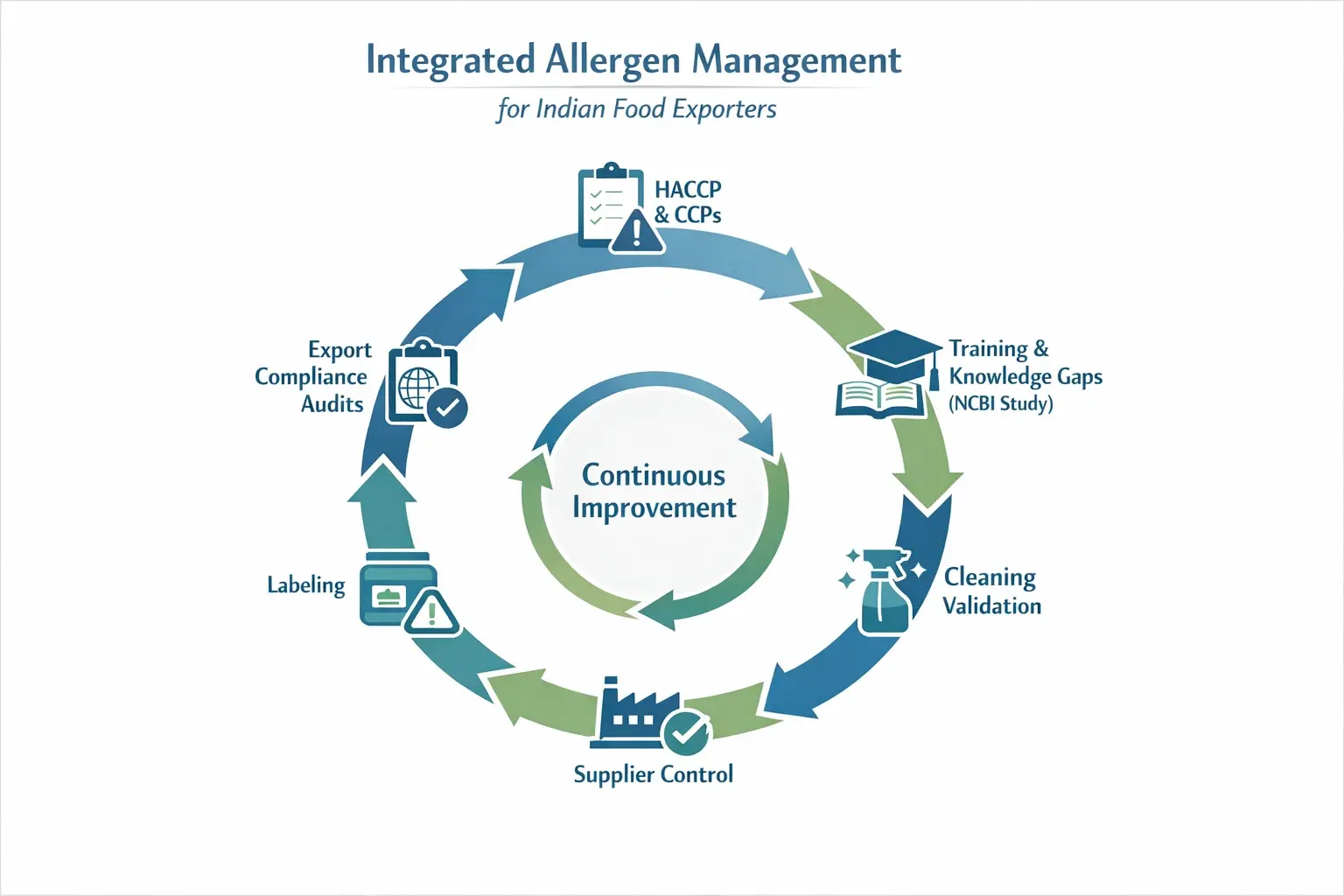
- Digital Record-Keeping: Move from paper logs to digital systems for better traceability and audit readiness.
- Managing Emerging Hazards: The food safety landscape is always changing. A robust system allows you to integrate new controls, such as monitoring for chemical contaminants like Ethylene Oxide in spices, alongside your allergen plan.
- Recall Preparedness: Practice what you’ll do in a worst-case scenario. A mock recall drill can reveal weaknesses in your traceability and communication plans before a real crisis hits.
- Full Visibility: For international buyers, peace of mind comes from transparency. Partnering with a sourcing expert who provides end-to-end management, from [custom procurement] and audits to quality assurance and [export logistics], ensures that these best practices are not just promised, but proven.
Frequently Asked Questions (FAQ)
Q: What’s the difference between “gluten-free” and “wheat-free”?
A: “Wheat-free” means the product contains no wheat ingredients. “Gluten-free” means the product is free of gluten, a protein found in wheat, barley, and rye. A product can be wheat-free but still contain gluten from barley. This distinction is crucial for accurate labeling.
Q: Is a “May Contain” statement enough to protect my business?
A: Precautionary Allergen Labeling (PAL), such as “may contain traces of nuts,” is not a substitute for robust GMPs and allergen control. Regulators and buyers see it as a last resort, not a primary safety measure. Overusing it can also limit your market. The goal is to control the risk so you don’t need the warning.
Q: How can I verify a supplier’s allergen plan from thousands of miles away?
A: This is a major challenge. You need “boots on the ground.” This can involve hiring a third-party auditor or working with a procurement partner who conducts in-person supplier audits as part of their service. Never rely solely on paperwork.
Q: We are a small facility. How can we afford all this?
A: Many of the most effective controls are about process, not expensive technology. Color-coding, smart scheduling, and rigorous employee training are low-cost, high-impact strategies. Start there. Investing in food safety is not a cost; it’s an investment in market access and brand protection.
Your Next Step Towards Confident Sourcing
Mastering allergen management and cross-contamination prevention is the single most important step you can take to de-risk your supply chain and build a sustainable food export business from India. It transforms your operations from a potential liability into a competitive advantage.
By understanding the regulations, implementing a robust HACCP-based system, and, most importantly, closing the knowledge gaps on the factory floor, you are not just ensuring compliance. You are building trust with every shipment. You are telling your global customers that you are a partner dedicated to safety, quality, and excellence.