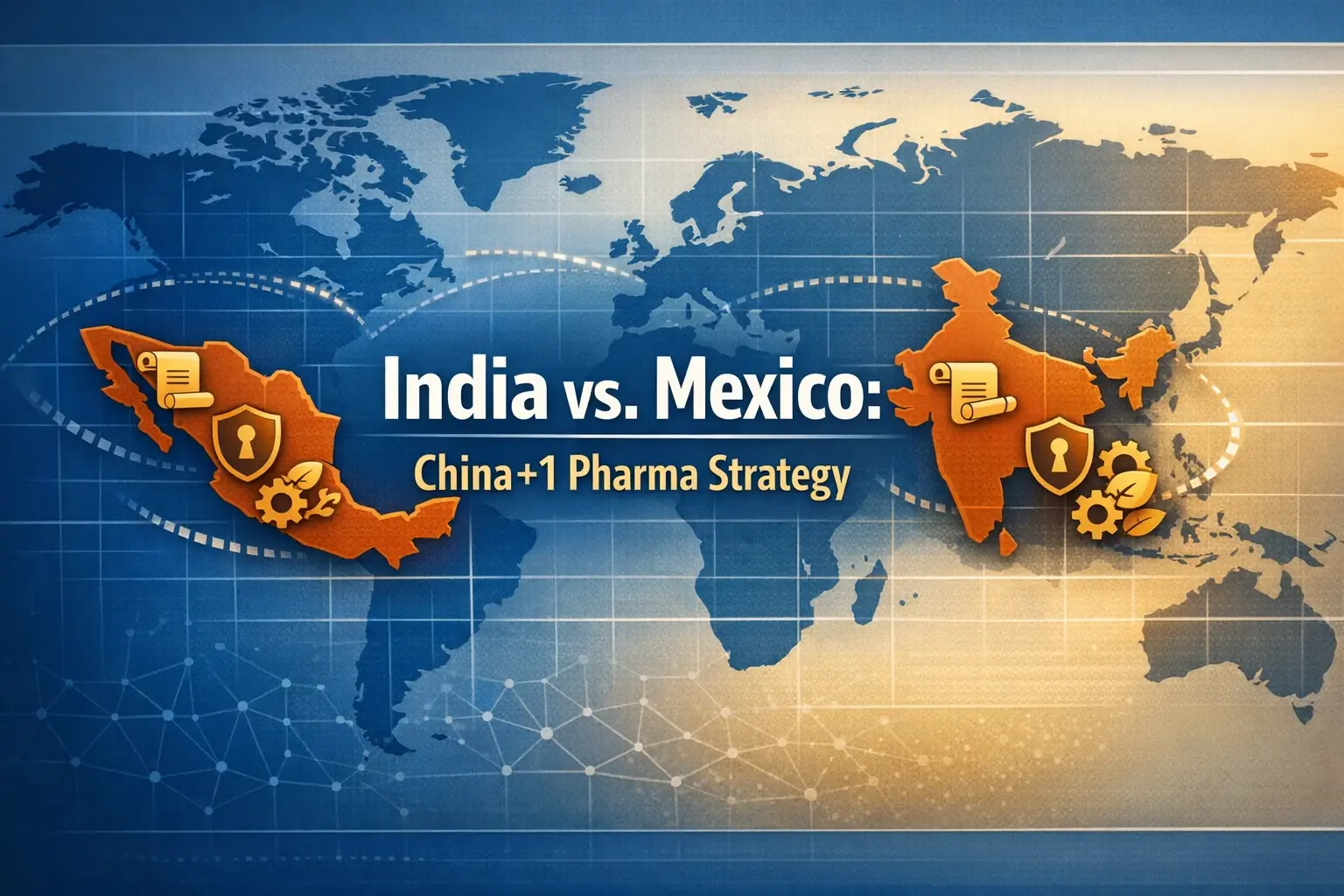
You’ve been tasked with a critical mission: diversify your company’s supply chain for high-value pharmaceutical intermediates. The memo probably had “China+1” in bold. It’s a smart strategic move, designed to build resilience and de-risk your operations. The two names that keep coming up are India and Mexico.
On the surface, it seems straightforward. But as you dig in, you realize you’re not just comparing shipping lanes and labor costs. You’re navigating a labyrinth of intellectual property laws, complex regulatory bodies, and environmental standards that could make or break your entire strategy.
Choosing between India and Mexico isn’t about picking a spot on a map. It’s about understanding two fundamentally different ecosystems. This guide is your first step—a coffee-chat-style breakdown to help you grasp the landscape, ask the right questions, and see the challenges and opportunities you might not have considered yet.
The Regulatory Maze: Who Makes the Rules?
Before you can source a single gram of a chemical intermediate, you need to understand the gatekeepers. Both India and Mexico have robust, and often complex, regulatory frameworks. Getting this wrong can lead to costly delays and compliance nightmares.

India: The Pharma Giant’s Playbook
India’s pharmaceutical industry is a global powerhouse, built on decades of experience. Its regulatory environment is mature, deep, and can feel labyrinthine to outsiders.
- The Key Player: CDSCO The Central Drugs Standard Control Organization (CDSCO) is India’s main regulatory body, analogous to the FDA in the United States. It operates under the Ministry of Health and Family Welfare and is responsible for approving new drugs, overseeing clinical trials, and setting quality standards.
- The Rulebook: The primary legislation is the Drugs and Cosmetics Act of 1940 and its subsequent rules. This foundational law governs the import, manufacture, distribution, and sale of drugs and cosmetics.
- What This Means for You: India’s system is well-established, with a massive ecosystem of suppliers familiar with its requirements. However, navigating the bureaucracy requires deep local expertise. A knowledgeable partner on the ground is essential for a smooth custom procurement process, ensuring all state and central-level regulations are met.
Mexico: Proximity and Modernization
Mexico’s regulatory framework benefits from its proximity to the United States and its participation in international trade agreements. The system is undergoing modernization, aiming for greater efficiency and alignment with global standards.
- The Key Player: COFEPRIS The Federal Commission for the Protection against Sanitary Risks (COFEPRIS) is Mexico’s health authority. It regulates a wide range of products, including medicines and the raw materials used to produce them.
- The Rulebook: The General Health Law is the cornerstone of Mexico’s health regulations. COFEPRIS often leverages guidelines from international bodies like the World Health Organization (WHO) and the International Council for Harmonisation (ICH).
- What This Means for You: COFEPRIS is actively working to streamline its processes, which can be an advantage. The country’s alignment with international guidelines can simplify compliance if you’re already operating under those standards. However, the system is still evolving, and staying on top of changes is crucial.
Aha Moment: Your focus isn’t on getting a final drug approved, but on sourcing its building blocks. The regulations for intermediates can sometimes be less clear-cut than for finished pharmaceuticals, making supplier vetting and a robust quality assurance program absolutely non-negotiable.
Protecting Your Crown Jewels: A Tale of Two IP Frameworks
For high-value, innovative pharmaceutical intermediates, intellectual property (IP) protection isn’t just a legal detail—it’s the foundation of your competitive advantage. India and Mexico approach IP with different philosophies and enforcement mechanisms.
India: A Balancing Act
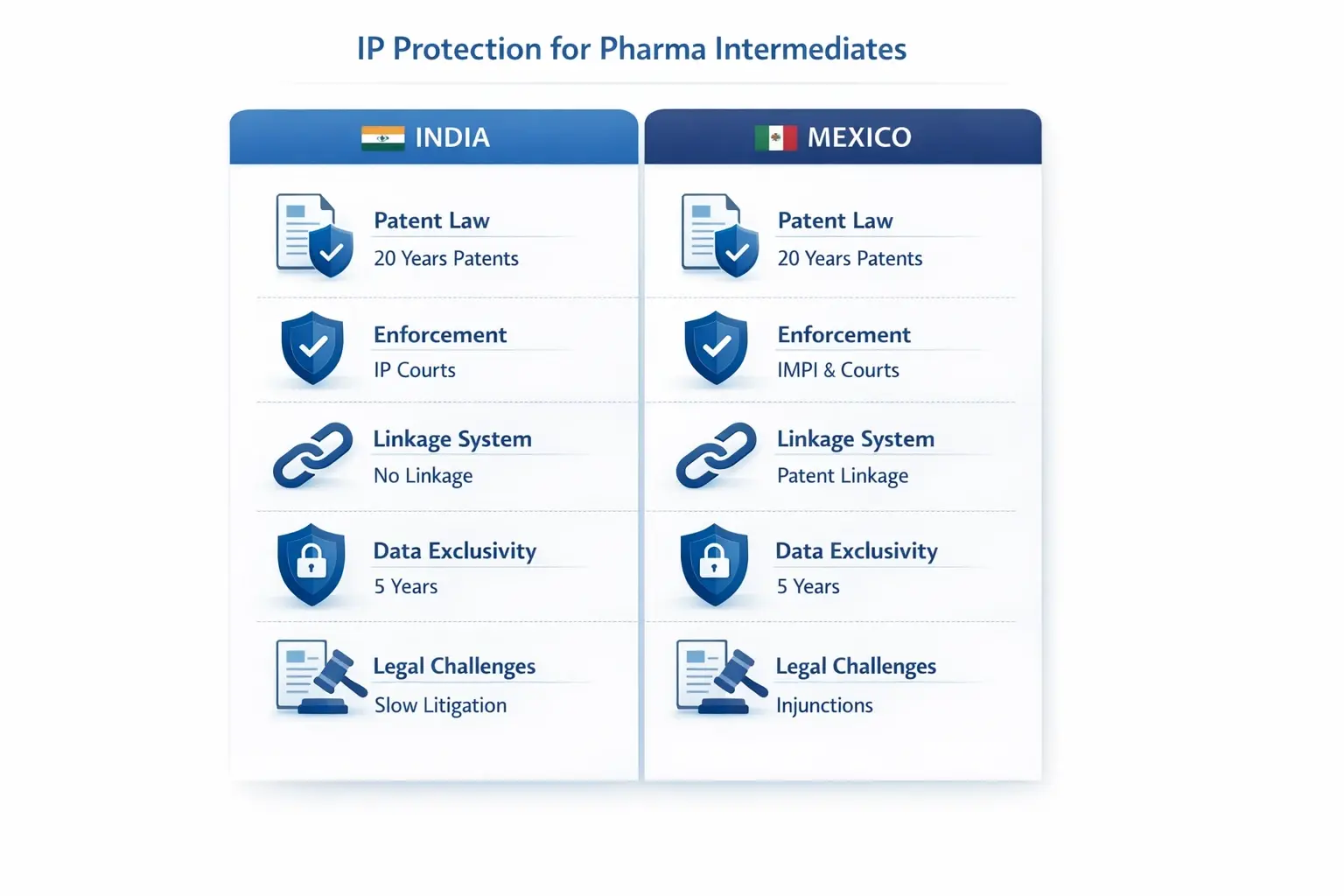
India’s patent law is famously designed to balance innovator rights with public health needs, which can be a double-edged sword for international firms.
- The Law: The Indian Patents Act of 1970 is the key legislation. A critical, and often debated, component is Section 3(d), which restricts patents for new forms of a known substance unless it shows significantly enhanced efficacy. This is intended to prevent “evergreening” of patents but can create uncertainty for certain chemical innovations.
- The Reality: While India is a signatory to the TRIPS agreement, the U.S. Trade Representative has noted ongoing challenges with its IP enforcement. For companies sourcing unique intermediates, this means a proactive strategy is essential. It involves careful patent filing, rigorous supplier agreements, and having a partner who can perform thorough supplier qualification to ensure your IP is respected.
Mexico: A Framework of Alignment
Mexico’s IP framework has moved towards closer alignment with U.S. and European standards, partly driven by trade agreements like the US-Mexico-Canada Agreement (USMCA).
- The Law: Mexico’s patent system includes a “linkage system” that connects marketing authorization for drugs with patent status, preventing approvals for products that infringe existing patents. This provides a layer of protection for innovators.
- The Reality: Mexico offers strong data protection and a more familiar IP environment for many Western companies. However, like any system, enforcement can vary, and navigating the litigation process requires specialized legal expertise.
Aha Moment: IP risk isn’t just about someone stealing your final formula. It’s about protecting the novel chemical processes and unique intermediate structures that give you a market edge. Your IP strategy must cover the entire supply chain, not just the finished product.
The Hidden Hurdle: Environmental Compliance and Your Market Access
This is the factor most often overlooked in high-level sourcing discussions, and it’s arguably one of the most critical. If the intermediate you source from India or Mexico doesn’t meet the environmental and chemical safety standards of your home market (like the U.S. or EU), it’s as good as useless.
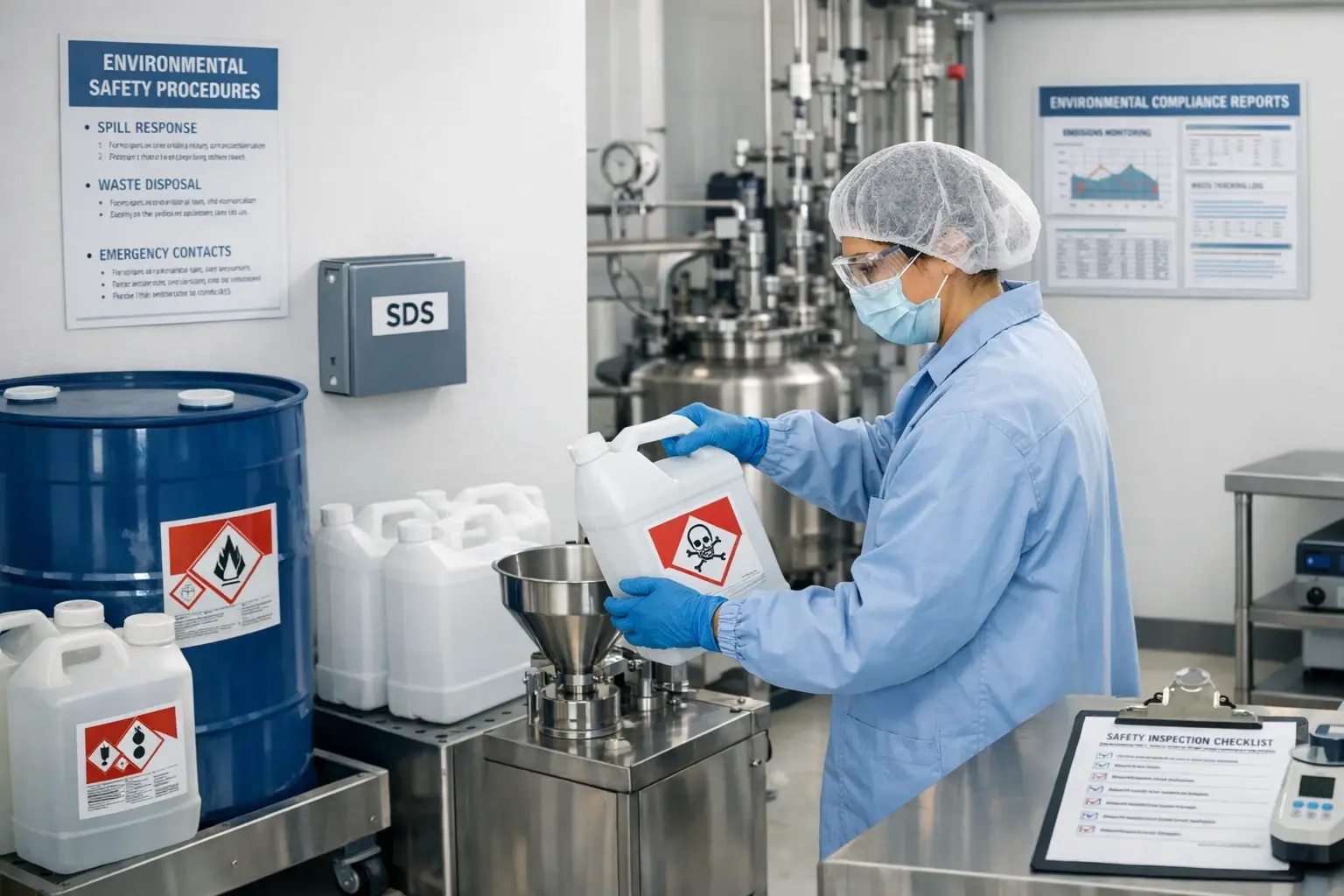
The world of chemical regulation is a web of acronyms: GHS, REACH, TSCA. Here’s what they mean for your choice between India and Mexico.
- GHS (Globally Harmonized System): This UN system standardizes the classification and labeling of chemicals. Proper GHS-compliant labeling and Safety Data Sheets (SDS) are mandatory for shipping hazardous materials, which includes many pharma intermediates.
- REACH (Registration, Evaluation, Authorisation and Restriction of Chemicals): This is the EU’s stringent chemical regulation framework. If your final product is destined for Europe, your intermediates must comply.
- TSCA (Toxic Substances Control Act): This is the primary U.S. law for regulating chemicals. Any intermediate imported into the U.S. must be on the TSCA inventory or have an exemption.
How India and Mexico Stack Up
- India: India is implementing its own framework, the Chemicals (Management and Safety) Rules (CMSR), often called “India REACH.” While it draws inspiration from the EU system, it has its own unique registration and reporting requirements. Suppliers in India are increasingly adopting GHS standards, but consistency can vary. Ensuring your partner can manage GHS-compliant labeling and provide accurate SDS/COA documentation is paramount for seamless export logistics.
- Mexico: Mexico has also adopted GHS through its own set of standards (NOMs). Its proximity to the U.S. means many top-tier suppliers are well-versed in TSCA requirements. However, verifying this compliance across the board is still a necessary due diligence step.
Aha Moment: Environmental compliance is not a “check-the-box” exercise. It is a fundamental qualifier for market access. A low-cost supplier is no bargain if their product is rejected at the port of entry due to improper documentation or non-compliance with REACH or TSCA. This is a major source of hidden costs and supply chain disruption.
The Final Analysis: A Decision Framework
There is no single “best” answer. The right choice depends entirely on your specific needs, risk tolerance, and strategic priorities. Use this framework to guide your thinking.
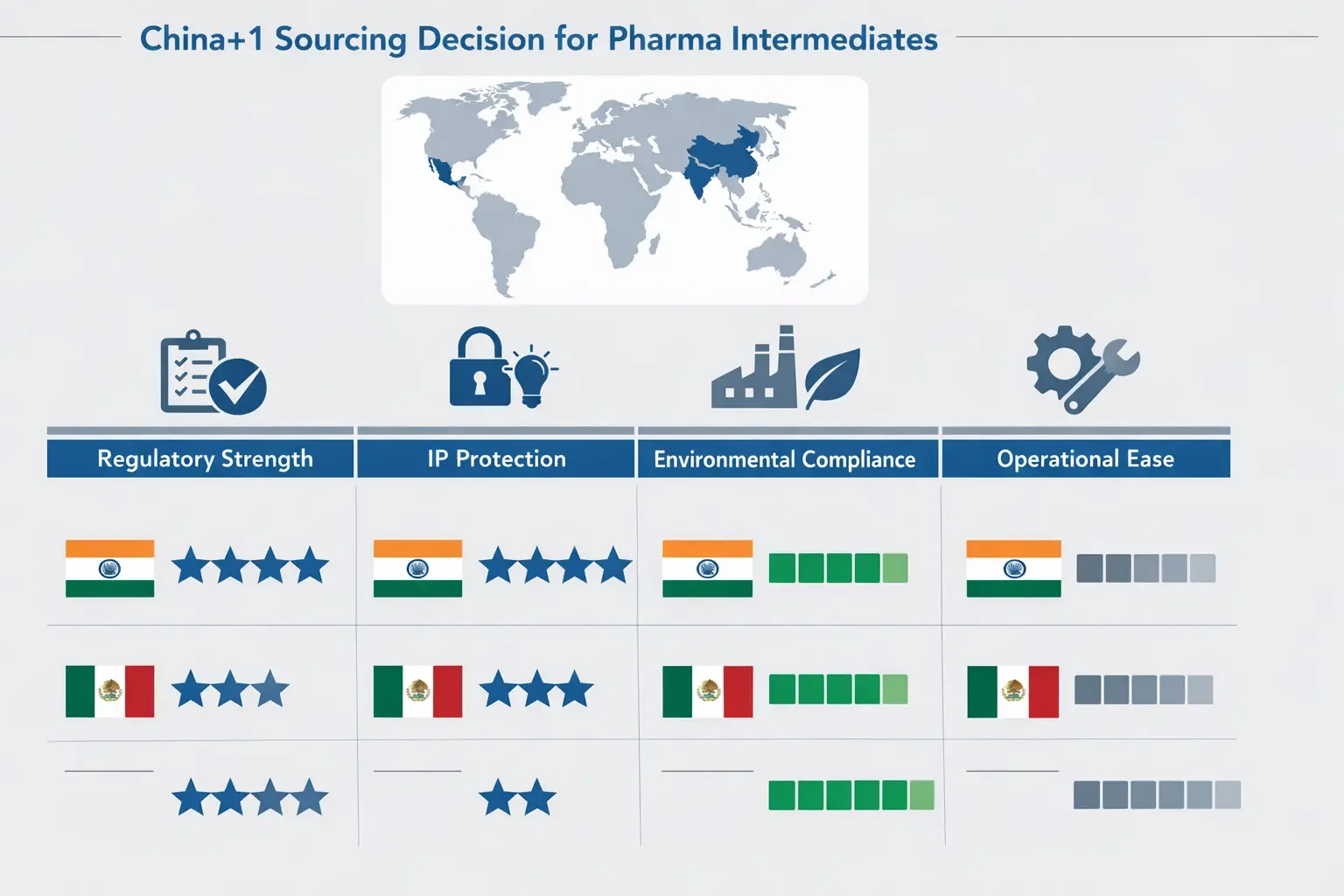
| Factor | India | Mexico | Key Consideration for Your Business |
|---|---|---|---|
| Supplier Ecosystem | Vast & Deep. World-class expertise in complex chemistries and generics. | Concentrated & Strategic. Strong capabilities, particularly for the North American market. | Do you need access to a massive, diverse supplier base or a more targeted one? |
| Regulatory Body | CDSCO. Mature, but can be bureaucratic. Requires significant local navigation. | COFEPRIS. Modernizing and often aligned with international standards. | How much experience does your team have with navigating complex foreign regulations? |
| IP Protection | Nuanced. Requires a proactive and specific legal strategy (e.g., Section 3(d)). | Aligned. Generally more familiar framework for Western companies (USMCA). | How novel and sensitive is your intermediate? What is your risk tolerance for IP? |
| Environmental Compliance | Evolving. “India REACH” (CMSR) is being implemented. GHS adoption is growing. | Established. GHS adopted and many suppliers are familiar with TSCA. | What are the specific chemical regulations in your primary end-markets (EU vs. US)? |
| Logistics & Proximity | Global Hub. Excellent sea and air links worldwide, but longer transit to the Americas. | North American Advantage. Significantly shorter lead times and overland options to the U.S. | How critical is speed-to-market and reducing shipping time for your supply chain? |
| Cost Structure | Highly Competitive. Often a leader in cost-efficiency for bulk and specialty chemicals. | Competitive. Especially when factoring in lower logistics costs and duties to the U.S. | What does the total landed cost look like, including logistics and compliance? |
Frequently Asked Questions (FAQ)
Q1: What exactly are CDSCO and COFEPRIS?
CDSCO (Central Drugs Standard Control Organization) is India’s national regulatory body for pharmaceuticals and medical devices. COFEPRIS (Federal Commission for the Protection against Sanitary Risks) is the equivalent health authority in Mexico. Think of them as the FDA-equivalents for their respective countries.
Q2: How does India’s patent law really affect sourcing for pharma intermediates?
The main point of attention is Section 3(d) of the Indian Patents Act, which makes it harder to patent new forms of existing substances. For a truly novel intermediate, patent protection is available. But for derivatives or slight modifications of known compounds, it can be more challenging. This requires careful legal review before committing to a sourcing strategy.
Q3: Is Mexico’s IP framework the same as in the United States?
While not identical, it is highly aligned, thanks in large part to the USMCA trade agreement. It includes strong provisions for patent enforcement, data protection, and a patent linkage system, making it a very familiar landscape for U.S.-based companies.
Q4: What is GHS and why is it so critical for chemical sourcing?
GHS is the Globally Harmonized System of Classification and Labelling of Chemicals. It provides a universal standard for communicating hazard information on labels and Safety Data Sheets (SDS). It’s critical because customs officials in the U.S., Europe, and most other regions will reject shipments that are not GHS-compliant, causing major delays and potential fines.
Q5: Which country is “better” for a China+1 strategy?
Neither is universally “better.” India offers an unparalleled depth of chemical manufacturing expertise and cost-effectiveness. Mexico offers logistical simplicity and regulatory alignment for the North American market. The best choice depends on your specific product, IP sensitivity, target market, and overall risk management strategy.
Your Next Step: From Learning to Action
Navigating the global sourcing landscape for pharmaceutical intermediates is complex, but it doesn’t have to be uncertain. By understanding the core differences in regulation, IP, and environmental compliance, you’re already moving from a reactive position to a strategic one.
The key is to partner with someone who has on-the-ground expertise and understands how to bridge the gap between global markets and local realities. A partner who treats compliance not as a chore, but as a core component of a resilient supply chain.
When you’re ready to explore the vast potential of the Indian market with confidence, discover how our end-to-end market-entry solutions can help you navigate these challenges and build a reliable, transparent, and resilient supply chain.