Imagine this: you’ve found a promising new supplier in India. The samples are perfect, the price is competitive, and they even have an ISO 9001 certificate. You place your first production order, feeling confident you’ve unlocked a key part of your “China +1” strategy.
Then the shipment arrives. The quality is inconsistent, the documentation is sloppy, and the supplier seems confused about why you’re concerned. What went wrong?
This scenario is all too common for international procurement managers sourcing from India’s vast and dynamic Tier 2 and Tier 3 manufacturing sector. The problem often isn’t a lack of potential, but a misunderstanding of what quality management truly means on the ground. A standard Quality Management System (QMS) certificate, while a good starting point, often fails to capture the reality of operations in these smaller, resource-constrained environments.
To build a resilient supply chain, you need to look beyond the certificate and understand how to adapt quality frameworks to fit the unique context of India’s small and medium-sized manufacturers (SMEs).
The QMS Framework, Simplified for the Real World
First, let’s clear up some confusion. A Quality Management System (QMS) is simply a company’s framework for ensuring it consistently meets customer and regulatory requirements. ISO 9001 is the world’s most recognized standard for creating a QMS. It’s a powerful blueprint, but it’s not a rigid set of rules.
For a Tier 2 or 3 Indian manufacturer, it provides a structure for:
- Understanding and meeting customer needs.
- Defining and controlling processes (from receiving raw materials to final shipment).
- Continuously improving operations.
Many Western buyers see ISO 9001 as a simple checkbox. But in reality, its value depends entirely on how it’s implemented. The biggest misconception is that a QMS is a mountain of paperwork and bureaucracy. When adapted correctly, it’s the opposite—it’s a tool for simplification and clarity.
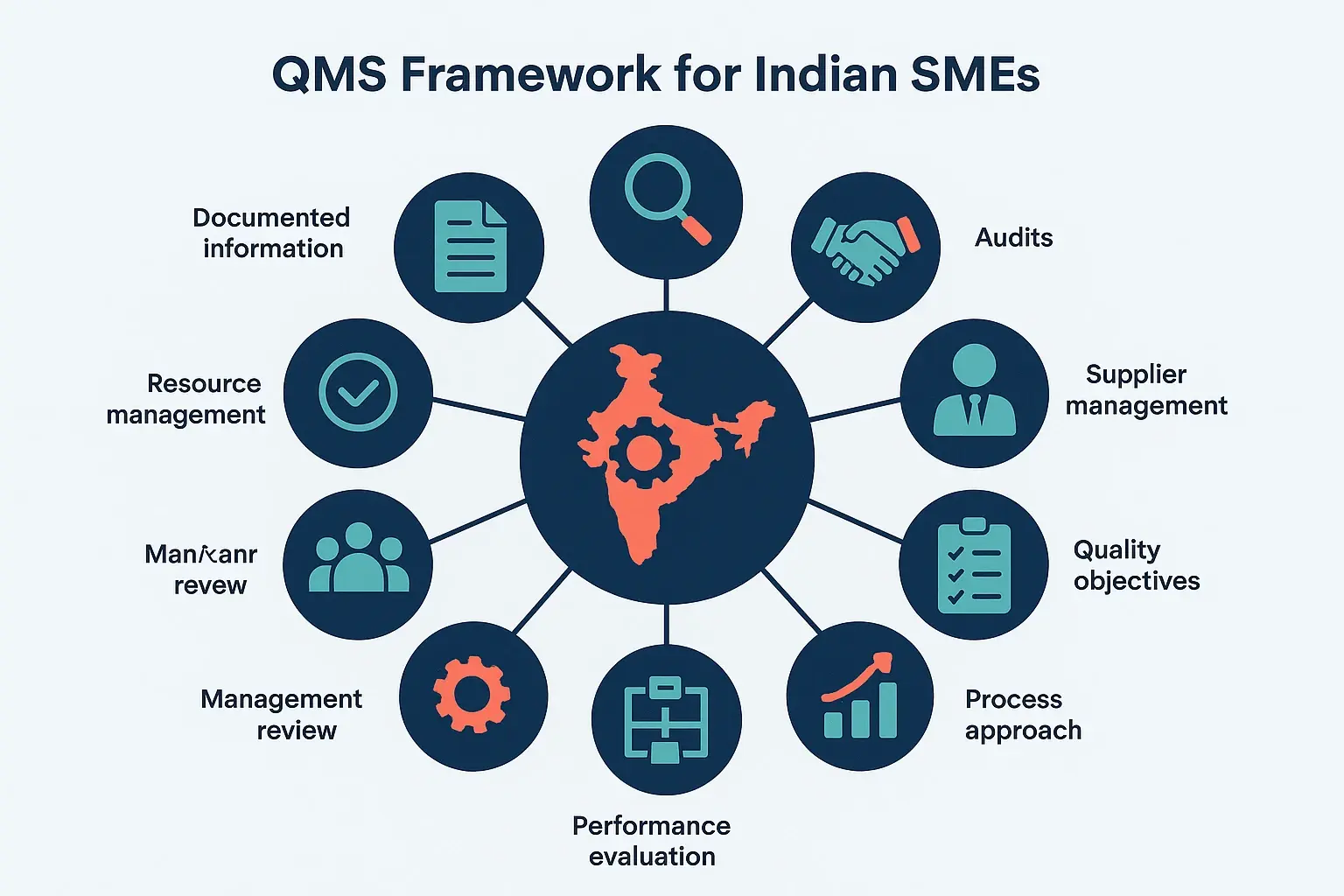 This infographic breaks down the core QMS ISO 9001 clauses into a simplified framework tailored for Indian Tier 2 and 3 manufacturers, visually connecting key elements relevant to their operations.
Ground Realities: Why a “Corporate” QMS Doesn’t Fit Indian SMEs
Applying a QMS designed for a large corporation to a 30-person manufacturing unit in an Indian industrial park is like trying to navigate a narrow lane with a freight truck. It’s cumbersome, impractical, and bound to get stuck.
Research and on-the-ground experience reveal several key challenges that demand a more adaptable approach:
The Resource Equation
Tier 2 and 3 SMEs operate on lean budgets. They often lack a dedicated quality control department or the capital for expensive QMS software. The owner might also be the lead salesperson and the head of production. Expecting them to manage a complex documentation system designed for a multinational is unrealistic. The solution isn’t to force it, but to build a system using simple, accessible tools like spreadsheets, checklists, and visual guides.
The Human Element: Culture and Training
Many shop-floor workers in these units are highly skilled artisans but may have limited formal education or digital literacy. Handing them a 50-page technical manual is ineffective. “Resistance to change” often isn’t defiance; it’s a breakdown in communication. Effective training involves on-the-job demonstrations, pictorial work instructions, and mentorship—not classroom lectures. A successful QMS must respect and integrate with the existing work culture, systemizing tribal knowledge rather than trying to erase it.
Supply Chain Irregularities
Smaller manufacturers often rely on local, sometimes informal, networks for their own raw materials. This can lead to variability in input quality, which directly impacts the final product. A robust, adapted QMS for an Indian SME must have an oversized focus on incoming material inspection and supplier qualification. It’s about controlling the one major variable they can influence before production even begins.
From Theory to Factory Floor: What an Adapted QMS Looks Like
So, what does a practical, effective QMS look like in this context? It’s not about diluting standards; it’s about applying them intelligently. It’s a journey of gradual upliftment, not an overnight transformation.
This process often follows a phased approach that builds capacity over time, ensuring the system is adopted, not just documented.
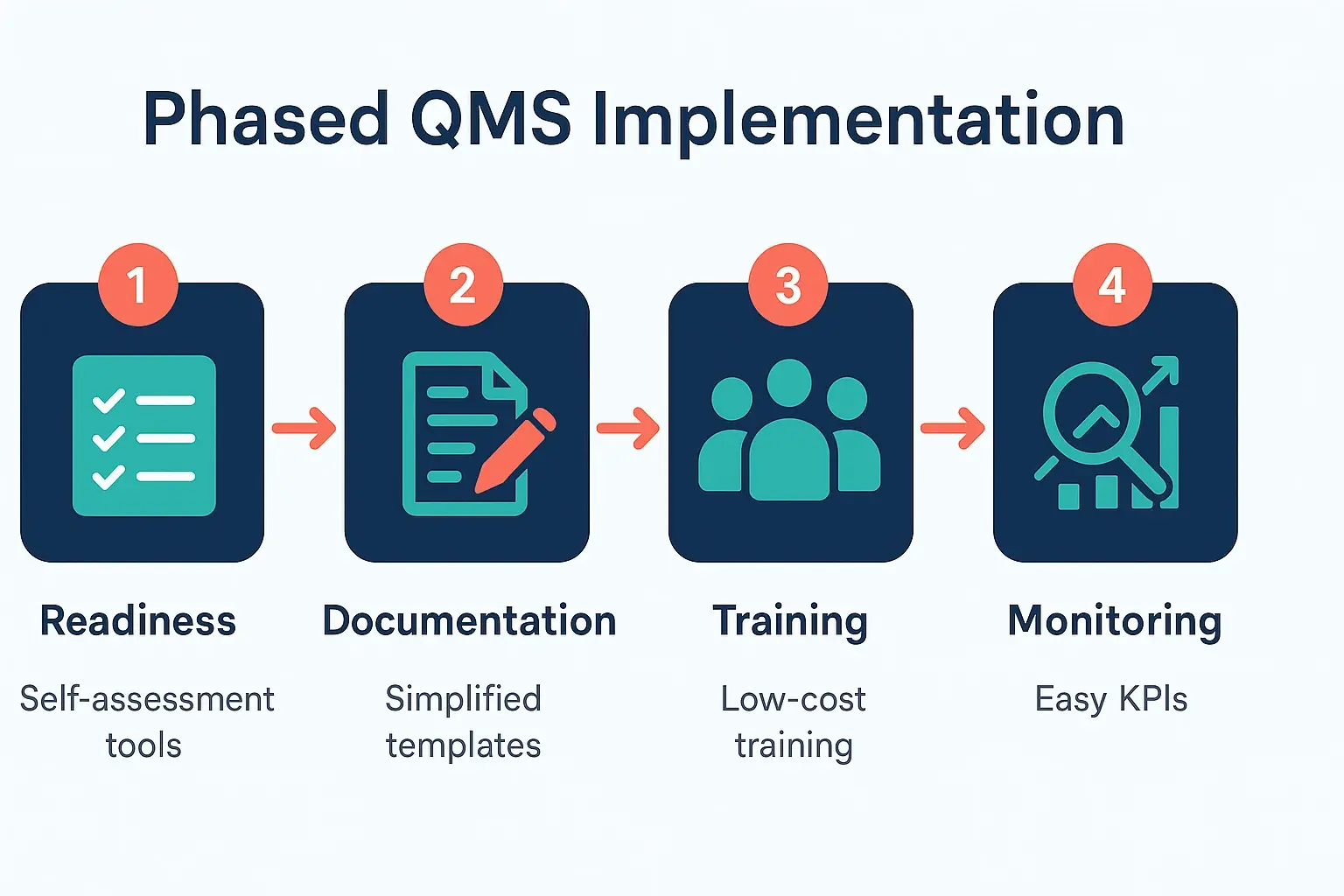 This process flowchart visualizes a practical, phased approach for Indian SMEs to adopt QMS, highlighting essential steps from readiness assessment to monitoring and continuous improvement.
Here are the hallmarks of a QMS that actually works:
- “QMS Lite” Implementation: It starts with the most critical processes. Instead of trying to document everything at once, the focus is on the 20% of operations that cause 80% of quality issues. This could be raw material verification or final product testing.
- Visual, Not Verbose, Documentation: Think laminated, photo-heavy work instructions posted at each station, color-coded bins for conforming and non-conforming parts, and simple checklists that require a signature, not a report.
- Ownership at Every Level: A great adapted QMS empowers every worker to be a quality inspector. It fosters a culture where an operator feels comfortable flagging an issue without fear of blame. This is far more powerful than having a single manager police the entire floor.
- Focus on Practical Metrics: Instead of complex statistical process control, the focus is on simple, powerful KPIs: What is our defect rate this week? How many customer complaints did we receive this month? How can we reduce rework by 5%?
Creating this kind of living, breathing quality culture requires more than an audit; it requires a partnership. It requires on-the-ground presence to guide, mentor, and support suppliers as they make these fundamental shifts. This is the core of supplier upliftment—helping good manufacturers become great, reliable partners. For buyers, understanding how to conduct an effective supplier audit in India is crucial to identifying these traits.
The Real Payoff: From Compliance to Competitive Advantage
When an Indian SME successfully adopts a QMS that fits their reality, the benefits extend far beyond a certificate on the wall. For an international buyer, this is where the real value lies.
You get more than just compliance; you get consistency. You can trust that the tenth shipment will be the same high quality as the first sample. This reliability is the foundation of a resilient supply chain.
Furthermore, this journey of upliftment unlocks new potential. With robust systems in place, these SMEs can handle more complex orders, scale their operations, and gain access to global markets. Government schemes like QMS/QTT provide financial support, encouraging this evolution. It’s a win-win: the supplier grows their business, and you gain a stable, long-term partner capable of growing with you.
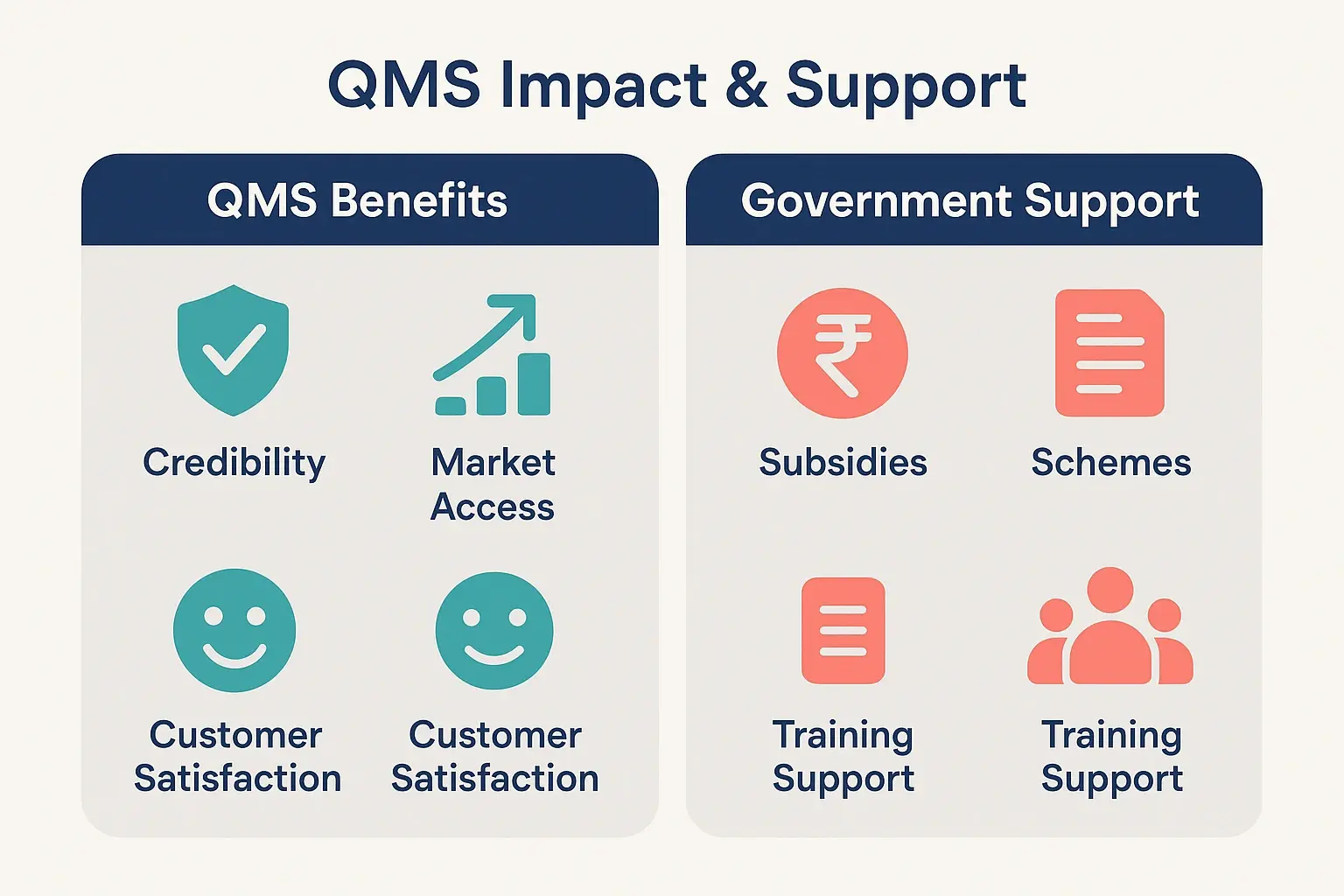 This comparison grid highlights the key benefits Indian SMEs gain from QMS implementation alongside government support options, clarifying advantages and accessible subsidies.
FAQ: Your Questions on QMS in Indian SMEs Answered
What’s the difference between a QMS and ISO 9001?
A QMS is the system itself—the processes, policies, and procedures a company uses to manage quality. ISO 9001 is a globally recognized standard that provides a framework or a blueprint for building an effective QMS. A company can have a QMS without being ISO 9001 certified, but certification demonstrates that their system meets international best practices.
How can a small supplier manage documentation without a dedicated team?
By simplifying it. Instead of lengthy manuals, they can use visual checklists, standardized forms (even paper-based), and clear process flow diagrams. The goal is clarity and usability, not volume. The key is that the documentation is used and useful to the people doing the work.
Is QMS only for large companies?
Absolutely not. The principles of QMS—understanding customer needs, controlling processes, and improving—are universal. For an SME, a well-adapted QMS is a powerful tool for scaling, reducing costly errors, and proving their reliability to larger international buyers.
How can I, as a buyer, verify a supplier’s QMS is actually working?
Look for evidence beyond the certificate. During a site visit or audit, ask to see the shop floor documentation. Talk to the operators—do they know the quality policy? Can they show you the work instructions for their station? Check the records for internal audits and how non-conformances were handled. A living QMS leaves footprints; a “paper” QMS exists only in a file cabinet. This is where an experienced partner with deep knowledge of navigating chemical compliance in India can provide invaluable insight.
The Path to a Truly Resilient Supply Chain
Sourcing from India’s Tier 2 and 3 manufacturers offers immense opportunity for diversification and competitive advantage. But success requires moving beyond a surface-level, checkbox approach to quality.
The key is to recognize that a QMS is not a one-size-fits-all solution. Its true power is unlocked when it is thoughtfully adapted to the unique operational, cultural, and resource realities of the supplier. By learning to identify the signs of a living, breathing, and properly adapted quality system, you can build partnerships that are not only compliant but truly consistent and reliable.
This understanding is the first step. The next is to develop a robust framework for identifying and developing these high-potential suppliers.